

How Do You Match Powder Coating Production Line Capacity from Mixing to Grinding?
How Do You Match Powder Coating Production Line Capacity from Mixing to Grinding?
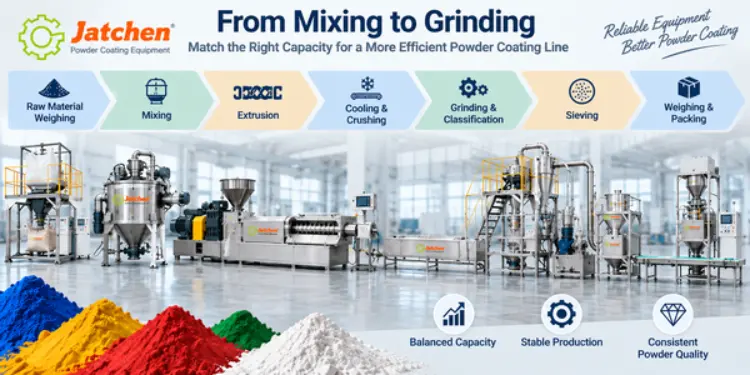
A powder coating production line is only as fast as the stage that limits material flow. A mixer may prepare a large batch, but a smaller extruder can leave premix waiting. The extruder may run steadily, but an undersized cooling or grinding stage can create a downstream buffer. Capacity therefore has to be matched as one route rather than selected machine by machine.
The practical sequence is raw material weighing → mixing → extrusion → cooling and crushing → grinding and classification → sieving → weighing and packing. To size the line, start with the required finished output, calculate effective operating hours, and then compare the practical capacity of every stage.
This approach is particularly useful when comparing an automatic container mixer for powder coating with a twin screw extruder and the downstream grinding system.
How Much Powder Coating Line Capacity Do You Really Need?
Start with Daily Output and Effective Production Hours
Use the daily finished-powder target divided by effective production hours as the first planning baseline. For example, 4 tons per day over 8 effective hours gives a starting requirement of about 500 kg/h. This is a planning value rather than a guaranteed production result.
Effective hours should exclude expected time for cleaning, formula changes, inspection, packing interruptions, and normal operating pauses. If the line changes color several times per shift, the practical hourly requirement should be evaluated against the shorter production window.
Separate Nominal Output from Practical Output
A product page may state a model output or batch capacity, but actual production depends on formula, bulk density, feed condition, operating settings, cooling conditions, particle-size target, cleaning frequency, and material transfer. Record both the nominal equipment range and the practical output required after routine interruptions.
Include Changeover Time in Capacity Planning
Frequent formula and color changes reduce continuous production time. Movable containers, accessible cleaning routes, and a layout that allows preparation and cleaning to occur without blocking every stage can reduce lost time. Capacity planning should therefore include changeover rhythm, not just motor size or maximum kg/h.
How Should Mixer Capacity Match Extruder Throughput?
Convert Container Mixer Batch Capacity into an Hourly Rhythm
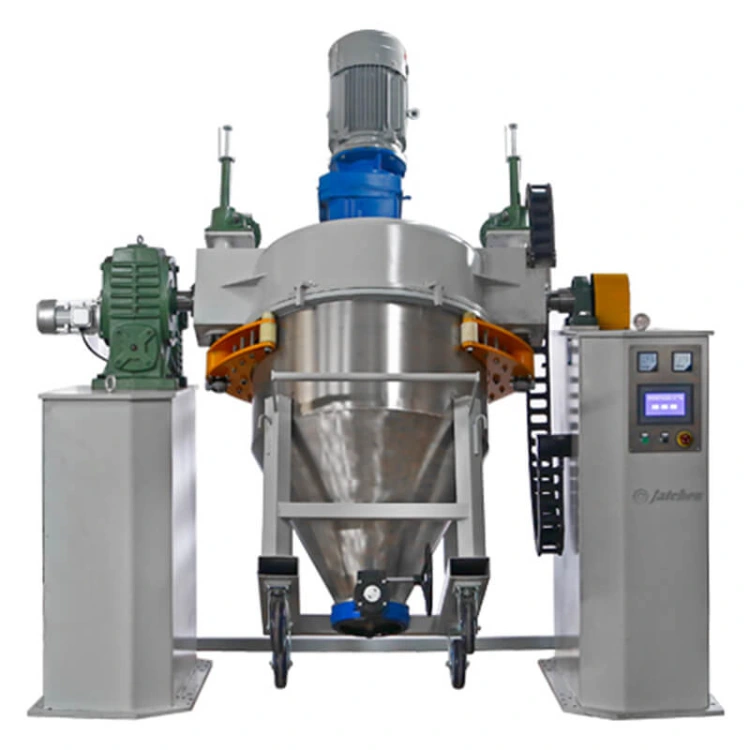
A container mixer for powder coating is normally discussed by batch or tank capacity, while extrusion and grinding equipment are commonly compared by hourly throughput. Convert the batch process before comparing stages.
A useful planning formula is: practical mixer output = batch weight × completed batches per hour. The completed batch cycle must include loading, lifting, positioning, mixing, discharge, trolley replacement, inspection, and relevant cleaning time. Do not calculate hourly output from the 3–5 minute mixing time alone.
The Jatchen CM series includes CM300 at 150 kg per tank, CM600 at 300 kg, CM1000 at 500 kg, and CM2000 at 1,000 kg. These containerized powder mixers use PLC control and are designed for repeated batch handling.
Avoid Material Starvation at the Extruder
If the powder coating mixer cannot prepare and transfer the next batch before the extruder needs material, the extruder may wait. The cause may be mixer capacity, but it can also be weighing, loading, trolley movement, discharge, or cleaning. Measure the complete premixing cycle before deciding that a larger mixer is necessary.
Avoid Excess Premix and Unnecessary Work-in-Process
An oversized mixer can create more premixed material than the extruder can consume. That does not increase finished output if extrusion remains the limiting stage. A suitable buffer should cover short timing differences without turning premixed material into permanent storage.
Jatchen’s high-ranking guide on how to choose the right container mixer for powder coating is a useful internal reference for batch size and container mixer selection.
How Do You Match Extrusion and Cooling Capacity?
Check Extruder Throughput and Feed Stability Together
The twin screw extruder sits between premixing and cooling. Its practical throughput depends not only on the selected model but also on stable feeding and the material condition entering the screws. Anti-bridge screw feeding, uniform feeding, deep-groove low-shear screw design, and multi-zone control are relevant because unstable feeding can reduce practical output.
For manufacturers moving from mixing to extrusion, the powder coating extrusion process is a useful next step for evaluating how stable feeding, screw configuration, and process control affect continuous production.
Make Sure the Cooling Belt Can Accept Continuous Extrudate
After extrusion, the hot material must be cooled, sheeted or flaked, crushed into chips, and transferred toward grinding. If cooling cannot accept the extruder’s output, material flow slows even when the mixer and extruder are correctly sized.
A water cooling belt can be considered where the line and utility conditions support that cooling method, while an air cooling belt can be considered for a different plant layout and cooling arrangement. The cooling method should be matched with extruder output, plant utilities, space, and the next grinding stage.
Do Not Use Maximum kg/h as the Only Matching Rule
A line can have equipment with apparently similar nominal capacities and still lose output at transfer points, cleaning stops, feeding instability, or cooling limitations. Capacity matching should therefore compare practical material flow rather than only the largest number printed for each machine.
How Should Grinding, Classification, and Packing Match the Line?
Grinding Capacity Must Follow the Cooling Stage
The grinder should process the cooled chip output without creating a growing buffer. Jatchen ACM grinding systems cover different production requirements, while ICM systems are used where particle-size control requirements justify that configuration. Classification, cyclone separation, sifting, and fine-powder collection should be included in the capacity review rather than counting only the grinding motor.
Check Fine Powder, Oversize, and Particle-Size Control
A grinding system can appear fast at the inlet but still lose practical capacity if excessive fine powder, oversize material, or collection limitations interrupt the route. Particle-size targets such as D50 and D90 should be considered together with output. The ranking data also shows search visibility around powder size control in grinding, making this a relevant internal link for the grinding stage.
Packing Must Keep Pace with Qualified Powder
The final weighing and packing stage should be able to receive qualified powder from the sifter without creating another queue. Packing rhythm, carton handling, taring, weighing, dust collection, and operator movement all affect the finished output that can leave the line.
How Do You Find the Real Production Bottleneck?
Build a Capacity Table for Every Stage
Create one row for mixing, extrusion, cooling, grinding, sieving, and packing. Record the model, nominal capacity, practical capacity, batch size where relevant, changeover time, and the next stage’s input limit. The lowest practical value is the first bottleneck to investigate.
For example, if practical mixing capacity is 800 kg/h, extrusion is 600 kg/h, and grinding is 400 kg/h, increasing the mixer from 800 to 1,000 kg/h will not raise final line output. Grinding remains the limiting stage.
Inspect Feeding and Transfer Points
Capacity is often lost between machines. Check outlet height, receiving hopper size, trolley route, lifting range, transfer method, dust collection, cleaning access, and the control sequence between connected equipment. A line can have adequately sized machines and still perform poorly if material repeatedly waits between them.
Check Plant Space and Utilities Early
A complete powder coating line needs sufficient plant height, maintenance access, and working space around the grinding section. Confirm power, cooling-water circulation where applicable, dust-removal space, raw-material routes, packed-product routes, and access for maintenance before finalizing equipment capacity.
Which Capacity-Matching Strategy Fits Your Project?
For a New Powder Coating Production Line
A new project can size mixing, extrusion, cooling, grinding, sieving, weighing, and packing around one effective output target. This makes it easier to coordinate batch rhythm, hourly throughput, material transfer, PLC/HMI logic, and maintenance access before equipment positions are fixed.
Jatchen’s powder coating production line solutions can be used to review the equipment route as a connected system rather than a collection of separate machines.
For an Existing Line Upgrade
An existing plant should identify the current bottleneck before replacing equipment. A higher-output mixer, extruder, or grinder will not improve final production if the next stage remains smaller or the existing layout cannot support faster material transfer.
For Future Formula and Capacity Changes
Leave reasonable flexibility for normal growth, formula changes, color-change frequency, cleaning access, and possible particle-size requirements. The objective is not to maximize unused equipment capacity. It is to maintain stable flow while avoiding repeated starvation or accumulation between stages.
Conclusion
Matching powder coating production line capacity means matching the complete route from mixing to grinding and packing. Start with effective daily output, include changeover time, convert mixer batch capacity into a practical hourly rhythm, and compare that result with extrusion, cooling, grinding, classification, sieving, and packing.
The strongest capacity plan is the one that identifies where material begins to wait. If the extruder waits for premix, investigate the mixing and transfer cycle. If premix waits for extrusion, adding mixer capacity may not help. If chips or powder accumulate downstream, cooling or grinding may be the real limit.
Manufacturers can review the full Jatchen powder coating equipment range and use Jatchen service or the contact page to provide output targets, formula information, workshop conditions, and existing equipment data for line matching.
FAQ
How Do I Calculate a Starting Capacity for a Powder Coating Production Line?
Divide the daily finished-output target by effective production hours, then account for cleaning, formula changes, inspection, packing, and normal operating pauses.
Should a Powder Coating Mixer and Extruder Have the Same Capacity?
They should be matched by practical batch rhythm and hourly consumption. The mixer needs to supply the extruder without repeated waiting, but excessive premix capacity does not automatically increase finished output.
What Is Usually the First Bottleneck in a Powder Coating Line?
There is no single stage that is always first. Compare practical output at mixing, extrusion, cooling, grinding, collection, sieving, and packing, then look for where equipment waits or material accumulates.
How Do Containerized Powder Mixers Affect Line Capacity?
Their batch size and full cycle time determine how often premixed material becomes available to the extruder. Loading, lifting, mixing, discharge, trolley replacement, and cleaning should all be included.
When Should I Choose Water Cooling or Air Cooling?
Choose according to extruder output, plant utilities, layout, maintenance route, and the cooling conditions needed before grinding.
What Information Should I Provide for Capacity Matching?
Provide target daily output, effective operating hours, formula types, batch size, changeover frequency, current equipment, workshop dimensions, utilities, transfer method, and target particle size.


