

Container Mixer vs High-Speed Mixer: Which Mixing Method Fits Powder Coating Production Better?
Container Mixer vs High-Speed Mixer: Which Mixing Method Fits Powder Coating Production Better?
A container mixer is usually a stronger fit when your powder coating plant works with regular batches, frequent color or formula changes, and more automated material handling. A high-speed mixer becomes especially useful when the raw materials contain coarse particles, lumps, or agglomerates that need intensive stirring and crushing before extrusion.
That does not make one machine universally better than the other. The practical question is what happens inside your production line before extrusion starts.
Resins, curing agents, pigments, fillers, and additives need to reach a sufficiently uniform state before entering the next process. If premixing is unstable, the extruder receives an inconsistent feed. If the mixer takes too long to clean, color changes slow the whole production schedule.
This is why Yantai Jatchen Powder Coating Processing Equipment Co., Ltd. offers different mixer designs rather than treating one machine as the answer for every plant. Its powder coating equipment range includes mixers as well as extrusion, cooling, grinding, bonding, laboratory, and auxiliary equipment, allowing the mixing stage to be considered as part of the complete process.
What Is the Main Difference Between a Container Mixer and a High-Speed Mixer?
Both machines prepare raw materials for powder coating production, but they move and process those materials differently.
How Does a Container Mixer Move Powder?
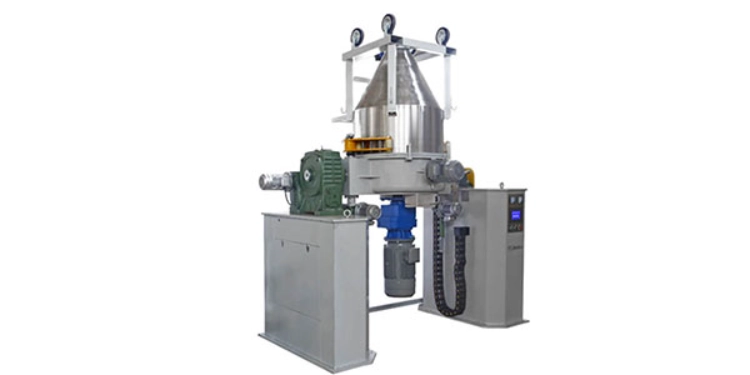
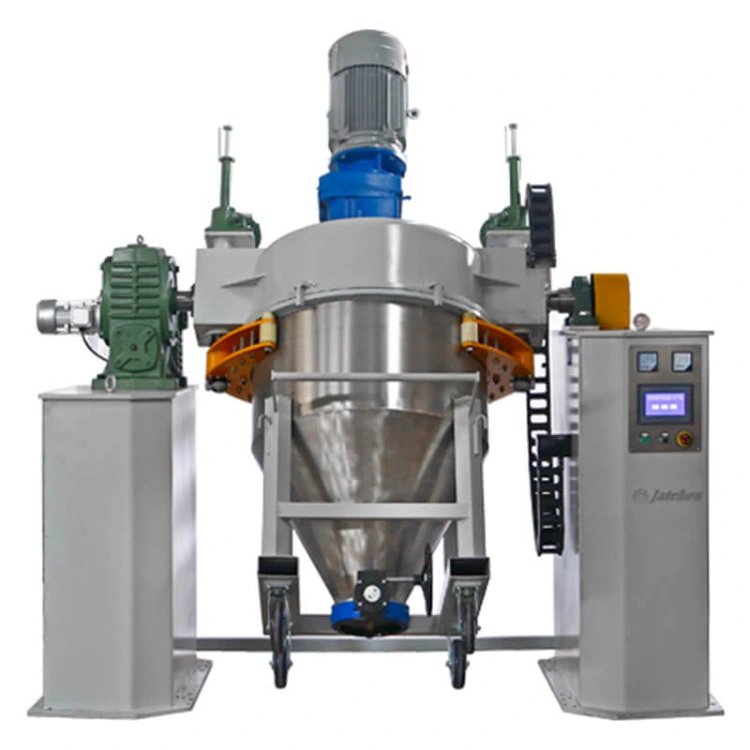
An Automatic Container Mixer combines container movement with mechanical stirring.
Raw materials are loaded according to the formulation. During operation, the container changes position while the internal mixing parts continue to stir, shear, and move the powder. This creates material movement through different areas of the container instead of relying only on one fixed stirring pattern.
For commercial powder coating production, this design has an important operational benefit: the container is part of the material-handling workflow.
That becomes useful when your factory runs multiple batches, changes formulas, or needs a more organized transition between one production order and the next.
How Does a High-Speed Mixer Handle Powder?
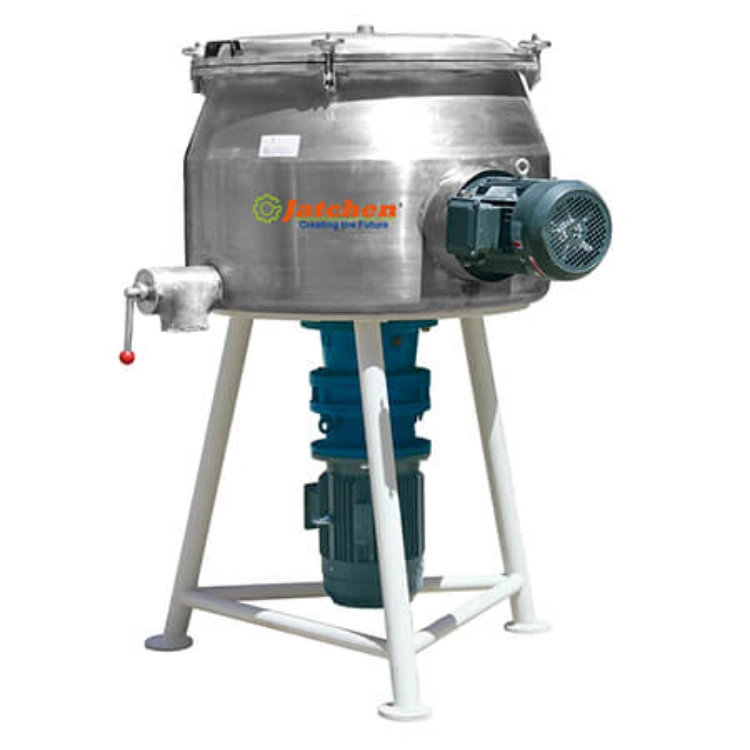
A High Speed Mixer relies more heavily on intensive high-speed mechanical action.
High-speed stirring makes different powder coating raw materials contact, collide, disperse, and mix rapidly. It is also well suited to materials that contain agglomerates or coarse solid components because the stronger shearing action can help break them apart during premixing.
For this reason, the first decision should not be based on motor power.
Ask a simpler question first:
Does your production need more flexible batch handling, or more intensive mixing and agglomerate breaking?
How Do the Two Mixers Compare in Real Powder Coating Production?
A specification sheet alone does not show how a mixer will affect your working day. Cleaning frequency, raw material condition, production scheduling, batch size, and downstream capacity all matter.
| Selection Factor | Automatic Container Mixer | High-Speed Mixer |
| Main mixing method | Container movement plus mechanical stirring | High-speed stirring and crushing |
| Main production strength | Flexible batch handling and automated operation | Intensive premixing and agglomerate breaking |
| Raw material condition | Multi-component powder batches | Especially useful for coarse or agglomerated solids |
| Formula and color changes | Movable container structure supports flexible batch changes | Cleaning workflow becomes more important |
| Control | PLC-controlled operation | Controlled mixing and crushing cycles |
| Typical mixing time | 3–5 minutes | 3–5 minutes |
| Capacity expression | kg/tank | kg/h |
| Best way to select | Batch weight and workflow | Required hourly output and material condition |
Which Mixer Is Better at Breaking Agglomerates?
The high-speed mixer has a clear reason to be considered when agglomeration is a regular raw-material problem.
Pigments, fillers, resins, or other materials do not always enter the production process in ideal free-flowing form. Some can contain lumps after storage or handling.
High-speed stirring creates stronger mechanical forces that help separate these agglomerates while distributing the different formulation components.
If this is a major issue in your factory, the High Speed Mixer deserves more attention than a simple comparison of tank capacity.
For more detail on this operating principle and its application in coating production, the existing guide on high speed mixer features, benefits, and powder coating applications provides a useful technical reference.
Which Mixer Fits Frequent Color Changes Better?
Color change introduces another kind of cost: downtime.
After finishing one formulation, operators need to remove remaining material before the next batch starts. Residue can cause cross-contamination, especially when moving from dark to light colors or between formulations that differ significantly.
A container-based mixing system gives the plant more flexibility because the container itself can be managed as part of the batch workflow.
That advantage becomes more important when your production schedule contains many smaller orders rather than long runs of one formulation.
Which Mixer Fits Automated Batch Handling Better?
The container mixer is particularly relevant when you want to reduce repeated manual handling and standardize the operating sequence.
Jatchen’s CM series uses PLC control, while the container movement, stirring, lifting, and related production steps are designed around repeatable batch operation.
That does not mean the high-speed mixer is a manual machine. It also offers controlled mixing cycles. The difference is where each design places more emphasis.
The container mixer focuses more strongly on batch movement and workflow, while the high-speed mixer focuses more strongly on intensive material processing during the mixing stage.
When Does a Container Mixer Fit Your Production Better?
A container mixer becomes attractive when production flexibility matters as much as mixing itself.
When You Change Colors or Formulas Frequently
Imagine two factories producing the same daily tonnage.
One produces the same formulation for most of the day. The other produces several colors and different customer formulations.
Their mixer requirements are not necessarily the same.
For the second factory, cleaning time and batch organization become major selection factors. A mixer that reduces production interruption can deliver more value even if its nominal mixing time is similar to another machine.
When You Need Controlled Batch Production
The Automatic Container Mixer series covers several batch sizes:
- CM300: 150 kg/tank
- CM600: 300 kg/tank
- CM1000: 500 kg/tank
- CM2000: 1000 kg/tank
The listed mixing time is 3–5 minutes across these models.
The important figure here is kg/tank, not simply the largest machine number.
A plant making 300 kg batches should think differently from one routinely preparing 1000 kg at a time.
If batch sizing is your main purchasing question, the existing guide on choosing the right container mixer for powder coating goes deeper into capacity, cleaning, sealing, and line matching.
When Mixing Needs to Fit a Larger Automated Process
The mixer is only the beginning of the line.
After premixing, the formulation normally enters extrusion, followed by cooling, crushing, grinding, classification, and later handling.
For this reason, the mixer should not be selected independently.
If the mixing stage cannot supply material quickly enough, the extruder waits. If the mixer produces far more premix than the downstream equipment can process, the additional nominal capacity may not improve qualified output.
When Is a High-Speed Mixer the Better Choice?
High-speed mixers solve a different set of production problems.
When Raw Materials Are Coarse or Lumpy
This is probably the clearest case.
Jatchen’s HLJ High Speed Mixer series is designed for mixing multi-component powder coating raw materials and can provide strong stirring and crushing action.
Its available models range from HLJ10 through HLJ1000, with listed outputs extending from 10 kg/h to 1000 kg/h.
That broad range means the same basic mixing method can serve small production requirements as well as larger commercial lines.
When Intensive Premixing Is More Important Than Container Handling
If your plant runs relatively stable formulations and long production batches, frequent container switching may not be your biggest concern.
You may care more about getting resin, pigments, fillers, curing agents, and additives mixed rapidly and evenly before extrusion.
In that situation, the high-speed mixer can be a straightforward solution.
Its strong mechanical action makes it particularly useful when the raw materials need both dispersion and crushing rather than only redistribution inside the vessel.
When Hourly Throughput Is a Major Selection Factor
HLJ models are expressed in kg/h:
HLJ150 provides a listed output of 150 kg/h, HLJ300 reaches 300 kg/h, HLJ500 reaches 500 kg/h, while HLJ800 and HLJ1000 support higher production requirements.
That makes hourly throughput easier to relate directly to the capacity of your downstream line.
Even so, the biggest model is not automatically the best purchase.
How Should You Compare Mixer Capacity Correctly?
This is where buyers can make an easy mistake.
The two product families do not describe capacity in exactly the same way.
Why Is kg/Tank Important for a Container Mixer?
Container mixer selection starts from the amount of material you want to prepare in each batch.
You should therefore know:
- real formulation batch weight;
- number of batches per shift;
- frequency of color changes;
- time available between orders;
- extruder feeding requirement.
A 1000 kg/tank mixer is not necessarily better for a plant that routinely produces smaller customized batches.
Why Is kg/h Important for a High-Speed Mixer?
For a high-speed mixer, hourly output gives a clearer view of throughput.
However, even this number should be connected to downstream equipment.
If your mixer can process 1000 kg/h but your extruder or cooling section is designed for considerably less, increasing mixer capacity alone does not increase the usable output of the complete line.
Why Should the Mixer Match the Extruder?
The production line works as one chain.
The most useful mixer capacity is the one that can maintain a steady material supply without creating unnecessary accumulation.
Before making the final choice, compare the mixer with extrusion capacity, cooling capacity, grinding output, batch change frequency, and plant layout.
Jatchen’s powder coating solution center is also relevant here because equipment selection can be considered at production-line level instead of treating the mixer as an isolated purchase.
Which Jatchen Mixer Should You Choose?
There is no need to force one answer onto every factory.
Choose an Automatic Container Mixer When:
Your production includes regular batch work, frequent color or formula changes, a need for more automated handling, or stronger requirements for organizing different batches.
The combined container movement and stirring action also supports uniform material distribution, while the product range from CM300 to CM2000 gives different factories room to match their actual batch weight.
Choose a High-Speed Mixer When:
Your raw materials often contain coarse particles or agglomerates, you need intensive mechanical stirring and crushing, or your production is easier to plan around an hourly output target.
The HLJ range also makes this approach available across very different production scales.
The more useful buying rule is therefore:
Choose by the production problem first, then choose the model.
Conclusion
A container mixer and a high-speed mixer can both prepare powder coating raw materials effectively, but they solve different production priorities.
Choose an automatic container mixer when batch flexibility, formula changes, automated handling, and production scheduling carry more weight.
Choose a high-speed mixer when strong mechanical mixing, agglomerate breaking, and straightforward hourly throughput are more important.
Do not make the final decision from motor power or maximum capacity alone. Start with the condition of your raw materials, real batch size, number of daily color changes, cleaning requirements, downstream extrusion capacity, and target output.
Once these factors are clear, the choice between the two mixing methods becomes much easier.
For a new line or an upgrade to an existing mixing section, you can also review Jatchen’s equipment service support before deciding how the selected mixer will connect with the rest of the production process.
FAQ
Q1: Is a container mixer better than a high-speed mixer for powder coating?
Not in every production situation. A container mixer is generally stronger for flexible batch handling and frequent formula changes, while a high-speed mixer is particularly useful when coarse or agglomerated materials need intensive mixing and crushing.
Q2: Which mixer is better for frequent powder coating color changes?
A container mixer is generally more convenient when batch switching is frequent because the movable-container approach can make production organization and cleaning more flexible.
Q3: Which mixer should I use for lumpy powder coating raw materials?
A high-speed mixer deserves priority when lump breaking is an important part of premixing because its high-speed mechanical action can help disperse agglomerated material.
Q4: How long does powder coating raw material mixing take?
For the CM Automatic Container Mixer and HLJ High Speed Mixer models discussed here, the listed mixing time is 3–5 minutes. Loading, unloading, cleaning, and material transfer still need to be included when calculating real production cycle time.
Q5: Should mixer capacity match extruder capacity?
Yes. Mixer capacity should support the operating rhythm of the extrusion, cooling, and grinding sections. Oversizing the mixer alone does not guarantee higher qualified production output.


