

What Machines Are Used for Powder Coating Production? A Complete Guide from Mixing and Extrusion to Grinding
What Machines Are Used for Powder Coating Production? A Complete Guide from Mixing and Extrusion to Grinding
A powder coating production line needs a mixer, twin screw extruder, cooling and crushing equipment, a grinding and classifying system, and weighing or packing equipment. These are the core categories of powder production equipment. Laboratory machines support formula trials, while bonding equipment is added for metallic powder. The practical buying rule is simple: select the line as one connected process, because the slowest stage sets the usable output.
Start with the required quantity of qualified finished powder and work backward through grinding, cooling, extrusion, and mixing. This approach keeps batch size, hourly output, cleaning time, plant space, and utility needs visible before equipment is ordered. The Jatchen powder production equipment range covers the main machines in this process and provides a practical reference for line matching.
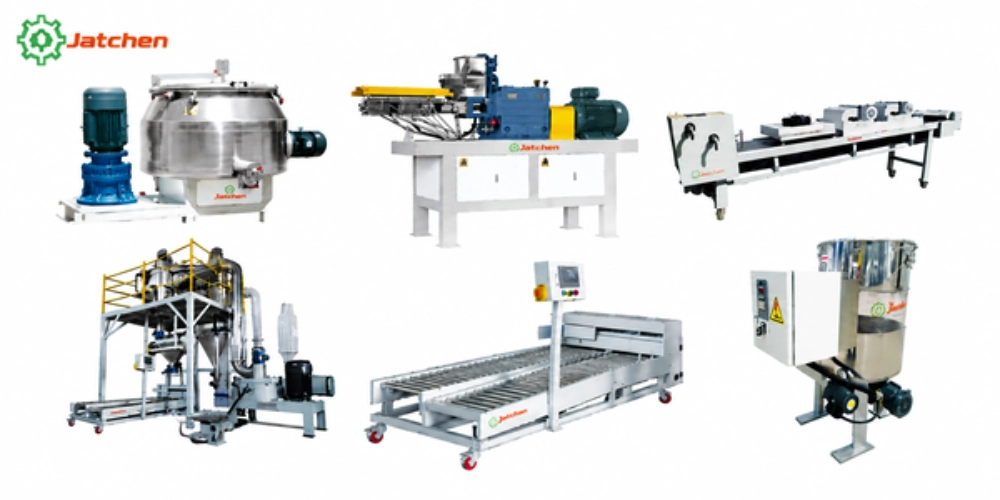
What Powder Production Equipment Is Needed at Each Stage?
Each machine has a defined job. A useful specification sheet should name the incoming material, the required output, and the handoff to the next stage instead of listing isolated machine capacities.
| Process Stage | Main Equipment | Selection Point |
| Raw material premixing | CM container mixer or HLJ high speed mixer | Batch size, cleaning, color changes, and material condition |
| Melt mixing | TSK twin screw extruder | Hourly output, feeding stability, low-shear screw design, and temperature control |
| Cooling and crushing | GDJ water cooling belt, YPJ cooling belt, or CR compact roller | Cooling conditions, layout, output, and chip preparation |
| Grinding and classifying | ACM or ICM grinding system | Target particle size distribution, cleaning, and product requirement |
| Particle size optimization | Optional CC classifier cyclone system | Fine-powder share, cut point, and recovery plan |
| Weighing and packing | AW-E weighing system and packing equipment | Carton weight, weighing rhythm, and connection to grinder output |
How Do Mixing and Extrusion Set Line Stability?
Choose the Mixer by Batch Workflow
Premixing distributes resin, curing agent, pigments, fillers, and additives before extrusion. The CM automatic container mixer suits larger batches and frequent color changes because its trolley can be cleaned away from the mixing head. Automatic lifting and tilting, PLC/HMI control, double shaft seals, and automatic dust vacuum support repeatable handling with lower dust around the premixing area.
The HLJ high speed mixer is useful when active crushing of coarse or lumpy components is part of the job. Its listed range runs from 10 to 1000 kg/h, while CM models are selected by output per tank. The high speed powder mixer guide helps compare this fixed mixing route with containerized handling.
Use a Twin Screw Extruder for Uniform Melt Mixing
The Jatchen TWIN SCREW EXTRUDER melts and mixes the premix before it reaches the cooling stage. Its co-rotating screws, deep-groove low-shear design, anti-bridge feeding, clamshell barrel, and multi-zone control support stable feeding, mixing, cleaning, and process adjustment.
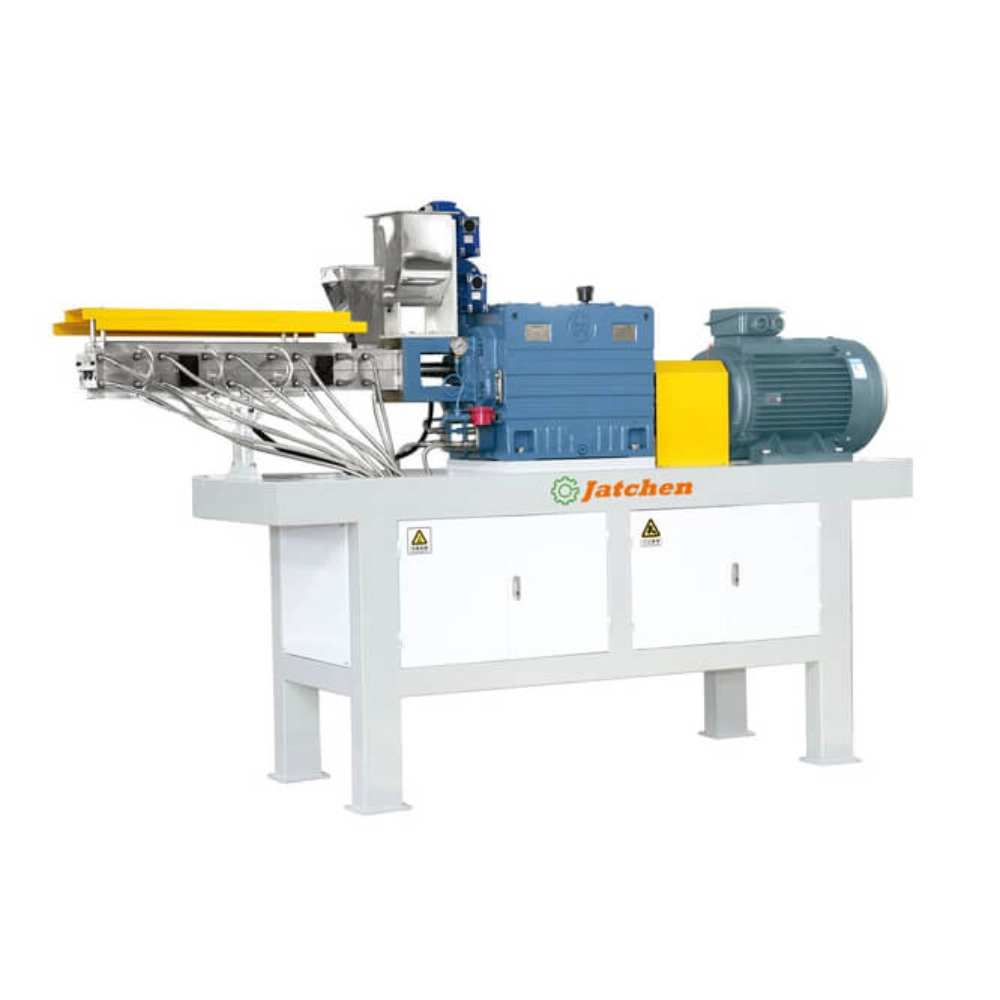
TSK models cover listed outputs from 50-80 kg/h to 1200-1500 kg/h. That range is useful only after the mixer batch rhythm and cooling capacity are checked. The related powder coating extrusion process guide shows why extrusion should be evaluated as part of the full material flow.
Match Batch Rhythm Before Comparing Nameplate Capacity
A mixer rated by kilograms per tank and an extruder rated by kilograms per hour cannot be compared directly. Calculate how many mixer batches are needed each hour, include loading and discharge time, then confirm that the extruder can receive material without long waits or surges. A sealed, leak-proof transfer path also reduces cleanup between these two stages.
How Do Cooling and Grinding Control Finished Powder?
Select Cooling Equipment by Output and Workshop Conditions
After extrusion, the melt is rolled into a sheet, cooled, and crushed into chips. A GDJ water cooling belt is a strong fit for higher-output lines with cooling-water circulation. A YPJ air cooling belt is more compact and suits many 100-500 kg/h lines or workshops without cooling-water conditions. CR compact rollers offer another compact arrangement. Cooling must produce chips that the grinder can accept steadily.
Choose ACM or ICM by the Required Particle Size Result
ACM combines grinding, air classifying, cyclone separation, sifting, and fine-powder collection. ICM is used when a tighter upper particle-size limit and steeper distribution are important. Do not choose by motor size alone. Compare the target particle size distribution, formula behavior, cleaning route, and expected output. The grinding mill selection guide provides useful comparison questions.
Plan Fine-Powder Control and Packing as Part of the Same Stage
An optional CC classifier cyclone system can reduce excessive fine powder, adjust the cut point, and return recovered fine powder for re-extrusion. After classification and sieving, the AW-E system can supply cartons, tare, and weigh 10-30 kg net cartons with listed precision within +/-0.2%. The grinder, sieve, and packing rhythm should be checked together so finished powder does not accumulate between machines.
What Problems Cause a Powder Coating Production Line to Underperform?
One Stage Becomes the Real Bottleneck
A large extruder does not create a large line if cooling or grinding cannot keep up. Use one capacity sheet for every stage and compare qualified output, not only maximum machine output. Include normal stoppages for loading, cleaning, inspection, and color change. The lowest repeatable figure is the safer planning capacity.
Cleaning and Color Change Take Longer Than Expected
Frequent color changes can reduce daily output even when every motor is large enough. Movable CM trolleys, openable extruder barrels, easy-clean grinding chambers, and smooth sealed discharge structures shorten the parts of the workflow that must be cleaned. Record the actual changeover sequence and assign access space before finalizing the layout.
Plant Conditions Do Not Support the Selected Machines
A complete line normally needs at least 4.5 m of plant height, while the grinding area normally needs at least 5 m. Water cooling requires a circulation system. Mixing, grinding, and packing points also need a planned low-dust route with local dust collection. Confirm height, floor area, power, cooling water, air, material movement, and maintenance access before equipment drawings are approved.
How Should You Select and Size the Complete Equipment Line?
Convert Daily Output into a Practical Hourly Target
Divide the required daily output by effective production hours. A target of 4 tons per day over 8 effective hours gives a 500 kg/h baseline. Then add realistic time for cleaning and changeovers. If colors change often, two smaller lines or faster-cleaning equipment may produce more usable output than one oversized line.
Decide Between a Complete Line and Single-Machine Replacement
A new plant usually benefits from a complete line because machine capacities, controls, installation, and commissioning can be planned together. An existing plant may replace one machine if the new unit can connect to the current material flow and controls. In both cases, compare the full powder processing equipment route before approving one isolated purchase.
Send the Supplier a Complete Selection Brief
A useful request should include the information that changes equipment selection:
- Target daily output and effective operating hours.
- Formula families, regular powder or metallic powder, and number of color changes.
- Required particle size distribution and packing weight.
- Available plant height, floor area, cooling water, power, and compressed air.
- Preferred automation level, cleaning method, expansion plan, and service expectations.
Conclusion
The essential powder coating production equipment follows one chain: premixing, twin screw extrusion, cooling and crushing, grinding and classifying, then weighing and packing. Bonding and laboratory equipment are added when the product plan requires them. A sound purchase matches each stage to qualified output, changeover time, particle-size requirements, utilities, and the machines immediately before and after it.
Yantai Jatchen Powder Coating Processing Equipment Co., Ltd. can support line matching, plant layout, installation, training, spare parts, and upgrades. Review the core TWIN SCREW EXTRUDER within the full line, then use Jatchen service or the contact page to provide your capacity and workshop details.
FAQ
What Machines Are Needed for Powder Coating Production?
A commercial line normally needs a mixer, twin screw extruder, cooling and crushing equipment, grinding and classifying equipment, and weighing or packing equipment.
Which Machine Controls Powder Coating Particle Size?
The grinding and classifying system sets the finished particle range. ACM and ICM systems serve different particle-size, cleaning, and output requirements.
How Do I Calculate the Required Line Capacity?
Divide daily qualified output by effective operating hours, then allow time for loading, cleaning, color changes, inspection, and packing.
When Should I Choose a Water Cooling Belt?
Choose a water cooling belt when higher output and cooling-water circulation are available. Air cooling is often more practical for smaller lines or plants without cooling-water conditions.
Can Existing Plants Replace Only One Machine?
Yes. A single-machine replacement can work when its capacity, controls, material transfer, dimensions, and maintenance access fit the existing line.


