

What Are the Main Types of Grinding Mills? Applications and 7 Key Selection Points
The main types of grinding mills include ball mills, impact mills, air classifying mills, and integrated classifier mills. Each type breaks material in a different way, so the correct choice depends on the feed condition, target particle size, required output, cleaning routine, and the equipment used before and after grinding.
For powder coating production, grinding is not a stand-alone crushing step. The mill must process cooled flakes, separate qualified powder from oversized particles, and maintain steady output across repeated batches. A machine may show a high rated capacity but still raise your production cost if it creates too many coarse particles, produces excess fines, or slows down color changes.
Yantai Jatchen Powder Coating Processing Equipment Co., Ltd. develops powder coating production equipment and complete line solutions for domestic manufacturers. Its equipment range covers mixing, extrusion, cooling, grinding, particle size optimization, weighing, and packing. The company matches machines with your formula, output target, workshop layout, cleaning schedule, and expansion plan. This matters because a grinding mill can only perform well when the full line runs at a balanced pace.
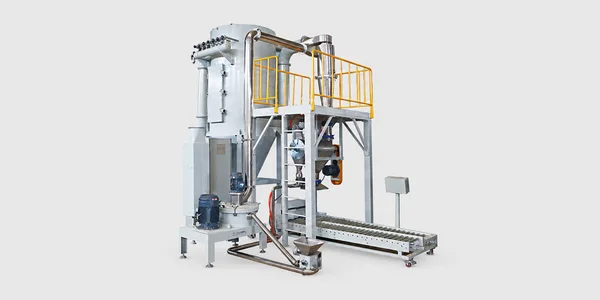
What Are the Main Types of Grinding Mills?
A useful comparison starts with the grinding force and the method used to separate finished powder. The machine shape alone does not tell you whether it will suit your production.
Ball Mills for Hard Material Grinding
A ball mill uses a rotating chamber filled with grinding media. As the chamber turns, the media rolls and falls against the material. Impact and friction gradually reduce particle size.
This type can process hard materials, but it usually needs a longer grinding cycle. A separate classification stage may also be required. For powder coating production, that can mean a longer material route, more floor space, and slower adjustment when the target particle size changes.
Impact Mills for Fast Particle Reduction
An impact mill uses a high-speed rotor, grinding disc, pins, teeth, or impact columns. The feed breaks when it strikes the moving parts and the inner grinding area.
Impact grinding works well with brittle flakes because they break quickly under repeated impact. Output can be high, but the final result still depends on rotor speed, feed rate, and the shape of the incoming flakes. Without effective classification, the finished powder may contain a wide mix of coarse and fine particles.
Air Classifying and Integrated Classifier Mills
An air classifying mill combines impact grinding with particle separation. Airflow carries the ground particles toward a classifier. Qualified powder passes through, while larger particles return to the grinding chamber.
An integrated classifier mill combines feeding, grinding, classification, conveying, and collection in one connected system. These designs are often a better fit for powder coating production because particle size is controlled during grinding rather than checked only after the material leaves the mill.
Where Are Grinding Mills Used in Powder Coating Production?
Grinding comes near the end of the production route, but its performance depends on the earlier stages. Feed shape, line speed, and collection efficiency all affect how much qualified powder you finally obtain.
Converting Cooled Flakes into Finished Powder
After raw materials are mixed and extruded, the material passes through a cooling belt and becomes solid flakes. These flakes are then broken into smaller pieces before entering the grinding system. Belt speed, cooling method, and residence time all affect the condition of these flakes, so reviewing how a cooling conveyor works can help you identify the correct feed requirements before selecting the mill.
Inside the mill, the material is reduced through impact, grinding, and shearing. Stable flakes help the machine run smoothly. If the feed is too thick or irregular, the mill may process less material per hour and produce a less stable particle range.
Controlling Particle Size and Material Recovery
Powder coating production needs more than a small average particle size. You also need to control the upper particle limit, the amount of fines, and the width of the full particle size distribution.
Too many coarse particles can affect the finished coating surface. Too many fines can reduce recovery and increase rework. A classified grinding system separates usable powder during the process and returns oversized particles for another grinding pass.
The Grinding Mill – ACM GRINDING SYSTEM follows this closed grinding and classification route. It combines high-speed grinding, air classification, cyclone separation, sifting, and fine-powder collection.
Matching Grinding with the Full Production Line
A grinding mill cannot make the full line faster by itself. If the extruder supplies material too slowly, the mill will wait. If the sieve or packing section cannot keep up, finished powder will build up after grinding.
The mill capacity should therefore match the mixer, extruder, cooling belt, sieving system, weighing unit, and packing equipment. The company’s solution center shows how these machines can be combined for laboratory work and commercial production at different output levels.
How Do ACM and ICM Grinding Systems Differ?
Both systems are used in powder coating production, but they are not aimed at exactly the same production need. One gives you more control over classification, while the other suits compact, steady grinding of brittle feed.
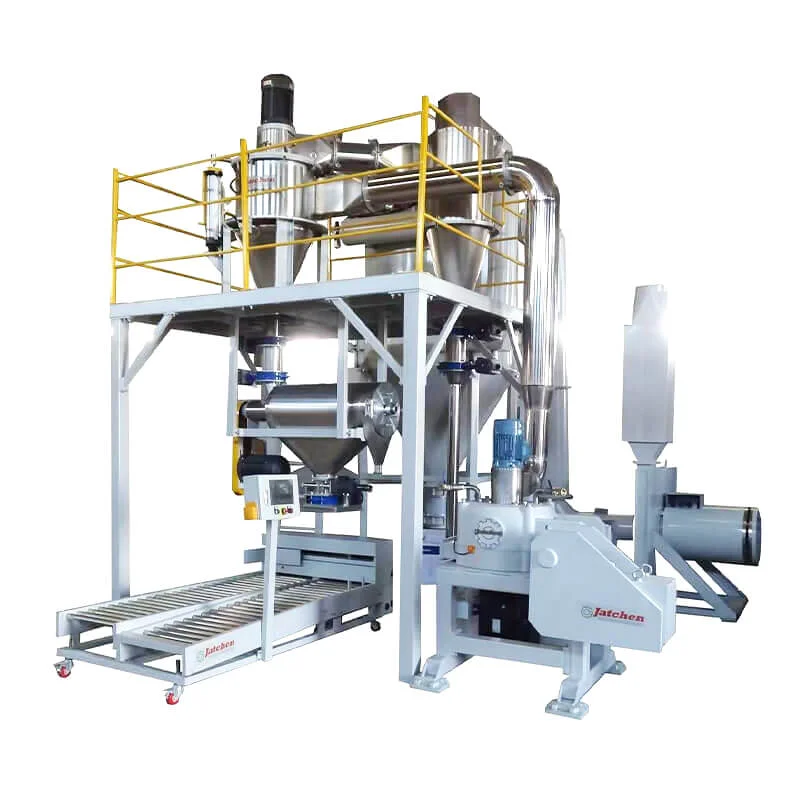
Grinding Mill – ACM GRINDING SYSTEM
The Grinding Mill – ACM GRINDING SYSTEM is the stronger general choice when you produce several formulas or need flexible particle size control.
Available models cover outputs from 15 kg/h to 1,000 kg/h. Classifier speed can be adjusted from 0 to 2,800 rpm. The system also offers adjustable particle size, a recovery rate of at least 97%, recipe storage, programmable touch-screen control, and an easy-to-clean layout.
You can also add an additive feeder, automatic weighing system, or classifier cyclone particle size optimization system. These options are useful when you need a complete production route rather than a basic mill.
Grinding Mill – ICM GRINDING SYSTEM
The Grinding Mill – ICM GRINDING SYSTEM is designed for fine crushing of brittle materials. Its model range covers outputs from 40 kg/h to 1,000 kg/h.
The system uses a solid mill housing and direct drive. It is designed for low vibration, low noise, easy cleaning, and a clear upper particle size limit. Its compact structure also helps when workshop space is limited.
ICM is a practical choice when you run stable formulas and want a direct, continuous grinding route without adding unnecessary complexity.
Choosing Between ACM and ICM
Choose ACM when you need adjustable classification, high material recovery, stored recipe settings, or frequent changes in particle size requirements.
Choose ICM when the feed is brittle, the production plan is steady, and a compact system fits your workshop better.
Neither choice should be based only on motor power. Send the supplier your feed sample, target particle range, hourly output, available floor space, and cleaning schedule before confirming the model.
What Seven Key Points Should You Check?
Choosing a grinding mill only by rated output can lead to poor line matching. You should first check the material, feed condition, particle size target, real production demand, cleaning routine, equipment wear, and connection with the rest of the line.
Material, Feed Size, and Feed Form
Material hardness and brittleness affect how easily the feed breaks inside the grinding chamber. Brittle flakes usually respond well to impact and classifier grinding. More abrasive material can increase wear on the grinding disc, rotor, teeth, and chamber, so the condition and material of these parts should be checked before model selection.
Feed size also affects load and hourly output. Smaller and more even flakes normally enter the grinding zone more smoothly than thick or irregular pieces. Feed form matters as well. A mill intended for cooled powder coating flakes should not be selected from performance data based on loose powder or large blocks. A sample test gives you a clearer idea of how the actual feed will move and break inside the machine.
Particle Size and Required Output
Your target particle size distribution should include more than one average value. You should define the acceptable coarse-particle limit, the fine-powder level, and the full particle range required for the finished powder coating. Classifier speed, grinding speed, airflow, and feed rate can then be adjusted around a clear production target.
Required hourly output should reflect daily production rather than the highest number shown on a specification sheet. Cleaning time, formula changes, maintenance, and peak orders all reduce effective production time. A mill rated at 500 kg/h may not always deliver 500 kg/h of qualified powder with every formula.
The number of formulas you produce also affects the choice. Frequent changes in particle size or powder specifications make adjustable classifier settings and stored process parameters more useful. A stable production schedule may place more weight on simple operation and consistent throughput.
Cleaning, Wear, and Line Integration
Cleaning frequency has a direct effect on usable production time. You should check access to the grinding chamber, classifier, cyclone, conveying pipes, sieve, and powder collection section. Smooth internal surfaces and detachable parts shorten color changes and reduce the risk of material remaining from the previous batch.
Wear also changes grinding performance over time. Worn grinding parts may reduce output or make the particle size distribution less stable. Check how easily the main wear parts can be inspected, removed, and replaced. Spare-part supply should also be discussed before ordering the machine.
The final selection point is line integration. Compare energy use per kilogram of qualified powder, material recovery, labor demand, maintenance time, and downstream capacity rather than looking only at the main motor. The grinding mill should run at a suitable pace with the mixer, extruder, cooling belt, sieving system, weighing unit, and packing equipment. The product center helps you compare these machines as one production route.
How Should the Grinding Mill Fit the Full Production Line?
A correct grinding model still needs correct line matching. Each machine may work well alone, but the full route only moves as fast as its slowest stage.
Matching the Extruder and Cooling Belt
The extruder determines how much material reaches the cooling stage. The cooling belt then turns that material into flakes suitable for grinding.
If the extruder output is higher than the cooling belt capacity, material flow becomes uneven. If the cooling belt sends poor flakes to the mill, the grinding system must work harder. These three machines should be selected as one production group.
Connecting Sieving, Weighing, and Packing
Qualified powder leaving the mill still needs sieving, weighing, and packing. A slow sieve can hold back the mill. Manual weighing may also create delays when production volume rises.
An automatic weighing system can supply cartons, remove tare weight, and complete weighing with listed accuracy within ±0.2%. This helps keep the final production stage closer to the grinding output.
Using Stored Parameters for Repeat Production
Stored settings help when you repeat the same formula. Operators can call saved process data instead of setting every parameter again.
This reduces variation between shifts and shortens setup time. It is useful for manufacturers producing several colors or particle size specifications on the same line.
Why Choose Yantai Jatchen Powder Coating Processing Equipment Co., Ltd.?
Grinding mill selection is not only a comparison between ACM and ICM. You also need someone to check the full production route and point out where a capacity mismatch may occur.
Product Matching for Different Output Levels
Yantai Jatchen Powder Coating Processing Equipment Co., Ltd. offers grinding systems from laboratory and small-output models to commercial units reaching 1,000 kg/h.
ACM is recommended when particle size adjustment and recovery are the main concerns. ICM is recommended when you process brittle flakes, need a compact layout, and want steady fine grinding. The company can also match these systems with mixers, extruders, cooling belts, and weighing equipment.
You can review the company’s powder coating production cases when comparing line layouts and capacity combinations.
Practical Service After Selection
The company’s service support covers line layout planning, installation guidance, commissioning support, technical assistance, repairs, rebuild work, and original spare parts.
Good service becomes important after the machine starts running. Clear parts supply, parameter support, and direct communication can reduce avoidable downtime.
Final Recommendation and Contact
Choose Grinding Mill – ACM GRINDING SYSTEM when you need adjustable particle size, high recovery, recipe storage, and support for several formulas.
Choose Grinding Mill – ICM GRINDING SYSTEM when you need fine crushing of brittle material, a compact structure, low vibration, and a stable upper particle size limit.
Yantai Jatchen Powder Coating Processing Equipment Co., Ltd. can help you compare the two systems, check line capacity, plan the workshop layout, and provide later service. For model selection or project details, use the official contact page.
FAQ
Q1: What Is a Common Type of Machine Used for Grinding Materials?
A1: Ball mills are common for hard materials, while impact mills suit brittle materials. Air classifying and integrated classifier mills are often more suitable for powder coating production.
Q2: Which Grinding Mill Is Better for Powder Coating Production?
A2: ACM is usually better when you need adjustable classification and several product specifications. ICM suits stable production of brittle feed in a compact system.
Q3: How Do You Select the Correct Grinding Mill Capacity?
A3: Match the mill with the mixer, extruder, cooling belt, sieve, weighing unit, and packing equipment. Include cleaning time and formula changes.
Q4: Which Factors Affect Final Powder Particle Size?
A4: Grinding speed, classifier speed, airflow, feed rate, flake size, and the condition of grinding parts all affect the final particle size distribution.
Q5: What Information Should You Send Before Asking for a Model Recommendation?
A5: Send your feed sample, target particle range, expected hourly output, workshop dimensions, cleaning frequency, and existing equipment details.


