

What Are the Main Types of Powder Coating Production Lines?
What Are the Main Types of Powder Coating Production Lines?
The main types are laboratory and pilot lines, small-batch lines, medium-capacity lines, high-capacity lines, metallic powder bonding lines, and particle-size-optimized lines. The first four are separated by output. The last two are defined by an added process or tighter finished-powder targets.
A complete line covers preparation, mixing, extrusion, cooling, crushing, grinding, classification, sieving, weighing, and packing. One slow section can hold back the rest.
Yantai Jatchen Powder Coating Processing Equipment Co., Ltd. supplies powder coating production equipment and complete line planning for domestic manufacturers. The company can match equipment to your formula, output, layout, cleaning routine, and expansion plan. Its powder coating production line SOLUTION covers laboratory work and several commercial capacities, so you can compare the full route rather than buy separate machines without one capacity plan.
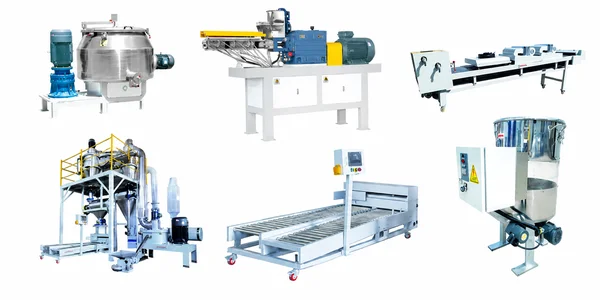
How Are Powder Coating Production Lines Classified?
A useful classification separates output, product type, and particle size target.
Output and Batch Size
Laboratory lines handle trials and samples. Small-batch lines suit changing orders. Medium and high-capacity lines support regular production.
Rated kilograms per hour do not equal saleable output. Cleaning, color changes, maintenance, and packing take time.
Product Type and Process Route
A standard line follows the usual route from raw materials to finished powder. Metallic powder needs a bonding stage. Products with tighter particle size targets need stronger grinding and classification control.
Two lines with the same output may therefore use different layouts.
Automation and Particle Size Targets
Automation may cover weighing, feeding, recipe storage, material transfer, and packing. It should reduce repeated manual work and keep batches steady.
A target such as D97 of 40–100 μm requires controlled feeding, grinding, airflow, classification, and collection.
What Are the Main Production Line Types?
The six types can be grouped into three practical pairs.
Laboratory and Small-Batch Lines
Laboratory and pilot lines are used for formula work, customer samples, and process trials. They reduce material use before larger production begins.
Small-batch lines often cover about 50–150 kg/h. They suit frequent color changes, custom orders, and factories with variable demand. Easy cleaning is a major selection point.
Medium and High-Capacity Lines
Medium-capacity lines commonly sit around 150–400 kg/h. They suit regular production while keeping some formula flexibility.
High-capacity lines often cover 500–1000 kg/h or more. They work best with stable orders and longer runs. Oversizing can create idle equipment, higher power use, and longer cleaning work.
Metallic and Particle-Size-Optimized Lines
A metallic powder bonding line adds a bonding stage after the base powder is produced. It helps metallic particles remain more evenly attached during later handling.
A particle-size-optimized line focuses on grinding, classification, fine-powder control, and usable recovery. It may be small, medium, or large.
What Equipment Forms a Complete Line?
Line sizes change, but the material path remains similar. Each section must prepare a steady feed for the next one.
Mixing, Extrusion, and Cooling
Resin, curing agent, pigment, filler, and additives first need even distribution. The mixed material then passes through extrusion and becomes a continuous melt.
Cooling rolls and a belt turn the melt into sheets or flakes. Sheet thickness and crusher settings affect the grinding feed.
Grinding, Classification, and Collection
Grinding reduces cooled flakes into fine powder. Classification separates qualified powder from material that needs more grinding.
ACM combines high-speed grinding, air classification, cyclone separation, sifting, and fine-powder collection. This route gives more control than a basic crusher.
Sieving, Weighing, and Packing
Finished powder still needs sieving, accurate weighing, and packing. A slow packing section can restrict an otherwise balanced line.
The powder coating equipment range helps you review these sections together. You can also check production cases for workshop arrangements.
Why Do Production Lines Develop Bottlenecks?
Most bottlenecks come from poor matching, unclear particle size targets, or missing cleaning time.
Unbalanced Throughput Between Stages
A 500 kg/h grinder should not receive 800 kg/h of flakes unless the layout includes controlled storage and feeding.
Compare sustained output, not only the highest stated figure. Similar rates reduce waiting.
Wide Particle Size and Too Much Fine Powder
Changing mill speed alone rarely fixes unstable powder. Feed rate, classifier speed, airflow, material condition, and collection work together.
Integrated classification lets qualified powder leave while larger particles continue grinding, reducing oversized material and unnecessary fine powder.
Long Cleaning and Color-Change Time
Powder left in the chamber, classifier, cyclone, or ducting can contaminate the next batch and delay production.
Smooth surfaces, accessible contact parts, short transfer paths, and enough maintenance space should be planned before installation.
How Does the ACM Grinding System Fit Different Lines?
The grinding section often decides whether a line reaches its particle size target and practical output. Select the mill with the whole route.
Broad Output Selection
The Grinding Mill – ACM GRINDING SYSTEM covers about 15–1000 kg/h. Its classifier speed can be adjusted from 0 to 2800 rpm.
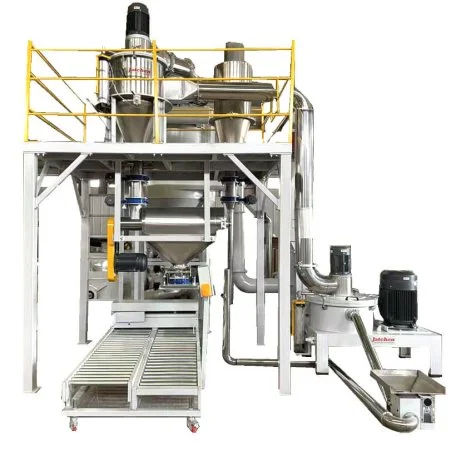
This range serves laboratory, small, medium, and high-capacity lines.
Grinding and Classification in One System
ACM combines grinding, air classification, cyclone separation, sifting, and fine-powder collection. The stated recovery rate is at least 97%, with recipe storage, parameter recall, and a programmable touch screen.
Options include an additive feeder, Classifier Cyclone PSD Optimization System, and automatic weighing system.
Cleaning and Daily Operation
The ACM GRINDING SYSTEM model range is designed for cleaning and maintenance access, which matters when colors or formulas change often.
Compare feed flakes, target D50, D90, or D97, output, floor space, and cleaning frequency before choosing a model.
How Should You Choose the Right Line?
Start with the powder you plan to make and the amount you can sell. Equipment selection comes after those two points.
Start with Saleable Output
Calculate output per shift, week, and month. Deduct cleaning, maintenance, trial runs, color changes, and rejected material.
The SOLUTION configurations show how the main processing sections can be matched at different capacities.
Match the Line to Your Product Mix
Choose a laboratory line for formula work, a small line for flexible orders, a medium line for regular production, and a high-capacity line for stable long runs.
Add bonding equipment for metallic powder. Give more weight to ACM when particle size and fine-powder control are central.
Check Layout, Cleaning, and Expansion
Leave space for operation, cleaning, component removal, dust collection, and later additions. Check transfer height and material direction before installation.
The technical news center provides more process information for early planning.
Conclusion
Choosing a powder coating production line is a matching task. The line must fit output, formula range, particle size target, cleaning schedule, and floor space.
Choose the Type Before the Model
First decide whether you need laboratory, small-batch, medium, high-capacity, metallic bonding, or particle-size-optimized production. Then select machine models.
This order prevents one oversized or undersized section from setting the pace for the plant.
Use a Complete Production Solution
Yantai Jatchen Powder Coating Processing Equipment Co., Ltd. can review the route from raw material preparation to packing. Its advantage is linking complete line planning with a wide ACM model range and optional particle size modules.
You can begin from the official website and compare the SOLUTION with the Grinding Mill – ACM GRINDING SYSTEM.
Service and Contact
A practical plan should cover selection, layout, installation, commissioning, operator guidance, spare parts, and maintenance. The company’s service support explains the available help.
Send your target output, powder type, particle size range, color-change frequency, and workshop drawing through Contact Us.
FAQ
Q1: What Is the Smallest Powder Coating Production Line?
A1: A laboratory line is the smallest type. It is used for formula trials, samples, and process setup before commercial production.
Q2: What Output Is Suitable for a Medium Production Line?
A2: A common range is about 150–400 kg/h, but the final choice should follow saleable output, operating hours, cleaning time, and order stability.
Q3: When Should You Choose a Metallic Powder Bonding Line?
A3: Choose it when metallic particles need a more stable bond with the base powder and simple dry blending does not give consistent handling.
Q4: Why Is the ACM Grinding System Important?
A4: It combines grinding, air classification, cyclone separation, sifting, and fine-powder collection, helping you control particle size in one process.
Q5: How Do You Avoid a Production Line Bottleneck?
A5: Match sustained capacity across mixing, extrusion, cooling, grinding, sieving, weighing, and packing, then include cleaning and maintenance time.


