

Which Machine Is Best for Grinding Solids into Powder in Industrial Production
Which Machine Is Best for Grinding Solids into Powder in Industrial Production
Choosing a machine to grind solids into powder is not only about finding equipment with enough power. You also need to control particle size, limit unwanted fine powder, maintain steady output, and keep each batch consistent. A basic crusher can reduce large pieces, but it usually cannot produce a finished powder with a controlled particle size distribution. For powder coating production, an air classifying grinding system is often the better choice because grinding and particle classification happen in one continuous process.
Yantai Jatchen Powder Coating Processing Equipment Co., Ltd. focuses on powder coating manufacturing equipment, from raw material mixing and extrusion to cooling, grinding, weighing, and packing. The company does not simply supply separate machines. Its team can match equipment around your formula, planned output, workshop space, cleaning needs, and production method. That point matters when you are building or upgrading a line because the grinding mill must work at the same pace as the mixer, extruder, and cooling belt. The company’s equipment manufacturing experience also covers particle size control, production automation, easy cleaning, and line planning for domestic powder coating manufacturers.
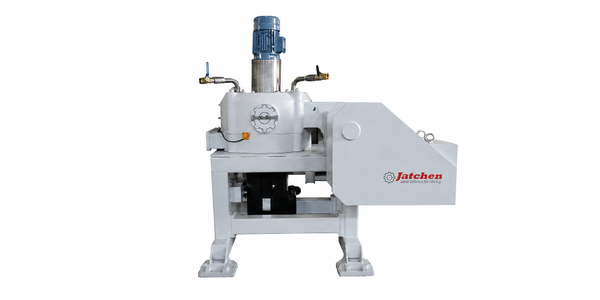
What Type of Machine Is Best for Grinding Solids into Powder?
The right answer depends on what you mean by “powder.” A coarse crushed material may be acceptable as an intermediate product, while finished powder coating requires a much narrower and more stable particle size range. You should first separate coarse size reduction from fine grinding.
Crushers for Coarse Size Reduction
A crusher is useful when large blocks, thick flakes, or compacted pieces must be reduced before fine grinding. It breaks the material into smaller pieces so the downstream mill receives a more even feed.
However, a crusher alone gives limited control over final particle size. Some pieces may remain too large, while other parts become unnecessarily fine. It works well as a preparation step, but it is rarely the best final machine when you need finished powder coating.
Grinding Mills for Fine Powder Production
An industrial grinding mill takes smaller flakes or granules and reduces them through impact, shearing, and repeated contact inside the grinding chamber. It can produce much finer material than a basic crusher.
When choosing a grinding mill, you should check more than the motor size. The target particle size, hourly output, feed condition, powder recovery, cleaning time, and classifier adjustment all affect the final result. A mill that produces enough kilograms per hour may still be unsuitable if its particle size distribution changes from batch to batch.
Air Classification for Controlled Particle Size
An air classifying mill combines grinding with particle separation. Powder moves through the system with controlled airflow. Particles that meet the selected size can leave the grinding area, while larger particles remain in the process for further reduction.
This arrangement gives you better control than grinding first and screening later. It also reduces repeated handling. For powder coating manufacturers that need stable finished powder, the combination of grinding and classification is usually the most practical route.
Why Do Basic Grinding Setups Produce Unstable Powder?
A simple grinding setup may appear cheaper at the beginning, but unstable particle size can create more work later. You may need extra screening, repeated grinding, manual adjustment, or more frequent cleaning. These issues reduce real output even when the mill itself runs at a high speed.
The better approach is to solve each problem inside the process instead of correcting the powder after production.
Integrated Grinding and Classification for Wide Particle Size Variation
A wide particle size distribution often appears when a mill reduces material without separating finished particles quickly enough. Powder that has already reached the required size may stay in the chamber, where it continues to break down. At the same time, larger pieces may leave too early.
An integrated grinding and classification system separates suitable powder during production. Larger particles continue through the grinding cycle, while qualified powder moves toward collection. This helps reduce both oversized material and unnecessary fine powder.
Adjustable Operating Parameters for Inconsistent Results
Changing only the mill speed rarely solves every particle size problem. Feed rate, classifier speed, airflow, and material condition work together. A change in one setting can affect output, recovery, and particle size at the same time.
You need a system that allows controlled adjustment rather than fixed operation. Stored production recipes are also useful when you make several powder coating formulations. Operators can return to known settings instead of rebuilding the process from the beginning for every batch.
Enclosed Processing for Dust and Material Loss
Open transfer points and poorly sealed equipment can release powder into the workshop. Material loss then becomes difficult to measure, and cleaning takes longer. Escaped powder may also enter nearby equipment during a formula or color change.
A closed grinding and collection process keeps more material inside the system. Good sealing, dust collection, and smooth internal surfaces also make daily operation easier. These details may look small during equipment selection, but they affect output and changeover time every week.
How Does an Air Classifying Grinding System Work?
An air classifying grinding system follows a clear material path. Each step needs to remain stable because irregular feeding or poor airflow can change the finished powder.
The process starts with controlled feeding, continues through grinding, and finishes with classification and collection.
Controlled Feeding into the Grinding Chamber
Cooled and crushed flakes enter the mill through a feeding device. The feed rate should remain steady. If too much material enters at once, the grinding chamber can become overloaded and output may fluctuate.
A controlled feeder keeps the material flow close to the mill’s working capacity. It also helps maintain stable motor load and gives the classifier a more even powder stream to separate.
Impact, Shearing, and Grinding
Inside the chamber, high-speed rotating components strike and cut the incoming flakes. Impact breaks brittle pieces, while shearing helps separate compacted material and reduce remaining coarse particles.
The material passes through repeated grinding actions until it becomes fine enough to move with the process airflow. Chamber design and rotor speed affect both grinding efficiency and particle shape, so the mill should be selected around the actual powder coating formula rather than output alone.
Classification, Collection, and Oversize Return
After grinding, the airflow carries powder toward the classifier. The classifier separates particles according to the selected operating settings. Suitable powder moves to the cyclone and collection section, while larger particles return for more grinding.
A production line may work toward a finished powder range such as D97 of 40–100 μm, though the correct target depends on the formulation and final coating requirement. Stable classification makes this range easier to maintain across repeated batches.
When Should You Choose the ACM or ICM Grinding System?
Both systems grind and classify powder coating materials, but they suit different production priorities. You should compare their structure, output range, adjustment needs, and connection with the rest of your line.
The choice should come from the material and production plan, not from a simple claim that one machine is always better.
ACM for Integrated Grinding and Broad Capacity Selection
The Grinding Mill – ACM GRINDING SYSTEM combines high-speed grinding, air classification, cyclone separation, sifting, and fine powder collection. It is designed for powder coating manufacturers that need adjustable particle size and a complete grinding process in one system.
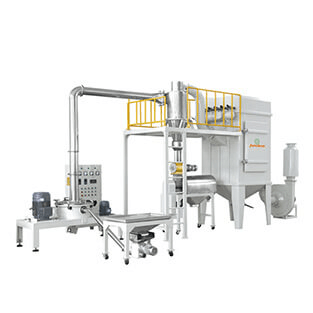
The ACM range covers outputs from about 15 kg/h to 1,000 kg/h. Classifier speed can be adjusted from 0 to 2,800 rpm. The system also offers a powder recovery rate of at least 97%, recipe storage, a programmable touch screen, and optional equipment such as an additive feeder, Classifier Cyclone PSD Optimization System, and automatic weighing system.
ICM for Compact Layout and Defined Particle Size Limits
The Grinding Mill – ICM GRINDING SYSTEM uses a compact structure and direct-drive design. It is mainly used for fine crushing of brittle powder coating materials and can help control the upper particle size limit while producing a steep particle size distribution.
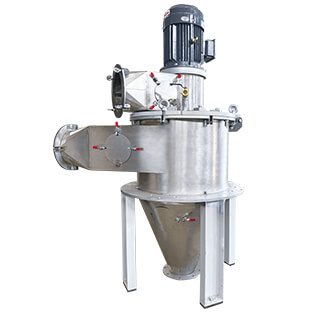
The ICM series covers about 40 kg/h to 1,000 kg/h. Its classifier also operates within a 0–2,800 rpm range. A solid mill housing supports low vibration and low noise, while the chamber design supports efficient grinding, easy cleaning, and lower wear during regular production.
A Practical Choice Based on Your Production Needs
ACM is a strong choice when you need a wide model range, several optional modules, recipe management, and further particle size optimization. It suits production lines where the grinding section may later connect with automatic weighing or other line equipment.
ICM is worth considering when you prefer a compact arrangement, direct drive, clear upper particle size control, and a simpler cleaning routine. Before ordering either system, test or review your feed flakes, target particle size, planned output, formula change frequency, and available floor space.
How Should You Match the Grinding Mill to the Production Line?
A grinding mill cannot be selected as an isolated machine. If the upstream equipment produces material faster than the mill can process it, the grinding section becomes a bottleneck. If the mill is much larger than the rest of the line, it may run below its practical capacity.
You should compare the full material flow before choosing a model from the company’s powder coating equipment range.
Matching Output with the Extruder and Cooling Belt
The extruder creates the molten material, and the cooling belt turns it into solid flakes for grinding. Their output should stay close to the mill’s practical processing rate.
For example, a 500 kg/h grinding system should not be paired with upstream equipment that regularly sends 800 kg/h of flakes unless storage and controlled feeding are part of the layout. Good capacity matching keeps material moving and reduces waiting between stages.
Matching Particle Size with the Final Product
Your target particle size should come from the powder coating formula and the required finished performance. A narrow distribution may support more even coating behavior, while too much fine powder can reduce usable recovery and create extra handling.
You should provide expected D50, D90, or D97 values when available. If those figures are not yet confirmed, sample testing can help establish suitable mill and classifier settings before full production.
Matching Cleaning Needs with Formula Changes
Frequent color or formulation changes make cleaning time an important purchasing factor. The grinding chamber, classifier, cyclone, ducting, and collection parts should be accessible.
Smooth internal surfaces and removable components reduce trapped powder. This lowers cross-color contamination and helps your operators return the line to production sooner. For plants making several products each week, cleaning design can matter as much as rated output.
Why Choose Yantai Jatchen for Powder Grinding Projects?
The best machine for grinding solids into powder is the machine that fits your actual production line. It must process the feed material steadily, control particle size, recover usable powder, and connect properly with upstream and downstream equipment.
Yantai Jatchen can support this decision with individual machines and complete line planning.
Product Selection Based on Real Production Conditions
The company can review your feed material, expected output, target particle size, workshop layout, cleaning routine, and operating method before recommending ACM or ICM.
Its powder coating production solutions also cover laboratory lines and production lines at different output levels. This helps you compare the grinding mill with the mixer, extruder, cooling belt, and packing section instead of choosing every machine separately.
Complete Equipment Planning and Project References
A complete project should account for material movement, operator access, cleaning space, and equipment capacity at each stage. The company’s project case information can help you review different line arrangements, while its technical news center provides more material on powder mixing, extrusion, cooling, grinding, and particle size control.
The ACM and ICM systems both offer a practical route to controlled powder production. ACM gives you broad capacity selection and more optional modules. ICM gives you a compact direct-drive structure and clear particle size control.
Service and Contact
Equipment selection should continue after the model is chosen. Installation planning, commissioning, operator guidance, spare parts, and routine maintenance all affect long-term use. You can review the available service support and send your material, output, particle size, and workshop details through Contact Us. The technical team can then help match the grinding system with the rest of your powder coating production line.
FAQ
Q1: Which machine is best for grinding solids into powder?
A1: An air classifying grinding mill is usually the best choice when you need fine powder with controlled particle size. It combines grinding and classification, which gives you better control than a basic crusher.
Q2: What is the difference between a crusher and a grinding mill?
A2: A crusher reduces large pieces into smaller flakes or particles. A grinding mill processes those smaller materials into fine powder. In powder coating production, both may be used at different stages.
Q3: When should you choose an ACM grinding system?
A3: ACM is suitable when you need integrated grinding, classification, cyclone separation, a wide output range, recipe management, and optional particle size optimization or automatic weighing equipment.
Q4: When should you choose an ICM grinding system?
A4: ICM is suitable when you need a compact direct-drive system, low vibration, easy cleaning, controlled upper particle size, and steady grinding of brittle powder coating materials.


