

How to Choose the Right Powder Coating Extruder for Your Production Line: 7 Key Selection Factors
How to Choose the Right Powder Coating Extruder for Your Production Line: 7 Key Selection Factors
Choose a powder coating extruder by matching the formula, required qualified output, screw design, temperature control, feeding stability, cleaning routine, and downstream capacity. The best model is not simply the extruder with the highest kg/h rating. It is the one that can turn a stable premix into a uniform melt at the same pace that the cooling and grinding sections can handle.
For powder coating production, a co-rotating twin screw machine is a practical starting point because resin, curing agent, pigments, fillers, and additives need controlled conveying, plasticizing, kneading, and melt mixing before cooling. Jatchen’s TWIN SCREW EXTRUDER range covers TSK35 through TSK98, from 50-80 kg/h to 1200-1500 kg/h, so selection can begin with a real production target rather than a generic machine size.
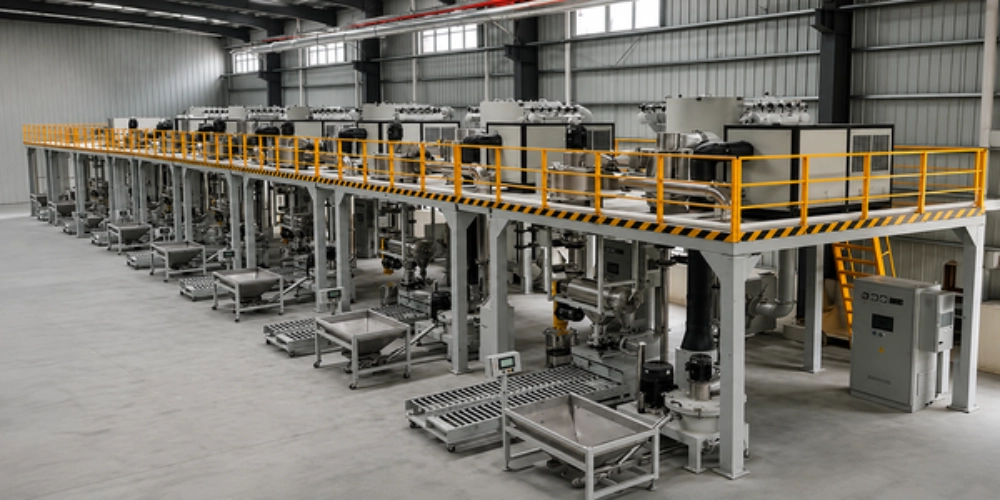
Why Does Extruder Selection Affect the Entire Powder Coating Line?
The extruder sits between dry premixing and cooling. That position makes it a line-balancing machine. If premixing is inconsistent, feeding into the barrel becomes harder to stabilize. If extrusion output is higher than the cooling belt or grinding mill can accept, hot material accumulates downstream. If it is too low, the cooling and grinding stages spend part of the shift waiting for feed.
Stable Melt Mixing Comes Before Rated Output
Jatchen’s TSK series uses a co-rotating twin screw layout with a deep-groove, low-shear design. The motor drives the screws to convey the premixed formula forward while threaded and mixing elements provide compression, kneading, and mixing.
For heat-sensitive formulations, low-shear processing is a relevant selection point because the job is to form a uniform melt without treating maximum screw speed as the only performance target. A short peak in output is less useful if melt quality changes during continuous production.
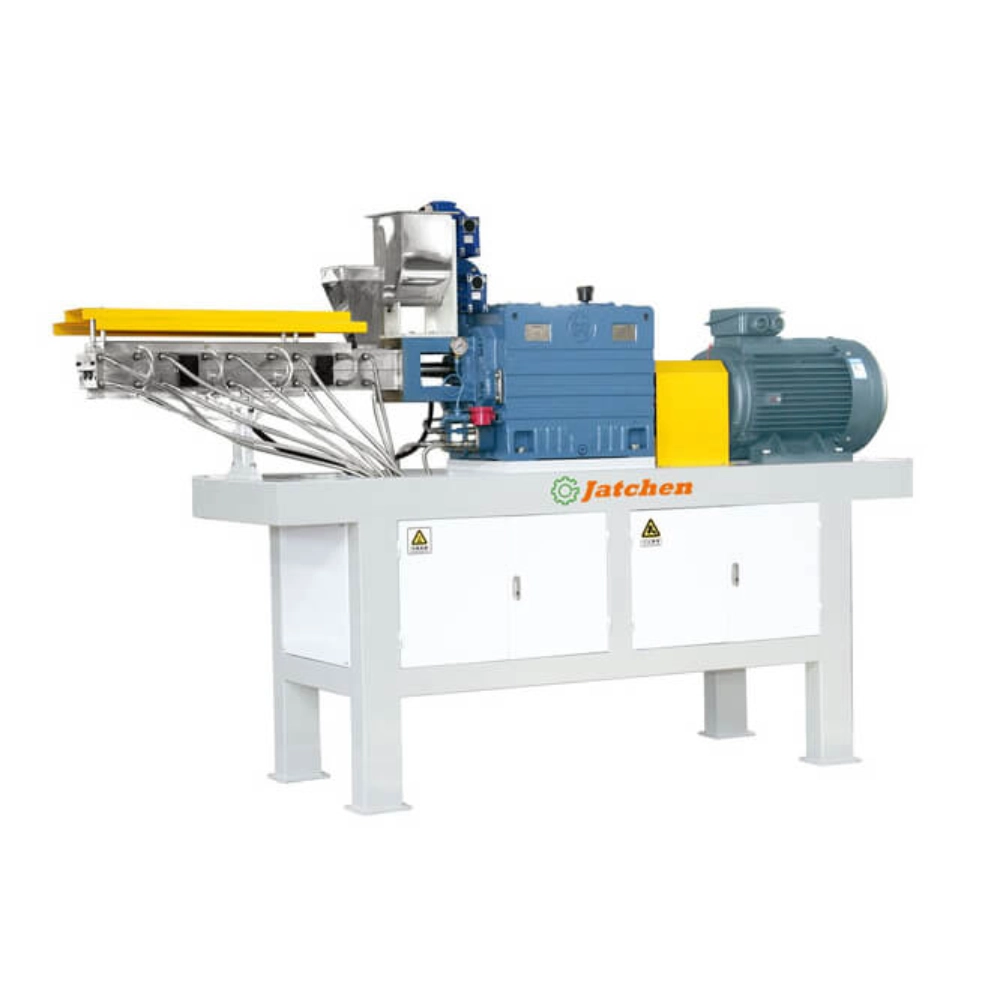
The Melt Must Leave at a Rate the Cooling Section Can Accept
A stable powder coating extrusion process continues beyond the die. The melt is sheeted and cooled before it is crushed into chips for grinding.
When comparing extruders, check the rated output of the proposed cooling belt and mill as part of the same decision. A 600-800 kg/h extruder does not create a 600-800 kg/h finished line if another stage is consistently slower. Extruder output becomes useful production output only when the downstream equipment can keep pace.
Which Powder Coating Extruder Output Range Fits Your Production Line?
Start with the qualified finished-powder requirement per hour and work backward. Then compare the TSK model output, screw diameter, screw speed, motor power, how to choose the right container mixer for powder coating, cooling capacity, and grinder throughput.
The model table below shows why output should be treated as a range to be matched to the complete production line rather than as an isolated headline figure.
| Model | Rated Output | Screw Diameter | Main Motor |
| TSK35 | 50-80 kg/h | 35 mm | 7.5 kW |
| TSK40 | 150-200 kg/h | 40 mm | 18.5 kW |
| TSK55 | 300-500 kg/h | 55 mm | 30 kW |
| TSK65 | 600-800 kg/h | 65 mm | 45 kW |
| TSK75 | 800-1000 kg/h | 75 mm | 55/75 kW |
| TSK85 | 1000-1200 kg/h | 85 mm | 90/110 kW |
| TSK98 | 1200-1500 kg/h | 98 mm | 110/135 kW |
Do not size the extruder only for a future maximum that the rest of the factory cannot support. A buyer running frequent colors may value manageable batch size and shorter cleaning cycles more than the highest nominal output. A plant with long, repeated runs may prioritize continuous throughput.
In both cases, leave room for normal cleaning, formula changeover, maintenance, and planned growth instead of assuming every operating hour will run at full rated capacity.
What 7 Key Selection Factors Should You Check Before Buying?
1. Required Output
First, define how many kilograms of qualified powder the line must produce per hour or shift. The target should reflect real finished-powder demand rather than only the extruder’s maximum nameplate capacity.
Cleaning time, formula changeovers, planned maintenance, and shift length also affect usable daily output. If the line needs 500 kg/h of qualified finished powder, the extruder should be selected together with the mixer, cooling belt, and grinding system rather than sized as an independent machine.
2. Formula Sensitivity
Describe the formula rather than giving the supplier only a capacity number. Heat-sensitive materials, filler loading, premix behavior, and feeding consistency can all change the practical operating window.
A model that processes one formulation steadily may require different operating conditions when resin type, filler content, pigment loading, or additive sensitivity changes. The goal is to choose a powder coating extruder that can maintain stable processing for the intended formula rather than simply reach a brochure capacity under ideal conditions.
3. Screw Design
The TSK series uses a 16D screw length and co-rotating twin screws. Screw geometry affects conveying, compression, kneading, and mixing inside the barrel, so it should be evaluated according to the formulation and required production conditions.
For powder coating production, the screw system must provide enough mixing action to create a uniform melt while avoiding unnecessary thermal or mechanical stress. Buyers should therefore compare screw diameter, screw speed, L/D, and mixing behavior rather than treating screw configuration as a basic mechanical specification.
If you are comparing different screw structures, the guide on single screw vs twin screw extruders explains the main differences in conveying and mixing behavior.
4. Temperature Control
Jatchen lists multiple heating and cooling zones with temperature control within ±2°C on the TSK series. This gives buyers a concrete specification to verify when comparing powder coating extrusion equipment.
Temperature stability matters because resin and additives need to melt and plasticize within a controlled operating window. If temperature fluctuates too much, the material may not process consistently, and the cooling and grinding sections can receive less stable feed.
When comparing two machines, check both the number of control zones and how accurately the machine can maintain the required temperature during continuous production.
5. Feeding Stability
Jatchen lists an anti-lag screw feeding system designed to support more uniform feeding. This matters because changing feed volume can cause material flow inside the barrel to rise and fall even when screw speed and temperature settings remain unchanged.
If extruder output repeatedly fluctuates, check the premix and feeder before changing the screw settings. A stable feeding system gives the twin screw section a more repeatable material load and helps the extrusion process remain consistent.
Feeding stability becomes especially important when the formula contains materials with different bulk densities or flow characteristics.
6. Cleaning and Controls
The TSK series uses a clam-style barrel with liner inserts, providing better access for inspection and cleaning. This becomes important when a factory frequently changes powder colors or formulations.
PLC/HMI program control and error-prevention functions also help operators repeat process settings across production runs. A machine that is easier to clean and operate can reduce changeover time and limit unnecessary production interruptions.
Cleaning access and control convenience may appear secondary during equipment purchasing, but both affect usable production hours over the life of the machine.
7. Full-Line Matching
The final selection factor is whether the powder coating extruder matches the rest of the production line. Compare its rated output with the actual mixer, cooling belt, grinding system, weighing equipment, workshop space, and available utilities.
Higher extruder output is useful only when surrounding equipment can accept it without creating another bottleneck. If a 600-800 kg/h extruder feeds a cooling or grinding section that can process substantially less, increasing extrusion capacity alone will not increase the finished-powder output of the factory.
For this reason, the best extruder should be selected as part of the complete material flow rather than as a stand-alone purchase.
What Problems Usually Show That an Extruder Is Mismatched?
Output Repeatedly Rises and Falls
Do not immediately blame screw speed. Check the premix and feeder first. A batch that is not uniformly prepared can change how material enters the extruder.
Stable extrusion starts with repeatable feed. If the premix reaches the screws with changing bulk behavior or uneven component distribution, operators may keep correcting machine settings even though the root cause is upstream.
Cooling Becomes the Daily Bottleneck
If hot melt consistently waits for cooling capacity, the extruder and cooling section are not balanced. Compare belt width, belt length, cooling mode, roller settings, and rated output.
Jatchen’s GDJ water-cooling belt range covers 200-1200 kg/h, while YPJ models cover 30-1000 kg/h. Higher extruder output will not improve the complete line if the cooling stage becomes the daily capacity limit.
The Grinder Needs Constant Correction
Large variation in cooled chip condition can make final particle-size control harder. Before changing classifier or mill settings, verify that extrusion and cooling are producing a repeatable feed form.
A stable grinding system depends on what arrives at the mill. This is another reason to evaluate the line as a connected production sequence instead of treating each machine independently.
How Should B2B Buyers Compare Two Powder Coating Extruders?
Put both machines into one technical comparison sheet. Compare tested or rated output for the intended formula rather than only the largest number printed in the product specification.
Include screw diameter and speed, L/D ratio, heating and cooling zones, temperature-control accuracy, feeder design, gearbox configuration, cleaning access, PLC/HMI functions, installed motor power, machine dimensions, spare-part access, mixer capacity, cooling-belt capacity, and grinding-system throughput.
Ask the supplier to explain where the production bottleneck will move if extruder output is increased. This question can reveal more about the practical suitability of a machine than simply asking which model has the largest motor.
Yantai Jatchen Powder Coating Processing Equipment Co., Ltd. develops powder coating equipment across mixing, extrusion, cooling, grinding, particle-size optimization, weighing, and laboratory production. That wider equipment range is useful when comparing extruder options because the proposed machine can be checked against adjacent process stages rather than being specified as an isolated unit.
Conclusion
Choosing the right powder coating extruder is mainly a production-line matching decision. Define qualified output and formula behavior first, then verify screw configuration, temperature control, feeding stability, cleaning access, control functions, and downstream capacity.
A stable powder coating extrusion process matters more than a short peak in extruder output. The correct TSK model is the one that can maintain repeatable melt mixing while material moves from premixing through cooling and grinding without forcing another stage to become the permanent bottleneck.
FAQ
What Type of Extruder Is Commonly Used for Powder Coating?
A co-rotating twin screw extruder is a common fit because it can convey, knead, plasticize, mix, and continuously discharge the premixed formula.
How Do I Choose the Right Powder Coating Extruder Capacity?
Start with required qualified finished-powder output, then match the extruder to mixer batch rhythm, cooling capacity, grinding throughput, shift hours, and changeover time.
Why Does Temperature Control Matter in Powder Coating Extrusion?
The formula must melt and plasticize inside a controlled operating window. Jatchen lists multi-zone temperature control within ±2°C on the TSK series.
What Should I Check If Extruder Output Is Unstable?
Check premix uniformity, feeder behavior, temperature stability, screw condition, and downstream resistance before changing operating settings at random.
What Output Range Does the Jatchen TSK Series Cover?
The listed range starts at 50-80 kg/h for TSK35 and reaches 1200-1500 kg/h for TSK98, with intermediate models for different production scales.


