

Powder Coating Extruder Market Demand: What Buyers Should Know Before Expanding Production
Powder Coating Extruder Market Demand: What Buyers Should Know Before Expanding Production
When production orders start to grow, many factories begin searching for a powder coating extruder that can increase production capacity without affecting product quality. That sounds simple, but in powder coating production, expansion is never only about one machine. You have to check output, formula stability, cooling speed, grinding capacity, labor cost, and daily cleaning time. So what is a powder coating extruder used for in production? A powder coating extruder melts, mixes, and processes resin, pigments, fillers, and additives into a uniform material before cooling and grinding.
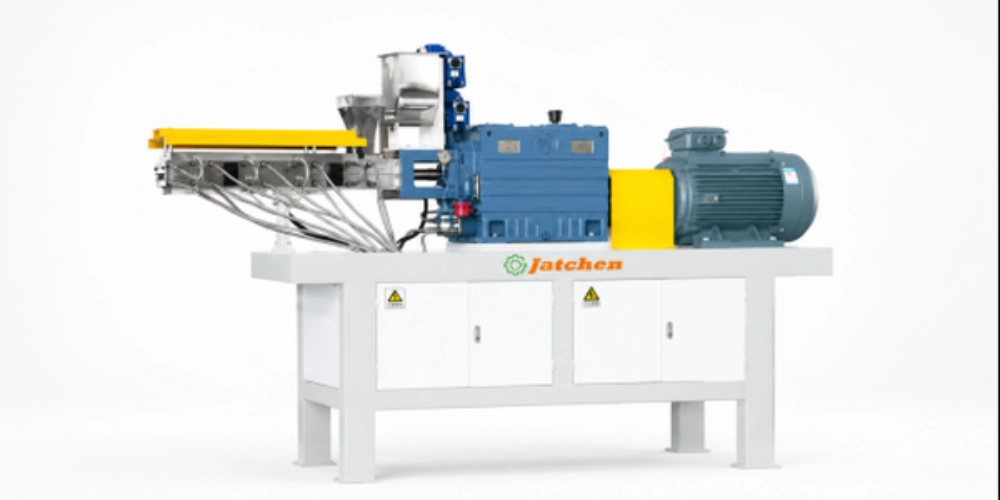
Yantai Jatchen Powder Coating Processing Equipment Co., Ltd. is a professional supplier focused on powder coating production equipment. The company has long experience in developing mixing, extrusion, cooling, grinding, laboratory, and complete production line equipment for domestic powder coating factories. Its work is not just selling machines. It helps buyers look at the whole production flow, then choose a practical configuration for real factory output. For buyers planning to expand, the Extruder – TWIN SCREW EXTRUDER is worth close attention because it directly affects melt mixing, production stability, and the later cooling and grinding result.
Why Powder Coating Extruders Are Important for Production Expansion
Many buyers feel the same pressure: orders increase, delivery time gets tighter, and the old line starts to run near its limit. At this stage, the extrusion section often becomes the part everyone watches most closely.
Order Growth Pushes Output Pressure
When daily production volume rises, a small machine may still run, but it cannot support stable long shifts. Workers may extend operating hours, but that only hides the problem for a short time.
A better way is to check your real target capacity. If your current line already struggles with output, then the new machine should be selected by hourly production demand, not by habit or price alone.
Stable Melt Mixing Affects Batch Quality
In powder coating production, premixed resin, curing agent, pigment, filler, and additives need to be processed into a uniform melt. If this stage is not stable, later steps will carry the problem forward.
You may see color variation, uneven powder quality, unstable gloss, or more rework. These issues are not always caused by raw materials. Sometimes the extrusion process is simply not steady enough.
Expansion Needs a Full Line View
A buyer may focus on the main machine first, which is normal. But after output rises, cooling and grinding must also keep up.
That is why many domestic buyers now check the whole process before placing an order. The main unit must match the mixer, cooling belt, grinding system, and packing plan. Otherwise, the line looks upgraded, but the bottleneck just moves to another place.
What Buyers Should Check Before Choosing a Powder Coating Extruder
Before you talk about model selection, it helps to put your production numbers on paper. This saves time and avoids buying a machine that looks strong but does not fit your line.
Confirm Real Hourly Production Demand
Jatchen’s twin screw equipment covers different output ranges, from smaller production to large continuous production. For example, the TSK series includes models suitable for 50–80 kg/h, 150–200 kg/h, 300–500 kg/h, 600–800 kg/h, 800–1000 kg/h, 1000–1200 kg/h, and even 1200–1500 kg/h production needs.
This range gives buyers more room to match real demand. A factory making regular medium-batch powder does not always need the largest model. A factory with long, steady orders should not choose a machine that will become overloaded after a few months.
Check Screw Diameter and Main Motor Power
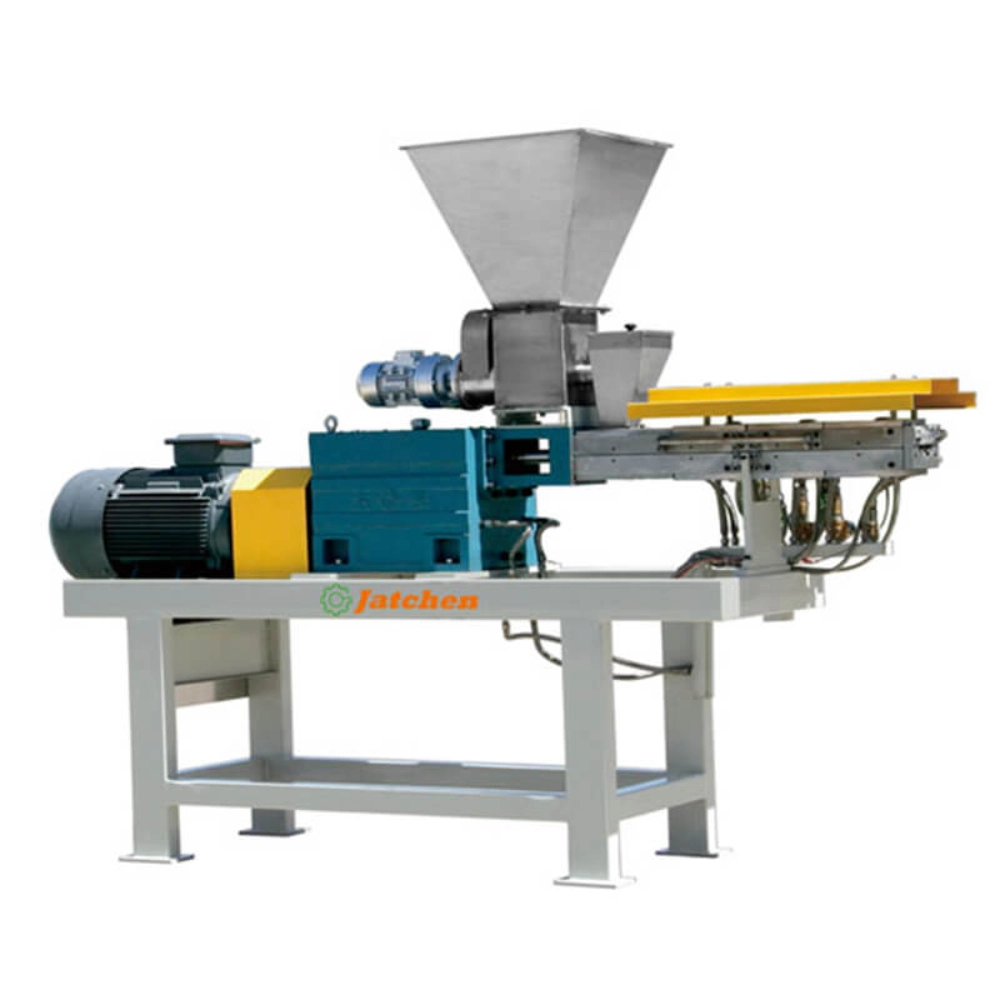
Screw diameter, screw speed, and motor power are not just technical details. They decide how steadily the material moves, kneads, and exits the machine.
For example, smaller models may fit trial production or lower-volume orders. Larger models are better when the factory needs long operation and stronger output. The point is simple: choose the machine by production rhythm, not by model name alone.
Think About Space and Future Line Layout
Factory space matters. A machine that fits today may become difficult to connect with later cooling, grinding, and material handling equipment.
Before you expand, check the layout. Where will the mixer stand? How will material enter the screw section? Where will the cooling belt connect? The earlier you confirm this, the fewer layout changes you need later.
How Powder Coating Extrusion Process Affects Final Quality
The extrusion section is where dry mixed materials become a more uniform processed material. This step gives the later cooling and grinding sections a better starting point.
Even Feeding Helps Keep Production Smooth
If feeding is uneven, the material flow inside the barrel becomes unstable. That can lead to uneven kneading, unstable discharge, or lower efficiency.
The company’s twin screw equipment uses an anti-lag screw feeding system for more even feeding. For buyers, this matters because stable feeding reduces production swings and helps the line run with fewer interruptions.
Temperature Control Supports Consistent Processing
The TSK series uses multiple heating and cooling zones, with temperature control accuracy within ±2℃. This is useful because powder coating materials need controlled processing conditions during melt mixing.
If temperature control is loose, the material may not process evenly. If it is controlled well, the later cooling sheet and grinding result become easier to manage.
Kneading Quality Carries Into Cooling and Grinding
After extrusion, the material goes to cooling and sheeting, then crushing and milling. If the processed material is not uniform, the cooling sheet may not be stable, and grinding may become harder.
Good kneading saves trouble later. It also helps reduce the chance of extra screening, rework, and wasted time during production.
How Buyers Can Improve Extruder Output Without Losing Stability
Many buyers ask how to improve output. The answer is not always “run faster.” In real workshops, stable output is more useful than a short peak output that causes trouble later.
Keep the Mixer and Feeding Section Matched
Before increasing output, check whether the upstream mixer can supply enough well-mixed material. If premixing is weak, the screw section has to deal with uneven raw material.
A practical setup usually combines suitable mixing equipment with the main production unit. You can review more related equipment from the company’s product center when planning a matched line.
Match Cooling Speed With Discharge Volume
When output rises, the cooling belt must handle more hot material without slowing down the line. If cooling is too slow, the whole process stops waiting.
This is why many expansion projects should include the extrusion machine and cooling section together. The two parts work closely. One raises output, and the other protects smooth downstream processing.
Use Automatic Control for Repeatable Operation
The TSK series uses PLC&HMI program control and error-prevention design. In daily production, this helps operators manage parameters more clearly.
For factories with repeated orders, this is useful. The same formula needs the same process settings again and again. Manual operation alone is not enough when the line runs for long hours.
Why Twin Screw Design Fits Powder Coating Production
Among different powder coating extruder designs, twin screw extruders are widely used for powder coating production because they provide better conveying, kneading, and melt mixing. A twin screw structure is widely used in powder coating production because it supports conveying, kneading, and mixing in one continuous process. For expansion, this structure is easier to scale than basic equipment.
Co-Rotating Screws Improve Material Movement
The TSK series adopts a co-rotating twin screw structure. The material moves forward while being kneaded and mixed inside the barrel.
This helps the factory keep continuous production. For buyers, the real value is not only higher output. It is the ability to keep production steady over a longer period.
Clam Barrel Design Makes Cleaning Easier
The barrel is designed with liner inserts and a self-cleaning structure. This is helpful when factories change powder formulas or colors.
Cleaning time is often ignored during equipment selection. But in real production, long cleaning time means lost output. A design that is easier to clean can save a lot of working time over a year.
PLC&HMI Control Helps Operators Work More Clearly
Production workers need clear settings, simple operation, and fewer chances to make mistakes. The control system helps manage key process data and operating steps.
This does not replace skilled workers. It helps them keep the line stable, especially during longer shifts or repeated batch production.
When a Single Machine Should Become a Production Line Plan
Not every buyer needs a complete line at the beginning. But when the order volume becomes steady, only upgrading one section may not be enough.
When Output Keeps Hitting the Limit
If the existing machine often runs near full load, you should not wait until delivery delays become serious. This is usually the right time to review the full production flow.
You can check the company’s solution center for production line planning ideas instead of only comparing single machines.
When Downstream Sections Start Slowing the Line
If the main unit discharges faster than the cooling or grinding section can process, the line still cannot reach the expected capacity.
In this case, the better choice is a matched plan. Mixer, screw processing, cooling belt, grinding system, and weighing should all be checked together.
When Long-Term Orders Need Stable Delivery
Large and repeated domestic orders need stable production. Buyers should care about uptime, cleaning time, energy use, operation convenience, and maintenance access.
You can also review the company’s case center to see how production lines are used in real projects. A case view is often more useful than only reading model parameters.
Conclusion
Powder coating expansion looks simple from the outside, but buyers know the real decision is more detailed. You need higher output, yes. But you also need steady feeding, accurate temperature control, strong kneading, easier cleaning, and a line that will not create new bottlenecks.
The right Extruder should help the factory raise capacity without making quality harder to control. The TWIN SCREW EXTRUDER for powder coating production from this company fits that direction well. It offers several output ranges, stable conveying, controlled heating and cooling zones, PLC&HMI operation, and a structure made for powder coating production rather than general material processing.
If you are preparing a domestic expansion project, start with your target hourly output, then check the full line. The company can support product selection, production line matching, and project discussion through its service and contact pages.
FAQ
How to Choose the Right Powder Coating Extruder for Production Expansion?
Buyers should check hourly output, screw design, temperature control, feeding stability, cooling capacity, and grinding capacity before choosing a powder coating extruder.
Why Is Twin Screw Equipment Commonly Used in Powder Coating Production?
Twin screw equipment supports continuous conveying, kneading, and melt mixing. It helps resins, pigments, fillers, and additives become more uniform before cooling and grinding.
How Can a Factory Improve Output Without Creating More Quality Problems?
The factory should keep feeding stable, control process temperature, match the cooling belt, and avoid forcing the machine to run beyond a practical range. Stable output is more valuable than short-term peak output.
When Should Buyers Consider a Complete Production Line Instead of One Machine?
Buyers should consider a complete line when orders are steady, the current line often runs near full load, or downstream cooling and grinding already slow production.
Is the Extruder Suitable for Domestic Powder Coating Expansion Projects?
Yes. For domestic powder coating factories, it can support capacity growth when selected with the right model, matched cooling section, proper grinding system, and clear production line layout.
What Is a Twin Screw Extruder Used for in Powder Coating Production?
A twin screw extruder is used to convey, knead, and melt mix resin, pigments, fillers, and additives before cooling and grinding. It helps powder coating factories maintain stable production quality.


