

How Do You Choose Between Air Cooling and Water Cooling Belts for Powder Coating Production?
How Do You Choose Between Air Cooling and Water Cooling Belts for Powder Coating Production?
Need to choose a cooling belt for a powder coating line? The practical answer depends on output, available cooling water, plant layout, and how the belt must connect to extrusion and grinding. A water cooling belt usually fits higher-capacity production when a cooling-water circulation system is available. An air cooling belt is often easier to place in a compact 100-500 kg/h line or a plant without suitable water conditions.
The choice affects more than cooling speed. It also affects sheet thickness, chip quality, cleaning access, maintenance work, and the rhythm of the complete line. Yantai Jatchen Powder Coating Processing Equipment Co., Ltd. provides both options, so you can compare the process conditions before selecting a model.
Start With the Line Conditions
Match the Required Output
Begin with the hourly output of the twin screw extruder. A belt that cannot accept the extruder discharge creates a queue at the cooling stage. A belt that is much larger than the rest of the line can also leave capacity unused. Water cooling belts in the GDJ series cover roughly 200-1200 kg/h depending on the model, while air cooling belts in the YPJ series cover roughly 30-1000 kg/h. Use these figures as a starting point for model discussion, then confirm the actual formula and operating conditions with the supplier.
Check Cooling Water Availability
A water cooling belt needs cooling-water circulation conditions. That includes space for the relevant circulation equipment and a practical route for operation and maintenance. If those conditions are already available, the water system can suit a higher-output line. If the plant cannot provide that arrangement, an air cooling belt may make the layout simpler. The earlier guide on consistent cooling in powder coating production is useful when the main concern is keeping cooling conditions stable across the line.
Measure the Available Floor and Headroom
Cooling equipment must leave workable space around the rolls, belt, crusher, and access points. Check the connection from the extruder die head to the cooling belt, then check the route toward two-stage crushing and grinding. A complete line generally needs at least 4.5 m of plant height, while the grinding area may need at least 5 m. Layout planning should include cleaning movement, dust collection, and maintenance access rather than only the machine footprint.
When a Water Cooling Belt Is the Better Fit
Higher-Output Cooling
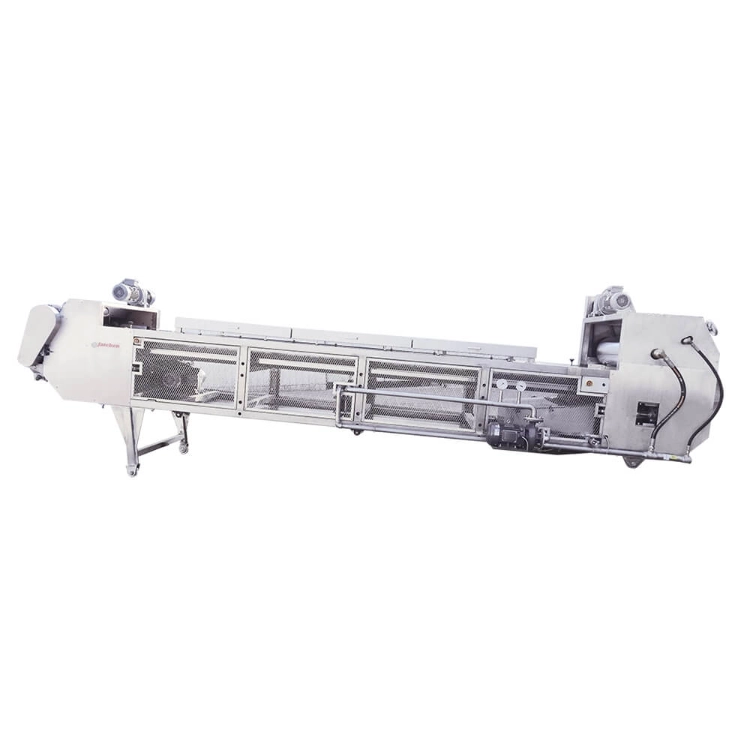
The GDJ water cooling belt uses cooling rollers, a stainless-steel conveyor, a crusher, and a cooling-water spraying system. It is designed to roll the extruded melt into a thin sheet, cool it, crush it into chips, and discharge the chips for grinding. This structure is a sensible choice when the upstream extruder and downstream grinding system are sized for a higher production rate.
Adjustable Sheet and Chip Control
The WATER COOLING BELT supports adjustable chip thickness and roller speed. A guide device helps reduce belt deformation, while the crusher can use finger-pin or tooth-type structures according to the selected configuration. These details matter when the grinding system needs a predictable feed instead of irregular large pieces.
img.WATER COOLING BELT.webp
A Complete Line Connection
The cooling belt should be discussed together with the TWIN SCREW EXTRUDER, grinder, sifter, and packing equipment. PLC/HMI control, low-shear extrusion, sealed leak-proof material transfer, automatic lifting in upstream mixing equipment, and low-dust collection all affect how cleanly the line works as one route. Jatchen’s water cooling belt page gives the product context for this selection.
When an Air Cooling Belt Is the Better Fit
Compact Small and Medium Lines
The YPJ air cooling belt is commonly considered for 100-500 kg/h small and medium lines. It uses air cooling, a stainless-steel slat chain, cooling rollers, a crusher, and a compact conveying route. This can be practical when floor space is limited or when adding a water circulation system would complicate the plant arrangement.
Plants Without Cooling-Water Conditions
An air cooling belt avoids the need to plan a cooling-water circulation route. That does not make every air system automatically suitable; the output, residence time, room temperature, and connection to extrusion still need to be reviewed. The air cooling belt conveyor guide provides a relevant reference for this layout concern.
Simpler Daily Operation Planning
Air cooling can make the utility side of the line easier to plan. Operators still need to inspect the belt, rolls, crusher, guide devices, safety switch, and optional air-conditioner fan. Automatic reverse control and error-prevention functions support a more repeatable routine, while a sealed material route and low-dust collection keep cleaning work manageable.
Compare the Two Options Before Ordering
Cooling Method and Process Stability
Do not compare air and water only by the word faster. Compare how each method will cool the sheet at your actual output, formula, belt speed, and available space. Stable cooling helps the crusher receive material with a more consistent condition, which then supports the grinding stage and particle-size control.
Maintenance and Cleaning Route
Ask where operators will clean the belt, rolls, crusher, and collection points. Also ask how water circulation components or air-side components will be inspected. A line with automatic timing and PLC/HMI controls still needs a clear maintenance routine. The best choice is the one your team can inspect and clean without disrupting the whole production route.
Downstream Grinding Capacity
Cooling capacity is only useful when the ACM GRINDING SYSTEM can process the chips at a matching rate. The ACM route combines grinding, air classifying, cyclone separating, sifting, and fine powder collection. Share the target output, particle-size requirement, and cooling method when discussing the complete line. The prior guide on stable D50 and D90 control is a useful related reference.
A Practical Selection Checklist
Prepare Five Numbers and Conditions
Before contacting a supplier, prepare the target kg/h, extruder model or output, available plant height, available floor length, and whether cooling-water circulation is possible. Add the required sheet or chip condition, cleaning frequency, and the planned grinding model. These details produce a better recommendation than simply asking for the largest cooling belt.
Plan Dust and Material Transfer Together
Cooling and crushing should connect to a low-dust collection plan. Upstream mixing equipment may use a sealed leak-proof structure and automatic lifting, while the grinding and packing areas need their own practical dust-removal arrangement. Review the Jatchen product range to see how cooling, extrusion, grinding, and auxiliary equipment can be matched.
Confirm Service Before the Layout Is Fixed
Send the formula type, output target, plant drawing, cooling-water conditions, and cleaning requirements to Jatchen before the model is finalized. Use Jatchen service for line planning and contact Jatchen for the specific water or air cooling belt discussion.
The better cooling belt is the one that matches your output and plant conditions. Choose a water cooling belt when higher-capacity production and cooling-water circulation are practical. Choose an air cooling belt when a compact 100-500 kg/h line or a simpler utility arrangement is the priority. Jatchen can match the selected belt with low-shear extrusion, PLC/HMI operation, sealed material transfer, automatic lifting upstream, and low-dust collection across the production route.
FAQ
How Do I Choose Between an Air Cooling Belt and a Water Cooling Belt?
Compare output, cooling-water availability, plant layout, sheet control, cleaning route, and the capacity of the downstream grinding system.
Which Cooling Belt Is Better for Higher Output?
A water cooling belt is generally the better starting point for higher-output production when the plant can provide cooling-water circulation conditions.
When Is an Air Cooling Belt Practical?
It is practical for many small and medium lines, especially when the plant has limited space or no suitable cooling-water arrangement.
Does the Cooling Belt Need to Match the Extruder?
Yes. The belt must accept the extruder discharge and pass cooled material to crushing and grinding without creating a line bottleneck.
What Should I Send Before Asking for a Cooling Belt Model?
Send the target output, extruder information, plant layout, cooling-water conditions, cleaning needs, and downstream grinding requirements.


