

How Does Classifier Speed Change Powder Coating Particle Size Distribution?
How Does Classifier Speed Change Powder Coating Particle Size Distribution?
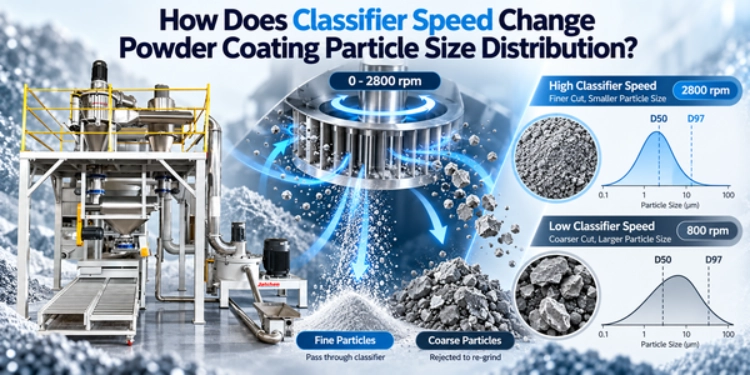
Ask a maintenance fitter where a stray defect comes from and the resin rarely gets the blame. It is the classifier wheel, still sitting at whatever rpm the commissioning crew left it on, sometimes three years back. Nothing has failed, so nobody argues, and the cut point walks away from the formula a few microns at a time until the sieve starts blinding every other shift. That is the setting classifier speed governs: the line between finished powder and another trip round the mill. Wind the wheel up and less material gets through, so the product sharpens. Ease it back and coarser grit rides out with D97 climbing behind it. A Jatchen ACM grinding system spans 0 to 2800 rpm, enough range for one frame to hold a fine decorative grade on Monday and a coarser functional coating on Thursday with no mechanical change.
The targets themselves get a proper treatment in this piece on stable D50 and D90 control, and it is worth reading before you touch the wheel.
What the Classifier Does Inside the Mill
Impact Grinding Comes First
The grinding chamber uses a straightforward impact-grinding mechanism. As the material passes the rotating disc, impact columns, and toothed ring, repeated impacts reduce the particle size. Flake drops in, a disc spins past impact columns and a toothed ring, and the material breaks wherever it gets caught. That is the entire mechanism, and it does most of the size reduction on its own. What matters in practice is access. The chamber opens in a couple of minutes and the wear parts are cheap slabs of hardened steel, because a mill that is awkward to strip down is a mill that runs with worn parts.
Air Classification Sorts the Result
The sorting happens overhead, and that is the part worth watching. Fragments get lifted toward the wheel and immediately face two opposing demands. Air wants to carry them through the blades. The wheel wants to throw them back down. Whichever side wins decides that particle’s fate, and wheel speed is the referee. Anyone who has seen a cyclone separator will recognise the principle, except here the cut moves with rpm rather than with the shape of the housing.
Speed and Air Flow Move Together
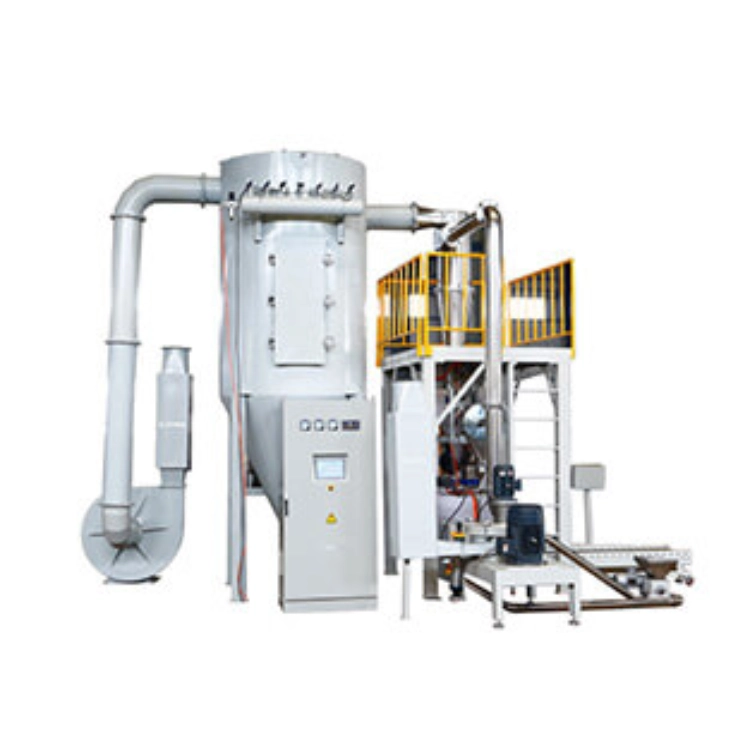
Air is the half of this that gets forgotten, and it does not announce itself. Push more volume through the chamber and material hits the blades harder, so the cut coarsens while the rpm display has not moved a digit. A Jatchen ACM30 pulls around 2500 m³/h, the little ACM04 closer to 350, and the two answer differently when you lean on the fan. Set the wheel, walk away, come back after lunch: the defect will be waiting, and the shift report will blame the resin again.
What Goes Wrong When the Speed Is Set Wrong
Too Fast, and the Mill Chokes on Recirculation
When the classifier wheel speed is set too high, coarse particles may repeatedly recirculate through the mill instead of exiting the system. This can reduce throughput even when the measured particle size distribution appears acceptable. Wheel too fast, coarse material never escapes, every particle takes extra hits, and throughput slides while the particle size report stays beautiful. The counter and the electricity bill tell the truth, which is that you are paying to grind the same powder twice. Filter bags load faster too, and the operator spends a week convinced the resin has gone off.
Too Slow, and Grits Escape
Ease the wheel back too far and the symptom moves off the report and onto the panel. Grit that should have gone round again lands in the bag, blinds the sieve, and turns up as specks in a cured film. Recipes do not fracture the same way, so the size band hitting the wheel shifts with every formulation change, and last quarter’s rpm quietly becomes this month’s reject. Nothing looks wrong on screen. That is what makes it expensive.
Recovery Falls When Fines Are Wasted
Fines are the most expensive dust in the plant, and nobody ever sends an invoice for them. Resin, pigment and additives, all paid for, all gone the moment they reach the collector. A loose cut leaks that material out of the loop continuously, and no single batch looks wrong while it happens. It surfaces at quarter end as a raw material figure nobody can explain. Tight classification on an ACM line gets 97 percent recovery or better, and the gap between that and ninety is usually one setting nobody has revisited.
How to Find the Right Speed for Each Recipe
Start From the Target Window
Write the target on the batch sheet before anyone walks up to the mill. For most coatings that means D97 between 40 and 100 microns, with D50 picked to match the film the customer is paying for. Then measure. A laser diffraction run takes five minutes and settles arguments that mill current never will.
Change One Thing at a Time
One knob at a time, then wait. Nudge the wheel, let the chamber settle, pull a sample, write it down. Move speed and airflow together and you have learned nothing except that something changed. The variable frequency drive on a Jatchen classifier motor makes small repeatable steps easy, which is worth more than a wide adjustment band.
Store the Recipe on the HMI
When a recipe finally behaves, save it. PLC and HMI control on a Jatchen grinding system stores the settings and recalls them with a tap, along with the error-prevention prompts that stop an operator loading the wrong numbers at startup. That is twenty minutes saved on a changeover, or two hours lost if you skip it.
When Classifier Speed Alone Is Not Enough
Add a Classifier Cyclone for PSD Optimization
Where people run out of road is the distribution curve itself. Move the wheel all you like and at some point the curve stops answering, because the mill loop has a floor of its own. That is the case for the classifier cyclone PSD optimization system. It strips ultra-fine content down to a minimum, keeps cutting accuracy adjustable and holds its settings under program control. Bolt one on and quality improves without losing throughput, with the fine fraction routed to the extruder instead of the waste bin. The return loop gets its own treatment in this article on cutting excess fine powder after grinding.
Match the Mill Size to the Throughput
No amount of tuning saves a mill that is sized wrong. Run a frame well past its rating and there is no headroom left. Run one that is oversized and it idles all week. Jatchen covers the spread with the ACM04 at 15 kg/h through the ACM50 at 1000 kg/h, each with airflow and motor power to match, so the classifier fine-tunes a sound process instead of papering over a bad match. Size it against the twin screw extruder upstream and you are most of the way there.
Keep the Loop Sealed and Low-Dust
Powder finds gaps. Sealed housings, negative-pressure extraction and enclosed conveying keep it inside the loop, which is good for recovery and better for the people working nearby. Upstream, a low-shear extruder delivers even flake and an automatic container mixer with auto lifting swaps premix without anyone hauling bags. One loose joint undoes the lot.
Conclusion
Yantai Jatchen Powder Coating Processing Equipment Co., Ltd. builds powder coating production equipment and the lines around it: mixing, extrusion, cooling, grinding, packing. The company manufactures its own ACM grinding systems, twin screw extruders, cooling belts and bonding mixers, and lays out lean lines around whatever tonnage a plant is chasing. PLC and HMI control with recipe storage, low-shear screws, sealed housings, fast-clean structures. Different features, same purpose, which is a line that holds the numbers it was bought for.
Service and spare parts support runs for the life of the line, commissioning included. Want a grinding system sized to your output, or a particle size window reviewed by someone who has set up these mills before? Contact the Jatchen team through the official website.
FAQ
Q1: What classifier speed should I use for a standard epoxy powder?
No such figure. Standard grades sit mid-range between 0 and 2800 rpm, and airflow, resin and target D97 decide the rest.
Q2: Does raising classifier speed reduce output?
Usually. Finer cut, more regrinding, less output. Worth measuring before you commit.
Q3: How often should I verify particle size during production?
Every recipe start, and any time resin, filler or airflow changes.
Q4: Can one mill handle both fine and coarse grades?
Yes, since speed and airflow both move. Store each recipe and changeover stays short.
Q5: What does the classifier cyclone optimization system add?
Fewer ultra-fines, tighter distribution, fines back to the extruder instead of the bin.


