

Bonded vs Dry-Blended Metallic Powder Coatings: What Is the Production Difference?
Bonded vs Dry-Blended Metallic Powder Coatings: What Is the Production Difference?
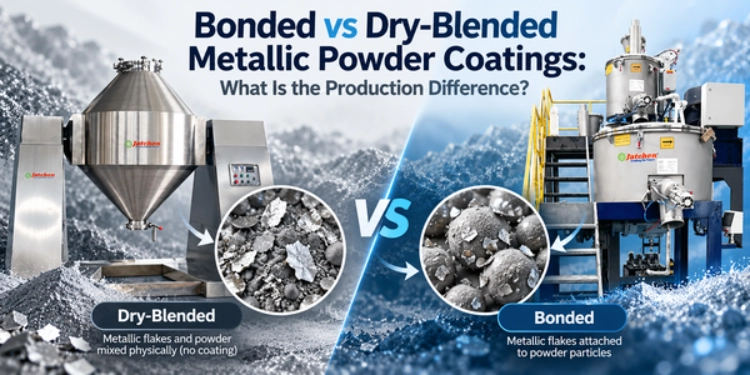
Many metallic coating defects can be traced back to the mixing stage, well before they become visible on the finished panel. Two routes put aluminium into powder and they are not the same animal. Dry blending drops flake in and leaves it there. Bonding softens the particle surface inside a bonding mixer until the flake beds into it, then cools the batch so nothing can drift. Identical feedstock, different physics, and the bill lands on the reclaim report long before it lands in an email.
How Dry-Blended Metallic Powder Is Made
A Straightforward Physical Blend
Dry blending is a common starting point for metallic powder coatings and remains a practical choice for many applications. Flake goes into the vessel with base powder, the blender turns, and by lunchtime there is metallic product to pack. No heat, and nothing to qualify before the first order ships. It is also the first thing plants outgrow, and the trigger is usually the second shade complaint rather than a spec sheet.
Why Shear Level Decides Flake Survival
Flake is thin, fragile, and usually the single most expensive line on the batch sheet, so a mixer that hammers it turns bright metallic into grey. A twin cone blender rolls the load over instead of beating it. Jatchen builds the container in stainless with a polished wall, which is what saves you the day a white batch follows a metallic one, and seals the discharge with a butterfly valve so the dust stays where it belongs.
The Trade-Offs of Dry Blending
Loose flake puts a ceiling on loading. Push metal content and flow suffers, charging goes patchy, and two panels off the same batch come out looking like cousins. Drift is the other tax: same recipe, different result, because the flake settled differently in the bag on the way to the hopper.
Short runs of ordinary metallics? Fine. Premium finishes? This is where accounts quietly change hands.
How Bonded Metallic Powder Is Made
Warming the Base Powder Into the Bonding Window
Bonding lives on heat, and the window is narrower than the brochure suggests. Base powder comes up in the jacketed vessel until the resin surface turns tacky enough to hold flake without slumping. Go past it and the batch is scrap, because over-bonded powder does not come back. For this reason, monitoring the actual powder condition is more reliable than relying on processing time alone. Resin behavior varies with temperature and formulation, so process parameters should be adjusted according to the material’s response.
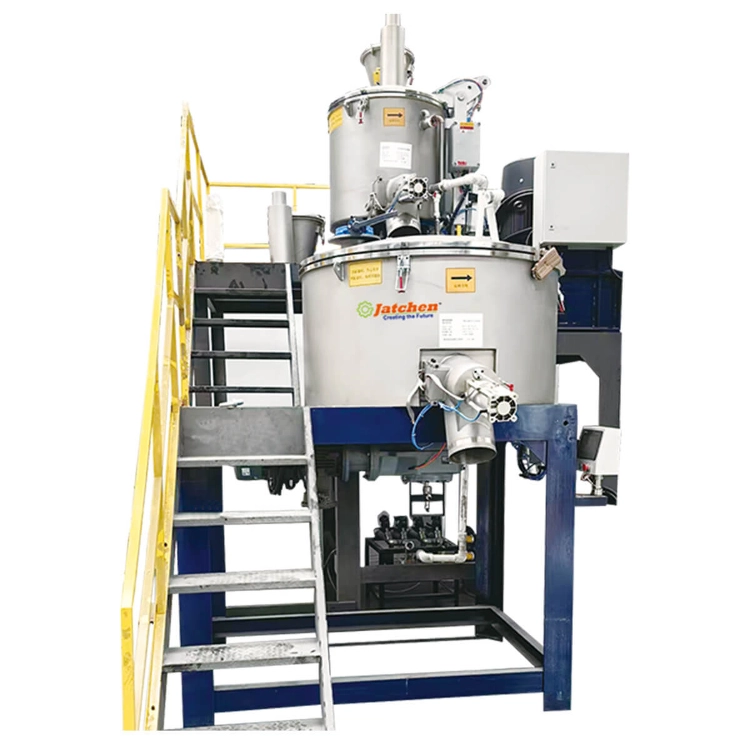
Jatchen BD vessels come with hot and cold water jackets as standard, so the same machine takes the batch up and brings it back down.
Flakes Anchor to the Particle Surface
A propeller blade turns at set speed and folds flake into the softened surface. The flake beds in, the batch cools, and now the effect belongs to each particle instead of floating loose around the batch. Temperature, time and blade speed sit in a PLC and HMI recipe, which is how batch forty ends up looking like batch three.
Cooling Down and Finishing
Cooling is where careful work gets thrown away. Bring the batch down too slowly and flake smears across the surface; rush it and particles stick together in lumps you cannot screen out. Bigger Jatchen frames pair a hot vessel with a cold one, the BD200/CM800 holding 200 L hot and 800 L cold on a single base, and the discharge valve works automatically so nobody reaches into a live vessel. Past that point it conveys and sieves like any other powder, which is half the reason reclaim behaves.
What the Difference Means for Your Product
Appearance and Batch Consistency
Bonded powder holds one flake angle per particle, so shade stays put across batches and through reclaim. Dry-blended powder can look right in the box and wrong on the part, because flake shifts at every jolt between blender and gun. Put two panels side by side and the argument ends there.
Charging and Film Build
Free flake interferes with charging and keeps drifting while the film forms, so metallic alignment varies from one corner of a part to the next. Bonded powder charges much like plain base, since the gun only sees particle surface and no loose metal. That is what the bonding cycle is built around: fluidity and chargeability that do not move, from the first part of a run to the last.
Cost, Speed and Changeover
On price and speed, dry blending wins outright. No temperature control, quick turnaround, easy sampling. Bonding costs energy and hours, and what it buys back is the aluminium you already paid for, an argument that gets louder as loading rises. This comparison of types of metal powder coatings sorts which grades justify which route.
Most plants run both in the end. Dry blend for the workhorse colours, bond for the shades that sell the job.
Choosing Equipment for Each Route
Sizing a Bonding Mixer
The range runs from the BD04 at 1.5 kg per batch, enough for a lab to argue with, up to the BD500/CM1200 at 200 kg per batch and 500 to 600 kg per hour. Power, volume and jacket design scale with batch size, so the bonding window stays workable whether you are running a trial or three shifts. The vessel design gets more attention in this piece on how a bonding machine works.
Pairing the Mixer With the Rest of the Line
Metallic runs change over constantly, so feeding the line matters as much as mixing. An automatic container mixer with auto lifting shuttles premix and bonded batches on trolleys, with no open container crossing the floor. Sealed transfer from mixer to sieve to packing keeps the fine metallic fraction in the product, where it earns money.
Safety Features With Aluminum Powder
Aluminium deserves respect. Jatchen bonding mixers carry a gas checking and control safety device, anti-explosion protection on the mixing container, and an optional nitrogen generator that pulls oxygen down during hot mixing, with automatic discharge so nobody opens a live vessel.
Omitting gas monitoring to reduce initial equipment costs can introduce significant safety risks during aluminum powder processing. Appropriate gas detection, process control, and explosion protection should be considered essential elements of a suitable safety strategy.
Conclusion
Yantai Jatchen Powder Coating Processing Equipment Co., Ltd. builds powder coating production equipment and the lines around it: mixing, extrusion, cooling, grinding, packing. Bonding mixers, container mixers, twin cone blenders, twin screw extruders and ACM grinding systems, all made in-house, with lean lines laid out around a plant’s tonnage. PLC and HMI control with recipe storage, low-shear mixing that leaves flake intact, sealed housings, fast-clean structures.
Service and spare parts support runs for the life of the line, commissioning included. Not sure which route suits your metallic range, or need a mixer sized to your batch volume? Contact the Jatchen team through the official website.
FAQ
Q1: Can bonded metallic powder be made on a standard mixer?
No. Bonding needs a jacketed vessel that holds temperature and a cooling stage to match, and a standard blender offers neither. Flake has nothing to anchor to, and the batch can clump.
Q2: Why does dry-blended metallic powder change shade between batches?
Free flake spreads by chance during blending, then moves again in handling and charging. Tiny differences in spacing read as shade drift, whatever the recipe says.
Q3: Is bonding safe with aluminum powder?
With the right equipment, yes. Gas checking and control, anti-explosion protection on the mixing container, and an optional nitrogen generator that lowers oxygen during hot mixing are all part of the package.
Q4: What batch sizes does a bonding mixer handle?
1.5 kg per batch on the BD04, 200 kg per batch on the BD500/CM1200, and everything between for lab work through production.
Q5: Does bonding affect powder recovery or reuse?
It reclaims better. Flake stays attached through charging and recovery, so recycled powder keeps its look instead of drifting.


