

How Texture, Matte and Structured Powder Coatings Are Made: The Equipment That Decides the Finish
How Texture Matte and Structured Powder Coatings Are Made The Equipment That Decides the Finish
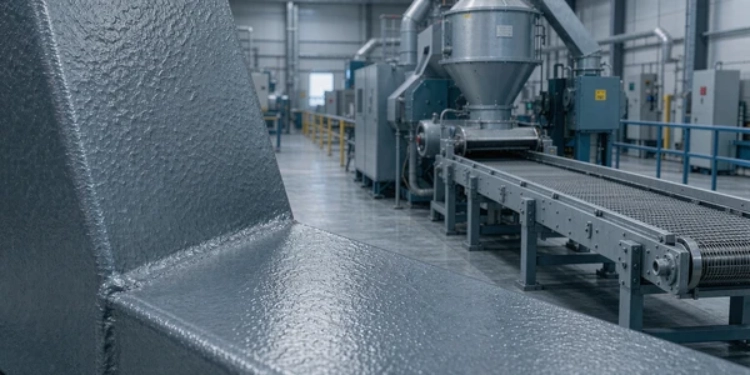
Three routes make a texture, a matte or a structured finish. The cheap one is a coarse grind, where granules melt late and stand proud of the film. The deliberate one needs a solid additive that refuses to melt. The third bonds metal flake into the particle. Pick the route and the equipment follows: wheel position, barrel temperature, mixer type. Get one of those wrong and the finish that shipped in March is gone by June.
Texture is not an ingredient. It is a structure that has to survive four machines, all of them built to flatten it.
| Route | How the pattern is made | What breaks it | What holds it |
| Coarse cut | Coarse granules melt late and sit proud of the film | Forty rpm of wheel drift after approval | ACM grinding system, 0 to 2800 rpm across 10 to 100 μm |
| Solid additive | Wax or filler stays discrete through the barrel | A barrel twenty degrees hot | Zone discipline on the extruder; gentle premix in a twin cone blender |
| Bonded metal | Flake pressed into tacky particles, then chilled | Dry-blend migration through box and gun | Bonding mixer with hot and cold jackets |
Three Routes to a Raised Surface
Coarse Particles, Visible Pattern
Accidental texture costs almost nothing. A coarse cut leaves granules that melt late, and there they sit, standing up in the film. All you paid for was a wheel position. Nobody bought an additive. Somebody moved the classifier. Then ownership arrives. Approve that panel once and the mill owns the appearance, and forty rpm takes the approval back.
Additives That Stay Solid
Texture on purpose needs an ingredient that will not melt. Wax, usually. Now and then a filler, or a resin that will not blend with the rest. It works while it stays discrete, and nothing announces the day it stops being discrete. Push the barrel twenty degrees hot and the wax is gone. The bag reads the same. The dose reads the same. The batch sheet reads exactly what it read in the trial.
Matte Is Not Texture
Matte arrives on the same order form, so most plants handle the two as one problem. They are not one problem. A matting agent roughens the film so the surface scatters light instead of bouncing it back, and dispersion matters here more than dose. Over-disperse and gloss lands under target. Under-disperse and panels leave with specks. One plant changed supplier twice while the fault sat in the classifier. The second supplier was fine. So, probably, was the first.
The Barrel Is Where Texture Goes to Die
A Few Degrees Is a Different Product
Two degrees either way, says the datasheet, and on an effect formula that is the whole margin. Four degrees hot and the additive dissolves without a sound, the pattern flattens, and every incoming test still passes. Run it cold and the resin never melts out. The texture then ships with adhesion trouble stapled to it. Open either box and the powder looks right.
Screws Do Damage Nobody Watches
Kneading blocks exist to disperse. On a texturing agent that is the wrong job. Fit a screw set built for a stubborn pigment and it works the additive until it dissolves. Nobody connects a flat panel in July to a screw fitted in February. The swap is easy, at least. Barrels split, liners lift, screws come out clean. A Tuesday morning, not a shutdown.
Starving the Screw Backfires
Starving the feeder to keep the melt cool is the other favourite trick. It backfires. Half-empty flights stretch residence time, the additive collects more heat, and the operator reports the opposite of what happened. Fill the screw. Hold the zones.
Cooling and Cutting
Cold Enough to Break, Not to Shatter
Warm sheet into the crusher and the pattern smears. Too cold and you make the fines that close it up later. A GDJ water cooling belt holds thickness to ±0.1 mm. It pulls heat through the steel rather than off the top, which is as close to a repeatable cooling curve as 900 kg/h allows.
A Coarse Cut, Held Steady
Gloss runs fine. Effect grades run coarse, and the grind has to hold them there. On a Jatchen ACM grinding system the wheel sweeps from 0 to 2800 rpm, and the working band sits near 10 to 100 μm. Finding your setting takes an afternoon. Holding it is the job. Let the wheel wander a hundred rpm and the pattern looks handmade in the worst sense of the word.
Fines Are the Quiet Killer
Fines fill the valleys between coarse particles. Enough of them and texture reads as orange peel. A classifier cyclone strips the sub-10 μm fraction and pulls span to 1.3 to 1.6, where conventional grinding sits at 1.8 to 2.0. Span is the width of the distribution: (D90 minus D10) divided by D50. That gap separates a pattern you can read at arm’s length from one that reads as a defect.
Quote the cyclone when texture runs every week. A job shop taking one texture order a quarter gets most of the way with a well-set wheel, a sieve check and a log sheet. Buy it when the orders repeat, not when they visit.
Dry Blend, or Bonded
Rolling Beats Stirring for Flake
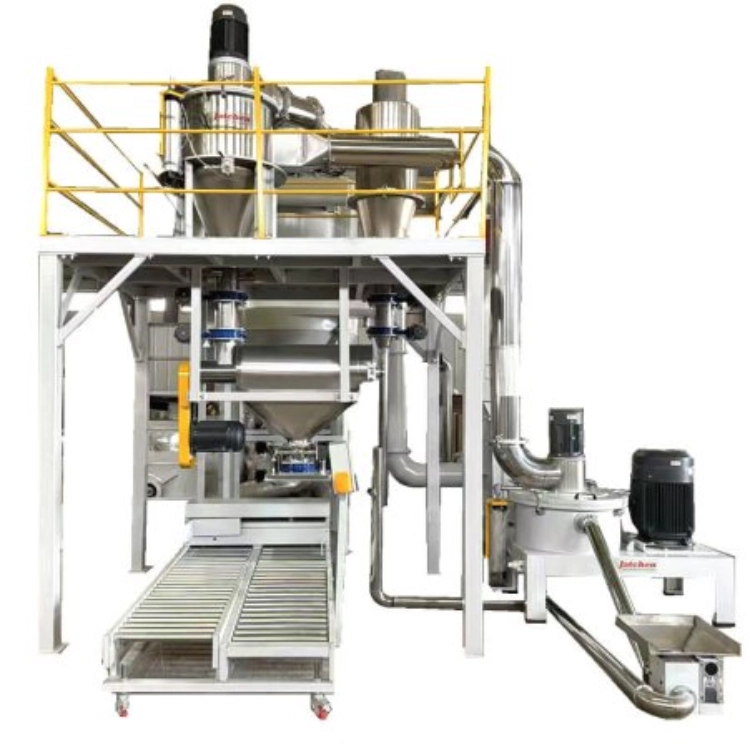
Six to nine rpm, no blades in the load. A twin cone blender keeps flake whole, and the polished wall keeps the next batch white. SHJ300 moves 50 kg/h, SHJ2000 up to 1000. Soft wax belongs here, not under a high speed head, if the pattern is to survive the premix.
Shear for the Lumpy Ones
Some additives arrive in agglomerates, weak clumps a gentle blend will not break. They sail through and come back as specks on a panel. A high speed mixer breaks them in 3 to 5 minutes, 150 to 1000 kg/h depending on frame. Stop on time. Run it long and the batch warms, and a warm matting agent is not the one you tested.
Bonding for Metal Plus Texture
‘Bond it or do not quote it,’ one formulator said. She had the returns to prove it. Free flake migrates through the box, the hopper and the gun, so pattern and metal effect leave together and the customer blames the texture. Bonding puts flake inside the particle instead. The bonding mixer warms the base powder until the surface turns tacky, works the flake in, then cools the batch so it stays put. 1.5 L on the BD04. 200 kg a batch on the BD500/CM1200, hot and cold jackets on one frame. The metal pigment adhesion piece and the metal powder types guide cover the rest.
Conclusion
Three tonnes is an expensive way to learn a barrel ran four degrees hot. A screw drawing and an afternoon of trials would have cost less, and both were available. Yantai Jatchen Powder Coating Processing Equipment Co., Ltd. builds the extruder, the belt and the ACM grinding system those variables live in. One supplier to argue with instead of three.
Tell the team the finish you have to hold, the batch size you run, the temperature on the panel. Contact through the official website.
FAQ
Q1: Can texture be made on a standard powder coating line?
A1: Yes. The line does not have to be special. The cut point does. So does writing the barrel temperature on the batch sheet, every time.
Q2: Why does texture fade between batches?
A2: Nine times in ten the barrel ran hotter than the trial. The tenth time it is fines under ten microns filling the gaps between coarse particles. Temperature first. Classifier second.
Q3: Does a coarser grind give a stronger texture?
A3: A coarser pattern, yes. Stronger, not necessarily. A wide distribution ships coarse panels and smooth panels off the same pallet.
Q4: Can metallics be textured?
A4: Yes, bonded. Dry-blended flake migrates, so the pattern and the metal effect leave together.
Q5: Which cooling belt suits effect powders?
A5: Water, for a thin sheet or high tonnage. Air at moderate output, and a good deal less plumbing to look after.


