

How to Specify a Powder Coating Cooling Belt Before Purchase: GDJ vs YPJ Models
How to Specify a Powder Coating Cooling Belt Before Purchase: GDJ vs YPJ Models
Even though a cooling belt has got the correct nominal capacity for a powder coating production line, it does not necessarily have to be the right choice for this line. Often it is a question of too short cooling time, wrong utility connection, too small floor space or feeding the chips not properly into the grinder.
A specification prior to purchasing of equipment needs to describe the connection between production and article formation, cooling, dimensions of the machine and the needs of subsequent equipment. Yantai Jatchen Powder Coating Processing Equipment Co., Ltd. offers GDJ water cooling belts and YPJ cooling belt configurations for different production conditions.
Accurate cooling belt selection requires defined operating specifications, measurable performance requirements, and clear acceptance criteria before equipment delivery.
What Should a Cooling Belt Purchase Specification Include?
Define Continuous Production Output
The first key figure to establish for continuous production is the required continuous throughput in kg/h. This figure should reflect the normal production output of the production line on a continuous basis and not the peak short-term output from a trial.
A production line which is supposed to produce 500 kg/h of solid article continuously does not automatically select a cooling belt of 500 kg/h capacity. The suitability of a machine for cooling solid articles also depends on sheet thickness, temperature of the material to be cooled, on cooling possibilities and on the composition of the article to be produced.
Capacity must be checked against the operational characteristics of the chosen twin screw extruder. Details required are: model of extruder; normal discharge rate; operating temperature; No. of different powder coating formulas to be produced.
Specify the Required Sheet Condition
In the powder coating cooling process the material, after it has been poured onto the cooling belt, is formed into a sheet and then crushed. The thickness of the sheet depends on the material to be processed and the relevant machine setting and is typically between 1 mm and 2 mm.
The purchase specification for the sheeting should detail the thickness required, the tolerance for this, and the condition of the material when it is delivered to the crusher inlet.
A sheet that remains soft can adhere to the conveying surface or form irregular break pieces. Sections that are excessively thick may require longer cooling times than thinner sections.
Instead of relying on the machine’s rated output, ask for a demonstration of making a sheet from the intended formula at the intended production rate.
Define the Crusher Discharge Requirement
Material does not cool off when it leaves the conveyor. It will go through the crusher and need to reach the subsequent processing stages in good condition.
The specifications for your chip, crusher and discharge should be detailed in the specification.
For a production line connected to an ACM GRINDING SYSTEM check whether the crusher is able to supply continuously sufficient quantities of material, without stockpiling, oversized pieces or sticky material.
GDJ vs YPJ: Which Model Specifications Matter?
Compare Published Capacity and Physical Dimensions
Jatchen’s GDJ and YPJ cooling belt series offer different production capacities and conveyor dimensions. Comparing belt width and length helps identify suitable models, while cooling performance and utility requirements determine their compatibility with the production line.
| Model | Output (kg/h) | Belt Width (mm) | Belt Length (mm) |
| GDJ406 | 200–400 | 600 | 4,000 |
| GDJ410 | 400–500 | 1,000 | 4,000 |
| GDJ510 | 500–700 | 1,000 | 5,000 |
| GDJ612 | 700–900 | 1,200 | 6,000 |
| GDJ712 | 900–1,200 | 1,200 | 7,000 |
| YPJ406 | 100–300 | 600 | 3,500 |
| YPJ508 | 300–500 | 800 | 4,500 |
| YPJ510 | 500–800 | 1,000 | 4,500 |
| YPJ612 | 800–1,000 | 1,200 | 5,500 |
These values are published model specifications and do not guarantee the performance of every single powder coating formulation.
Confirm the Actual Cooling Configuration
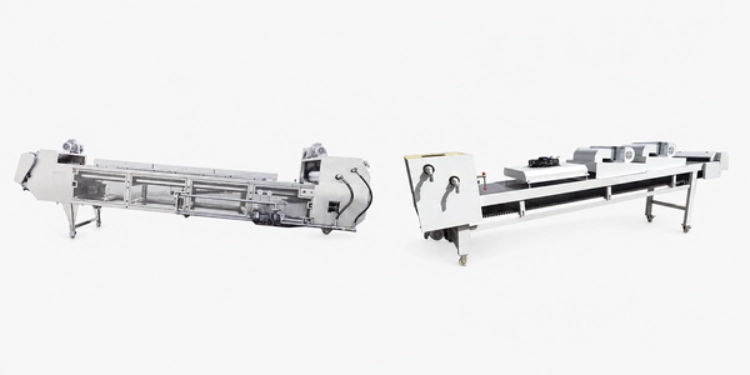
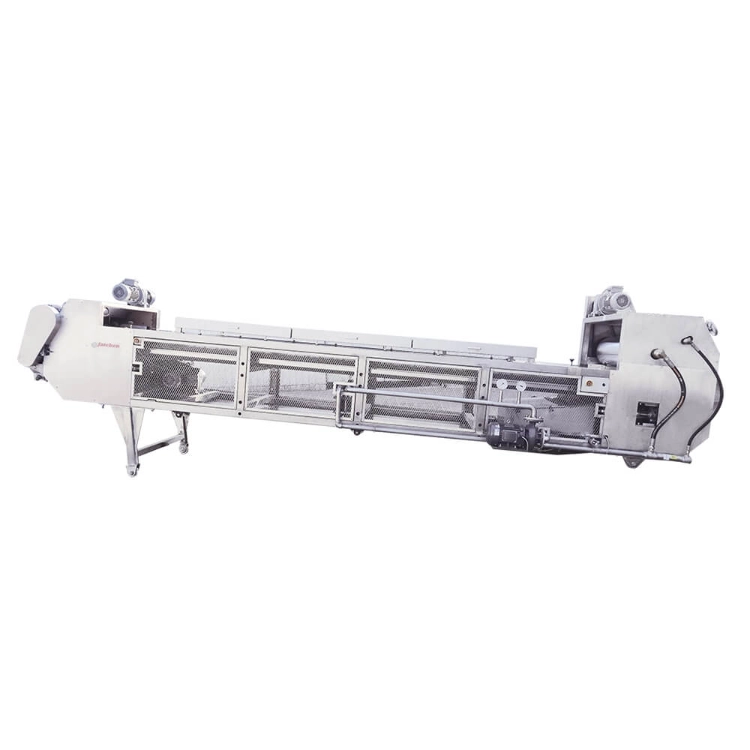
The GDJ WATER COOLING BELT comprises of cooling rollers, stainless-steel conveyor, steel crusher and cooling-water spraying system. The system requires suitable circulating-water conditions.
YPJ AIR COOLING BELT uses cooling-sheeting rollers, a stainless-steel slat-chain conveyor and a crusher. Please refer to published YPJ model specifications for details on possible Water/Air Cooling configurations and corresponding utility requirements for the equipment in question.
For a plant without a cooling water system confirm whether YPJ proposed can run with existing air coolers and whether any water connection is required.
Check Machine Dimensions Separately
The length of the belt does not necessarily correspond with the overall dimensions of the machine. Please check the complete machine footprint against the workshop drawing.
For instance, the published machine dimensions for the GDJ510 are approximately 5,000 mm x 1,100 mm x 1,900 mm while those for the YPJ510 are approximately 5,000 mm x 1,490 mm x 1,450 mm.
Machine selection must account for the complete equipment footprint, installation orientation, and maintenance access rather than conveyor length alone.
How Should You Evaluate 300, 500, and 900 kg/h Production Requirements?
Example 1: A 300 kg/h Production Line
For an operation at 300 kg/h several options are available.
YPJ406 has an output range of 100–300 kg/h, and thus is at the upper end of the required output. YPJ508 has an output range of 300–500 kg/h, while GDJ406 has an output range of 200–400 kg/h.
Can one keep to the intended formula and cool this consistently at 300 kg/h in one’s own workshop?
Also compare available capacity margin, required cooling, dimensions of equipment and chip condition before selecting a model if production is running continuously at this rate.
Example 2: A 500 kg/h Production Line
For a production of 500 kg/h, the upper limits of the published capacity of YPJ508 and GDJ410 are reached.
Other suitable machines are YPJ510 and GDJ510. Their rated capacity is 500–800 kg/h and 500–700 kg/h respectively.
The choice of chiller must take into account the cooling method available at the plant, the finish required on the sheets and whether the machine is expected to run a variety of different formulas.
A higher published production does not automatically mean the best model for purchase. It must also fit the available space in the factory and provide sufficient cooling and crushing performance for the selected operation.
Example 3: A 900 kg/h Production Line
Operating at 900 kg/h means that the cooling system must handle a large amount of continuous material.
Capacity of the GDJ612 is 700–900 kg/h, of the GDJ712 – 900–1,200 kg/h. YPJ612 is rated for 800–1,000 kg/h.
Published capacity ranges help identify suitable cooling belt models, but actual performance must be verified under the intended powder coating formulation and operating conditions.
For water-cooled plant obtain cooling water temperature, circulation flow and associated utility conditions as proposed. Verify the proposed air-cooling method can deliver the required heat transfer at the proposed continuous rate.
It would be better to test the production rather than rely on the nominal capacity.
Which Utility and Installation Details Should Be Confirmed?
Cooling-Water Requirements
A suitable water circulation unit and water connections have to be provided by the factory for a water cooling belt.
Please note the supplier’s requirements for inlet-water temperature, circulation flow, operating pressure, pipe connections, and cooling equipment if any.
The necessary conditions will depend on the required production and the chosen machine and should be specified prior to the design of the workshop utility layout.
Operating stably is important. Fluctuations in cooling are reflected in the conditions of the sheet going into the crusher.
Air-Cooling Requirements
The air-cooled configuration has to operate in a defined environment as well.
Supplier should confirm the cooling equipment, airflow, workshop conditions and any additional utilities required.
In this case, the ambient temperature is of particular interest since the air-cooling system has to remove heat from the material and has to be suitable for the material’s state.
The test conditions need to reflect normal conditions found in a factory, rather than results which could be expected throughout the year.
Machine Access and Factory Layout
A complete installation drawing needs to show the extruder outlet, cooling rollers, conveyor, crusher discharge and the downstream material collection route.
Jatchen’s general production-line guidance indicates a minimum planning height of the plants of about 4.5 m. For the grinding area 5 m are recommended. The real requirements for installation depend on the chosen equipment arrangement.
The drawing should also detail cleaning access, space for removal of equipment, electrical connections and safe routes for maintenance.
What Should Be Checked During Factory Acceptance Testing?
Verify Stable Operation at the Required Output
Agree test conditions with supplier prior to delivery of test equipment.
A representative test run should be fully documented with formula used, material feed rates, roller settings, belt speed, cooling used and actual output produced.
Acceptance target has to be the agreed production target under agreed operating conditions and not simply that the conveyor is running at maximum speed.
Inspect Sheet Formation and Material Release
Inspect the material at several points along the process during the test.
The formed sheet should have an adequate thickness and should not stick excessively to the conveyor belt.
Always check the sheet before crushing it, especially when producing temperature sensitive formulas or formulas that in the past were difficult to cool.
The actual acceptance limits should be defined by the formula and the subsequent process steps.
Check Crusher Performance and Material Transfer
The crusher must be able to process the cooled sheet without the risk of blocking or excessive material accumulation at the crusher discharge.
Check whether the chips will be suitable for your planned transfer and grinding equipment.
If purchasing as part of a complete production line, then the test requirements should be coordinated with the downstream grinding system.
A stable cooling belt output does not by itself guarantee the final D50 or D90 of the powder. Those results also depend on grinding and classification settings.
Confirm Cleaning and Safety Functions
Acceptance must also include a demonstration of the cleaning access around all rollers, belts or chains, guides and crusher.
Also check if the safety switches, emergency stops etc. are functioning correctly as well as all error-prevention devices.
List all equipment drawings, operating instructions, electrical documentation, maintenance information and specified utility settings to be handed over in the final handover.
What Information Should Be Included in a Cooling Belt RFQ?
A request for quotation should provide enough information for the supplier to select a configuration rather than simply quote a machine with a similar rated output.
| Required Information | What to Provide |
| Target capacity | Continuous production target in kg/h |
| Extruder information | Model, output, discharge arrangement |
| Powder coating formula | Material type and relevant processing conditions |
| Sheet requirement | Target thickness and required condition before crushing |
| Cooling utilities | Available water circulation, air-cooling conditions, and plant utilities |
| Workshop layout | Available floor space, height, and access restrictions |
| Downstream equipment | Crusher discharge arrangement and downstream grinding-system requirements |
| Testing requirements | Agreed formulation, operating rate, and acceptance criteria |
Clearly defined production targets, utility conditions, and acceptance criteria help suppliers prepare accurate quotations and establish realistic delivery requirements.
For new plant installations as well as modifications to existing equipment, the service team of Jatchen reviews the production requirements and the corresponding workshop drawings within the scope of the planning of the required equipment.
Final Selection: Verify the Operating Conditions Before Ordering
Choosing between our cooling belts made by GDJ and YPJ needs more than just a comparison of water cooling vs. air cooling.
The final specification should outline the required continuous capacity, sheet condition, cooling utilities, machine dimensions, crusher discharge etc. with associated acceptance criteria.
A model towards the upper end of the published parameters for a given model needs to be tested to establish that it can make the required product at the required production rate.
Jatchen supplies cooling equipment for powder coating production. We can check your proposed model against the upstream extruder and downstream grinding arrangement. For information on a specific GDJ or YPJ model please contact Jatchen with the required output, the relevant formulation information and the utility being used, plus a copy of the relevant factory drawing.
FAQ
Q1: Is the Published Cooling Belt Capacity a Guaranteed Continuous Output?
A1: No. While the published capacity data can be used for model selection, the actual capacity must be verified under the specific formulation, cooling conditions, sheet thickness and operating conditions for which the machinery is intended to be used.
Q2: Can a 500 kg/h Line Use a Cooling Belt Rated Up to 500 kg/h?
A2: Yes, it may be possible but at the upper end of the planned output. Compare other models with higher rated capacity. Test in production with a representative test piece.
Q3: Does Every YPJ Cooling Belt Require Only Air Cooling?
A3: Not necessarily. Published YPJ specifications include Water/Air Cooling configurations. Confirm the exact cooling arrangement and required utility connections for the selected machine.
Q4: Are Belt Width and Belt Length Enough to Select a Model?
A4: No. This details the physical size of the plant but there are many other specifications that need to be detailed such as continuous throughput, cooling, roller adjustment, crusher discharge etc. plus the plant’s utilities.
Q5: What Should Be Tested Before Accepting a Cooling Belt?
A5. Verify operation at designated production, sheet formation and release, cooling, chip discharge, cleaning and safety functions. Record test data for subsequent verification of accepted equipment.


