

How Do You Add a Cooling Belt to an Existing Powder Coating Production Line?
How Do You Add a Cooling Belt to an Existing Powder Coating Production Line?
Are you replacing a cooling unit without rebuilding the entire powder coating line? Adding a cooling belt to an existing route requires more than checking the belt width. You need to match the extruder discharge, sheet and chip condition, cooling method, crusher, grinding capacity, dust collection, plant space, and maintenance access. A mismatch can move the bottleneck from cooling to grinding or create difficult material transfer.
Yantai Jatchen Powder Coating Processing Equipment Co., Ltd. offers water and air cooling belt options for powder coating production. The right retrofit starts with the existing process record and a layout review, then selects the belt that can connect to the current extruder and downstream equipment.
Audit the Existing Line Before Selecting the Belt
Record the Extruder Discharge
Measure the current extruder output, discharge width, sheet behavior, and operating rhythm. The cooling belt must accept the continuous melt without creating overflow or a long waiting section. Also record the TSK model, die-head arrangement, feeding method, and control signals if a new belt needs to connect with existing PLC/HMI operation.
Check the Current Grinding Capacity
A new cooling belt may produce chips faster than the existing mill can process them. Compare the belt output with the ACM GRINDING SYSTEM, sifter, dust collection, and packing rate. If grinding is already close to its limit, plan the retrofit around the whole route instead of treating the cooling belt as an isolated replacement.
Map Space and Material Movement
Draw the route from the extruder die head to the belt, crusher, temporary transfer, grinding, collection, and packing. Mark operator access, cleaning movement, dust-removal points, and maintenance openings. The previous guide on cooling flow from extrusion to grinding is a useful reference for this connection problem.
Choose Air Cooling or Water Cooling
Water Cooling for Higher Output Conditions
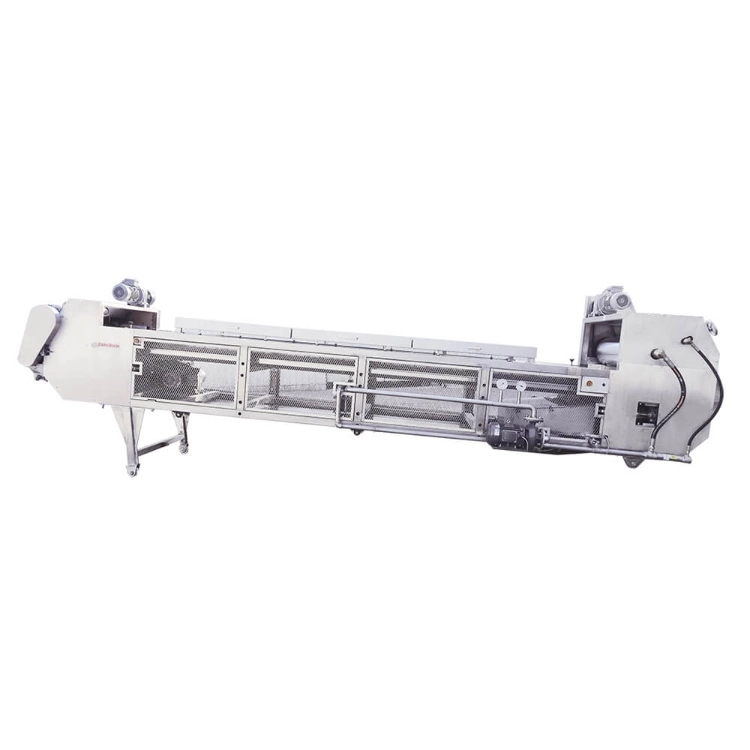
The GDJ water cooling belt uses cooling rollers, a stainless-steel conveyor, a crusher, and a cooling-water spraying system. It is commonly considered for higher-output lines when cooling-water circulation conditions are available. The system can support sheet-thickness and roller-speed adjustment, which should be compared with the existing crusher and mill feed requirement.
Air Cooling for Compact Retrofits
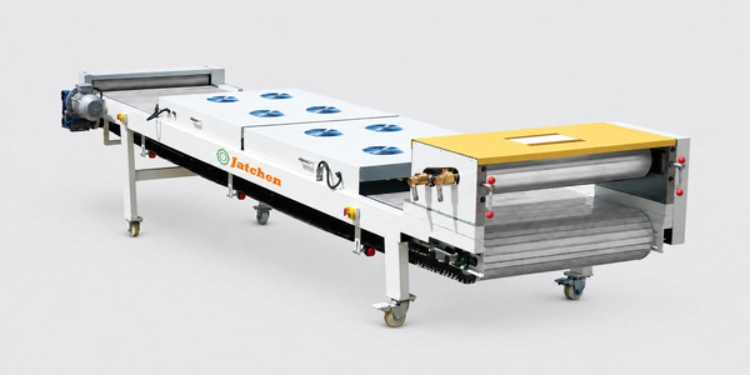
The YPJ air cooling belt uses air cooling, a stainless-steel slat chain, cooling rollers, and a crusher. It can be practical for small and medium lines or plants where a cooling-water route is not available. Review the air cooling belt when the retrofit must fit a compact layout.
Do Not Decide From Utility Preference Alone
The cooling method should also match output, formula, sheet condition, crusher arrangement, maintenance, and downstream grinding. The water cooling belt may suit a higher-capacity route, but only when the plant can support its circulation conditions and the rest of the line can accept the output.
Check Retrofit Compatibility Point by Point
Mechanical Connection
Confirm the die-head height, belt entrance, roll position, discharge direction, crusher connection, and support structure. A small change in height can affect the material transfer route. Leave access for inspection and cleaning rather than filling every available gap with structure.
Control and Safety Connection
Discuss whether the new belt should operate independently or communicate with the existing line PLC/HMI. Confirm stop sequence, speed adjustment, safety switch, automatic reverse control where applicable, and error-prevention logic. Keep unsupported alarm or diagnosis claims out of the specification; define the actual control points clearly.
Dust and Housekeeping Connection
Cooling and crushing can release powder around transfer points. A sealed leak-proof upstream route, automatic lifting for container handling, and low-dust collection around grinding and packing can make the retrofit easier to maintain. Plan independent dust removal where the current workshop arrangement requires it.
Protect the Existing Grinding and Packing Route
Keep Chip Size Suitable for Grinding
The belt and crusher should produce a feed that the existing mill can accept. If the chip is too thick, too irregular, or too wet from an unsuitable water arrangement, the grinder may become unstable. Define the desired chip condition with the grinding operator before finalizing the belt.
Match Collection and Sifting
The particle-size control guide shows why cooling, grinding, classification, and sifting cannot be separated in practice. A retrofit should confirm the cyclone, sifter, fine powder collection, and transfer pipe. If the existing collection route is undersized, belt replacement alone will not solve the production problem.
Plan Formula and Color Changes
Frequent changes require cleaning access at the belt, crusher, transfer area, and mill. A removable or accessible route can reduce the disruption. Upstream container mixing with multiple trolleys, automatic lifting, and PLC/HMI control can also help organize the batch changeover before material reaches the cooling stage.
A Practical Retrofit Checklist
Collect Process Data
Prepare current kg/h, extruder model, die-head dimensions, belt speed, sheet thickness, chip size, grinding model, particle-size target, changeover frequency, and packing rate. Add the plant drawing, utility information, and photos of the connection points.
Choose the Replacement Scope
Decide whether the project includes only the belt, the belt and crusher, the belt control cabinet, dust collection, or a downstream grinder upgrade. A clear scope helps avoid a retrofit where the new belt output exceeds the old collection or packing route.
Review the Plan With Jatchen
Jatchen can review the retrofit through service support, then confirm the layout and model through contact Jatchen. The Jatchen equipment range can be used to compare the belt with extrusion, grinding, weighing, and packing equipment.
Manage the Retrofit From Shutdown to Restart
Plan the Removal Window
A cooling-belt retrofit should include material run-out, electrical isolation, equipment removal, support adjustment, connection work, control checks, cleaning, and trial production. Decide where the remaining extruded material will go before the old belt is stopped. Protect the grinder and packing area from receiving material during the installation window, and reserve space for tools, removed parts, and the new belt components.
Test Empty and Loaded Operation Separately
After mechanical and control connections are complete, run the belt and crusher without production material first. Check belt tracking, roller movement, reverse control where applicable, safety switches, water or air conditions, and the discharge route. Then introduce a small controlled amount of material and inspect sheet formation, chip condition, transfer, and grinding response. Separating empty and loaded tests makes the first correction easier to identify.
Keep a Retrofit Record for the Operators
The final handover should state belt speed, cooling conditions, crusher setting, cleaning points, lubrication or inspection tasks, stop sequence, and the signs of an abnormal material transfer. Include the new connection drawing and the model information for service. A retrofit is complete only when the operators can run, clean, and inspect the new route without relying on informal memory.
Allow for Future Capacity Changes
If the production plan may grow, discuss the future output target before selecting the replacement belt. A belt that fits today’s extruder may become a restriction after a larger grinder or higher-output extruder is installed. At the same time, avoid paying for unused capacity that the existing line cannot feed. A staged upgrade plan can show which part should be replaced first and what later connection points must remain available.
Check Water and Air Conditions Under Load
Utility checks should continue during loaded production, not only during an empty test. For a water cooling belt, observe circulation stability, spray coverage, roller condition, and the sheet after the line reaches its normal rate. For an air cooling belt, observe fan operation, airflow route, belt tracking, and the cooled sheet at the planned output. The loaded check confirms whether the selected method works with the actual production rhythm.
Record the loaded result at low, normal, and planned peak output. This shows whether the belt remains stable as the production rate changes and gives the operator a useful reference for future adjustments.
Adding a cooling belt to an existing powder coating production line requires a point-by-point compatibility review. Check extruder discharge, cooling utility, belt and crusher connection, chip condition, grinding capacity, sifting, dust collection, controls, and cleaning access. Jatchen can compare GDJ water cooling and YPJ air cooling options, then match the selected belt with PLC/HMI operation, low-shear extrusion, sealed transfer, automatic lifting upstream, and low-dust production planning.
FAQ
Can I Replace Only the Cooling Belt in an Existing Line?
Often yes, but the extruder, crusher, grinding system, controls, dust collection, layout, and packing capacity must be checked first.
When Is Water Cooling Suitable for a Retrofit?
It is suitable when the line needs higher cooling capacity and the plant can provide practical cooling-water circulation conditions.
When Is Air Cooling More Practical?
Air cooling is often practical for compact small and medium lines or plants without a suitable cooling-water arrangement.
What Is the Most Common Retrofit Risk?
A new belt may exceed the capacity of the existing grinder, collection system, or packing route, so the complete material flow should be reviewed.
What Information Should I Send for a Cooling Belt Retrofit?
Send output, extruder details, die-head size, layout, chip condition, grinder model, particle-size target, utilities, and cleaning requirements.


