

How to Choose the Right Industrial Mixer for Powder Coating Production Lines: powder mixing machines for Real Production Use
How to Choose the Right Industrial Mixer for Powder Coating Production Lines: powder mixing machines for Real Production Use
Choosing the right industrial mixer is not just a purchasing job. In powder coating production, powder mixing machines affect formula stability, batch rhythm, color change speed, and the work pressure on your operators. If the mixing section runs poorly, the next steps will feel it very fast.
For buyers who want a supplier that knows the full production line, Yantai Jatchen Powder Coating Processing Equipment Co., Ltd. is worth a close look. The company focuses on powder coating production equipment and has built practical experience in developing and manufacturing mixers, has built practical experience extruders, cooling belts, grinding systems, bonding machines, laboratory equipment, and related auxiliary equipment. What I like about this company is that it does not only talk about one machine. It looks at how each machine sits in the line. For a factory that wants better output, easier operation, and a cleaner production rhythm, that matters. Its equipment range also makes it easier for you to discuss real line planning, not just a single quotation.
Why powder mixing machines Matter Before the Line Starts Running
Before you compare models, motor power, or tank size, you need to know what job the mixer is doing in your line. The mixer prepares the material before extrusion. If the formula is not mixed evenly, later equipment has to deal with a problem that started too early.
Mixed Material Decides the Next Process
In powder coating production, raw materials such as resins, curing agents, pigments, fillers, and additives need to be added by formula ratio and mixed evenly. This is not a small detail. A weak mix can lead to uneven component distribution, and that can affect the extrusion stage.
Good powder mixing machines help you send a more stable premix into the next machine. That means the production line does not need to keep “correcting” problems from the first step.
Batch Size Should Match Your Real Output
Some factories only look at the largest model because it feels safer. That is not always the best choice. If your daily batch size is not that large, a very large mixer may make cleaning, material movement, and schedule planning harder.
For a normal powder coating production line, you should compare tank output with your extruder and grinding system. If the mixer is too slow, it blocks the line. If it is too large, it may create waiting time between batches.
Formula Changes Need a Smarter Setup
Many plants do not run only one color or one formula all day. When the production team changes color often, the mixer design becomes more important. You need shorter changeover, easier cleaning, and less manual handling.
This is where a container movable design becomes useful. You can prepare materials in trolleys, move them into position, and keep the workflow cleaner than a fixed mixing setup.
Check the Mixer Structure, Not Only the Nameplate
A nameplate gives you model data, but it does not tell the whole story. You should check how the equipment moves material, how it connects with your daily workflow, and whether your team can run it without making the job too heavy.
Container Movement Reduces Waiting
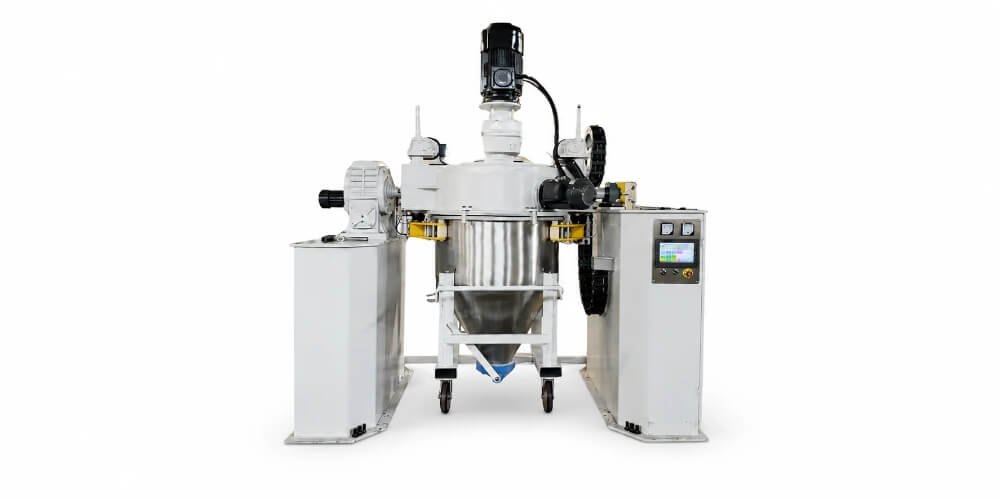
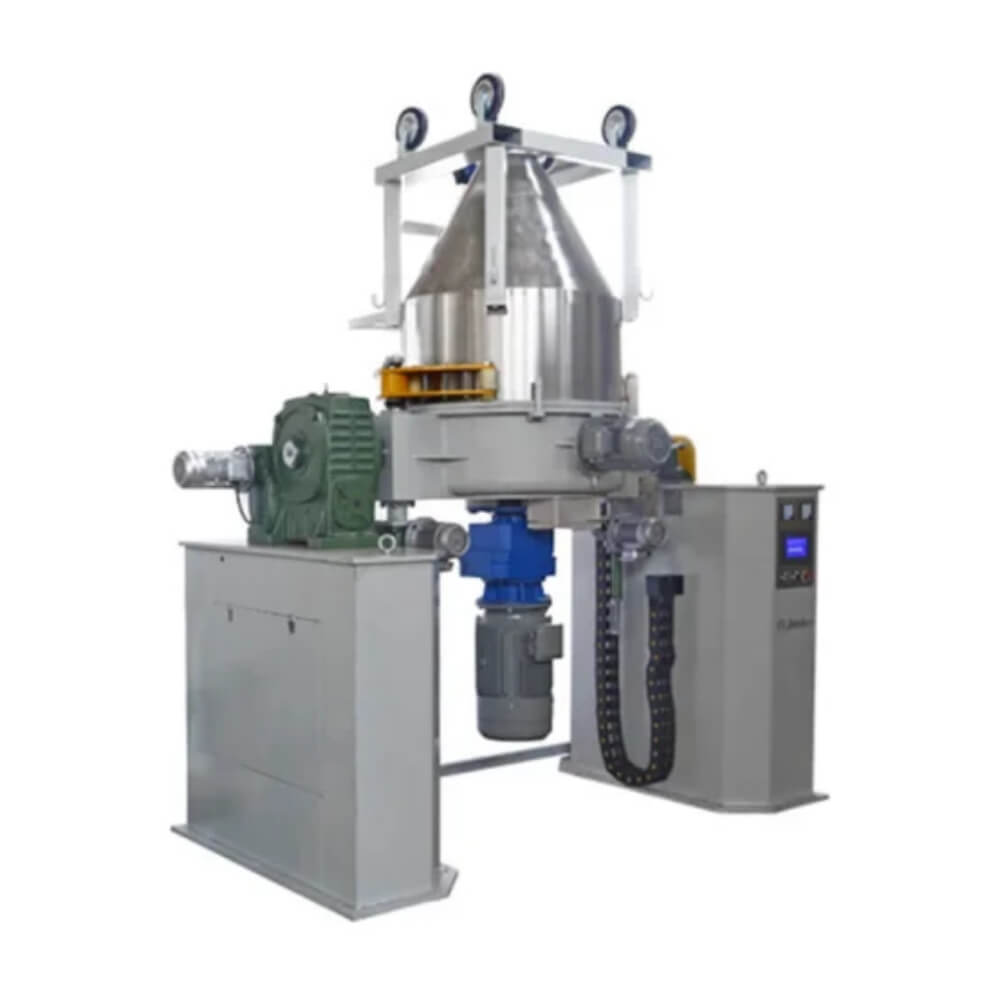
The Mixer – AUTOMATIC CONTAINER MIXER is built as a container movable mixer. The trolley filled with raw material is lifted and connected tightly with the mixing parts. Then the material is mixed automatically during tilting. After mixing, the trolley returns to its original position.
This sounds simple, but in daily production it helps a lot. Multiple trolleys can support operation, cleaning, and color change. For a plant handling frequent batches, this is often more practical than stopping the whole section for every change.
Flipping and Stirring Should Work Together
A good mixer does not only spin material around. The CM series uses tilting movement together with stirring action. Materials move inside the container, and each part of the formula keeps changing position.
That kind of movement is useful when you need the components to spread more evenly before extrusion. You are not relying on one simple motion. You are using combined action to reduce weak mixing areas.
PLC and HMI Help Keep the Process Repeatable
Manual habits change from operator to operator. One worker may mix longer, another may stop earlier. Over time, that can create batch differences.
This machine uses PLC&HMI control, so the process can follow set parameters. Mixing time, movement, and operation steps are easier to manage. For buyers comparing powder mixing machines, this point is important because stable operation matters more than a machine that only looks powerful on paper.
Match Capacity with Your Production Line, Not with a Catalogue
Once the structure looks right, capacity is the next serious point. Do not choose only by tank volume. Look at the whole line, from raw material preparation to extrusion, cooling, crushing, grinding, and final powder handling.
CM Series Models Cover Different Batch Needs
The CM series includes several model choices. CM-300 has 300 L volume and 150 kg per tank output. CM-600 has 600 L volume and 300 kg per tank output. CM-1000 reaches 1000 L volume and 500 kg per tank output. CM-2000 reaches 2000 L volume and 1000 kg per tank output.
All these models are designed with 3–5 minutes of mixing time and PLC control. So the selection is not only about “big or small.” It is about which size fits your real batch plan.
Mixing Time Affects Line Rhythm
A 3–5 minute mixing time can help the production team keep the line moving, especially when the next steps are ready to receive material. But the real result still depends on your formula, operator arrangement, trolley preparation, and discharge plan.
This is why you should not view powder mixing machines as isolated machines. They must match the rhythm of your extruder, cooling section, and grinding equipment.
Product Range Helps with Whole-Line Matching
The company’s product range covers mixers, grinding mills, extruders, cooling belts, bonding machines, laboratory equipment, auxiliary equipment, and testing instruments. For a buyer, that makes communication easier.
You can discuss the mixer together with the next equipment. That is better than buying a mixer first and finding out later that the rest of the line cannot keep pace.
Look at Cleaning, Color Change, and Daily Operation
Many buying decisions look good on paper but fail in daily work. The operator has to load material, discharge material, clean the equipment, prepare the next batch, and keep the area moving. If the mixer makes those jobs harder, your production cost quietly rises.
Multiple Trolleys Make Color Change Easier
The CM series supports multiple trolleys for operation. For powder coating plants that change color or formula often, this is a real working advantage. The team can prepare or clean one trolley while another is connected to the mixing section.
This does not mean cleaning disappears. It means the workflow can be arranged in a more practical way. Less waiting, less back-and-forth, and fewer rushed changeovers.
Sealing Matters in Powder Handling
Powder leakage is annoying in a workshop. It wastes material, makes cleaning harder, and creates extra work for operators. The automatic container mixer uses double seals for the shaft, helping reduce powder leakage and solidified particles.
That is one of those details buyers should not ignore. A mixer may look similar from the outside, but sealing and discharge design show whether the equipment was built for real production work.
Maintenance Should Be Easy to Plan
The smooth container interior, detachable parts, and practical outlet design help with cleaning and maintenance. In a busy factory, maintenance is not only about repair. It is about how fast the team can clean, check, and restart the next batch.
For buyers comparing powder mixing machines, this is where a cheaper machine may not be cheaper in the long run.
Think About Supplier Support Before You Place the Order
A mixer is not a small accessory. It sits near the start of the line and affects everything after it. So supplier support is part of the equipment value.
Line Planning Is Better Than Single-Machine Thinking
If your line is being upgraded, it helps to discuss the full layout. The solution center gives you a clearer idea of how different production capacities and equipment combinations can be arranged.
This is useful when your factory is not only replacing an old mixer, but also planning a smoother production line for the next few years.
Service Should Support Real Factory Questions
After installation, the questions are usually very practical. How should the batch rhythm be arranged? Which model fits the next expansion? How should the mixer connect with current equipment? What should operators check during daily use?
A clear service channel helps buyers ask these questions before and after purchase.
Contact Early with Real Production Details
When you send an inquiry, do not only ask for a price. Share your batch size, formula type, planned output, color change frequency, current equipment, and available workshop space. These details help the supplier recommend a more suitable setup.
If your team is already comparing mixers, you can use the contact page to send the needed information and ask for a more practical selection plan.
Conclusion
Choosing an industrial mixer for a powder coating production line should start from your own production problem. Are batches uneven? Is color change taking too long? Is the mixer blocking the extruder? Are operators spending too much time cleaning and moving material?
The Mixer – AUTOMATIC CONTAINER MIXER gives a solid answer for many of these issues. Its movable container design, PLC&HMI control, multiple trolley operation, double shaft seals, 3–5 minute mixing time, and CM model range make it a practical option for powder coating production plants that want better mixing efficiency and smoother daily operation.
A good supplier also matters. This company has a wide equipment range and can look at the whole powder coating production line, not only the mixer. If you are comparing powder mixing machines for a new line or an upgrade project, the right next step is simple: check the product details, review the service support, and contact the team with your real production data.
FAQ
Q1: How Do I Know Which Mixer Size Fits My Powder Coating Production Line?
A1: Start with your batch weight, daily output target, formula change frequency, and the capacity of your extruder and grinding system. Do not choose only by tank volume. Choose the model that keeps the whole line moving without long waiting time.
Q2: Why Is the Mixer – AUTOMATIC CONTAINER MIXER Useful for Color Change?
A2: It uses a movable container and can work with multiple trolleys. This helps the team arrange material preparation, cleaning, and batch change in a cleaner way, especially when production does not stay on one color all day.
Q3: Are powder mixing machines Important for Final Powder Coating Quality?
A3: Yes. The mixer prepares the raw material mix before extrusion. If resins, curing agents, pigments, fillers, and additives are not evenly distributed, later equipment may struggle to keep the batch stable.
Q4: What Makes PLC&HMI Control Helpful in Daily Production?
A4: PLC&HMI control helps the mixer run by set operation steps instead of relying only on operator habits. This can make mixing time and workflow more repeatable from batch to batch.
Q5: What Information Should I Send Before Asking for a Quotation?
A5: You should send your target output, single batch weight, formula type, color change frequency, current line layout, available workshop space, and any future expansion plan. This helps the supplier recommend a more suitable model and line setup.


