

How Does an ACM Grinding System Improve Particle Size Control in Powder Coating Production? A Guide for Powder Mixing Machines
How Does an ACM Grinding System Improve Particle Size Control in Powder Coating Production? A Guide for Powder Mixing Machines
In powder coating production, powder mixing machines prepare the formula, but the grinding system decides whether the powder can reach the right fineness and stable particle size range. If grinding is not steady, you may see more coarse powder, too much fine powder, lower recovery, and more trouble during later production. That is why many factories look closely at the ACM grinding system, not only the mixer or extruder.
Yantai Jatchen Powder Coating Processing Equipment Co., Ltd. is a professional supplier focused on powder coating processing equipment and production line planning. From mixing, extrusion, cooling, grinding, bonding, laboratory testing, auxiliary systems, and testing instruments, the company works around the full production process, not just one single machine. This matters because particle size control is never solved by one point alone. A grinding mill must match the earlier mixing stage, the extruded flakes, the cooling condition, the plant layout, and the output target. For factories that want a practical domestic production line with stable operation, easier cleaning, and better repeat work, Yantai Jatchen Powder Coating Processing Equipment Co., Ltd. gives a more grounded choice.
Why Does Particle Size Control Matter After Powder Mixing Machines?
Before talking about the grinding mill itself, it helps to look at the link between mixing and grinding. Powder mixing machines make the raw materials more even before extrusion. After cooling and crushing, the grinding system has to turn flakes into finished powder with the right particle size.
Stable Powder Size Helps Keep Each Batch Closer
When particle size stays in a controlled range, the finished powder becomes easier to manage in later use. The powder flows better, and the batch result feels more predictable.
If the powder is too coarse or too fine in random areas, operators may need more adjustment. This creates extra work and makes batch control harder than it should be.
Poor Grinding Can Waste Good Pre-Mixing Work
Good powder mixing machines can prepare a solid base. But if the grinding stage is unstable, the earlier work gets wasted.
That is why grinding should not be treated as a final small step. It is one of the key points that affects finished powder quality and daily production rhythm.
Particle Size Distribution Affects Production Efficiency
A good grinding system should not only crush material. It should also classify powder and collect qualified product clearly.
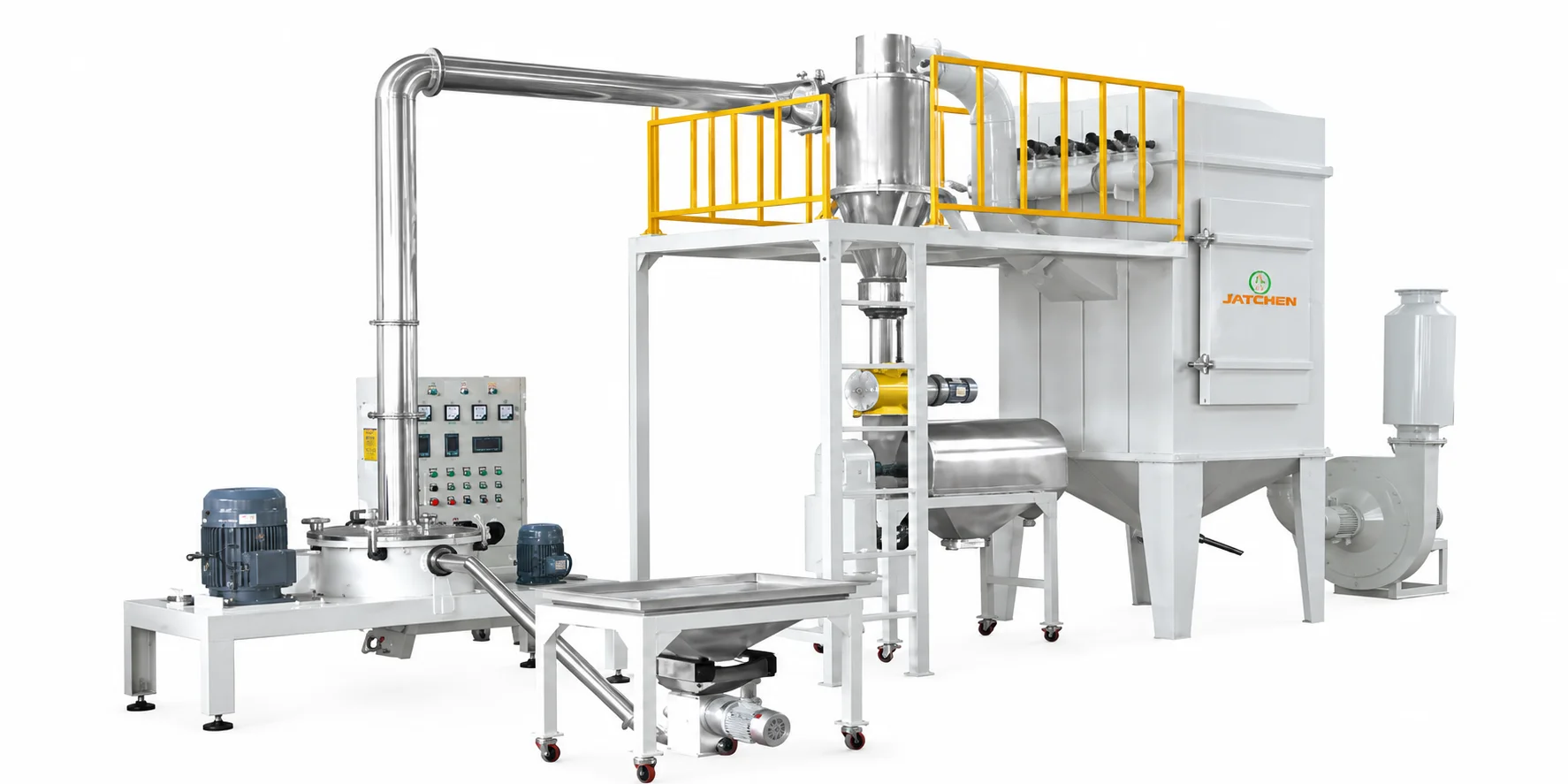
This is where the Grinding Mill – ACM GRINDING SYSTEM becomes useful. It combines high-speed grinding, air classification, cyclone separation, sifting, and fine powder collection in one system.
What Problems Show Up When Grinding Is Not Easy to Control?
Most factories do not worry about grinding when the line is new. The real problems appear after repeated batches, color changes, and output pressure. Then you start to see if the system is easy to control or just hard to manage.
Uneven Powder Needs Adjustable Particle Size
Different powder coating formulas may need different fineness. If the grinding mill cannot adjust particle size well, one system may feel too limited.
The ACM grinding system supports adjustable particle size. This helps you make changes based on actual production needs instead of forcing every formula into the same setting.
Too Much Fine Powder Needs Better Classification
Fine powder is not always useful. Too much fine powder can affect recovery and make production harder to control.
The ACM system uses air classification to separate powder by size. Qualified powder moves forward, while material that needs more grinding can stay in the process longer. This helps build a cleaner particle size distribution.
Low Recovery Needs a More Efficient System
Material loss is not a small matter when production runs every day. A grinding system with poor recovery can slowly increase cost.
The ACM grinding system is designed with a high recovery rate of at least 97%. For a factory, that means better use of material and less waste during regular production.
How Does the ACM Grinding System Work With Powder Mixing Machines?
The grinding system does not work alone. Powder mixing machines, extrusion, cooling, crushing, and grinding are connected. If one part runs poorly, the next part has to carry the pressure.
Flakes Enter the Grinding Chamber First
After the mixed material is extruded and cooled, it becomes sheet-like material or chips. These pieces then enter the grinding mill.
Inside the grinding chamber, high-speed parts create impact, grinding, and shearing action. The goal is to turn tableted material into fine powder in a controlled way.
Air Classification Selects Qualified Powder
After grinding, powder moves with airflow into the classification area. The classifier separates material based on particle size.
This step is important because it keeps the finished powder from becoming a random mix. It helps the system select powder that meets the required range.
Collection Becomes Cleaner and More Organized
After classification, cyclone separation, sifting, and fine powder collection help finish the process. The system is not just breaking material down. It is also organizing the powder flow.
This is one reason ACM grinding fits production lines that care about repeat results, not only output numbers.
Why Is the ACM Grinding System a Good Product Choice?
When choosing a grinding mill, you should not only compare model names. You need to look at daily work: cleaning, energy use, noise, data setting, and whether operators can repeat the same process.
Adjustable Particle Size Fits More Formulas
The adjustable particle size advantage is useful when you handle different powder coating formulas.
It gives your team more room to match product needs. You do not need to rely only on repeated manual changes.
Lower Noise and Lower Specific Energy Consumption Help Daily Work
Factory managers care about output, but operators also care about the work environment. The ACM grinding system is designed with low noise and low specific energy consumption.
These details look small on paper. In daily production, they help reduce running pressure and make long shifts easier to manage.
Recipe Management Makes Repeat Production Easier
The ACM system has recipe management, storage, and call functions. That means operators can save proven settings and reuse them later.
For factories with repeated orders, this is very practical. It reduces guesswork and helps keep production closer from one batch to the next.
Which ACM Model Should You Choose for Your Production Line?
The right model depends on output, airflow, plant space, and the production plan. You should not choose the biggest model just because it looks stronger. A suitable model should match your real production rhythm.
Smaller Output Can Start With ACM04 or ACM07
For lower output needs, ACM04 and ACM07 can be considered. They are more suitable when you need smaller production capacity or a more controlled production plan.
This can also be useful when a factory wants to test process flow before moving into larger output.
Medium Production Can Consider ACM10 to ACM30
If your line already runs more regularly, ACM10, ACM15, ACM20, or ACM30 can match stronger output needs.
These models suit factories that need steady production but still want flexible control over particle size and process settings.
Larger Production Can Look at ACM40 or ACM50
For higher output, ACM40 and ACM50 offer stronger capacity and larger airflow.
Before choosing them, it is better to discuss full-line matching with Yantai Jatchen Powder Coating Processing Equipment Co., Ltd. through the product center or service team, because the grinding mill should match the mixer, extruder, cooling belt, and collection system.
How Can Jatchen’s Particle Size Optimization Support Better Results?
For better particle size control, the grinding mill can also work with a classifier cyclone PSD optimization system. This makes sense when you need more accurate control over powder range and want to reduce unwanted fine powder.
More Accurate Cutting Supports Better Distribution
The classifier cyclone system can help adjust cutting accuracy. This helps the powder stay closer to the target particle size range.
For powder coating production, this is useful because finished powder quality depends on more than average size. Distribution also matters.
Less Ultra-Fine Powder Helps Improve Stability
Too much ultra-fine powder can bring extra production problems. A better classification system helps reduce unwanted small particles.
Yantai Jatchen Powder Coating Processing Equipment Co., Ltd. designs the particle size optimization system for factories that need higher-quality powder and more stable output.
Easy Cleaning Supports More Practical Operation
Frequent color or formula changes make cleaning important. The ACM system is designed to be easy to clean and maintain.
This is also why powder mixing machines and grinding systems should be considered together. If mixing, grinding, and cleaning do not match, the whole line slows down.
Conclusion
Particle size control is not a small detail in powder coating production. Powder mixing machines prepare the raw materials, but the ACM grinding system decides how well the material becomes finished powder. If you want better particle size distribution, higher recovery, easier repeat production, and more stable daily operation, the Grinding Mill – ACM GRINDING SYSTEM is a strong product to consider.
Yantai Jatchen Powder Coating Processing Equipment Co., Ltd. has an advantage because it does not only provide one machine. It works with mixing, extrusion, cooling, grinding, bonding, laboratory equipment, auxiliary systems, and full production line planning. That makes the product recommendation more practical for your workshop. For model selection, production line matching, and after-sales support, you can review the company’s service information or contact the team with your real output plan.
FAQ
Q1: How Does an ACM Grinding System Help Powder Coating Production?
A1: An ACM grinding system helps crush cooled flakes into fine powder, classify qualified particles, and collect finished powder. It works after powder mixing machines and extrusion, so it plays a key role in final particle size control.
Q2: Why Is Particle Size Distribution Important?
A2: Particle size distribution affects powder flow, batch stability, recovery, and final powder quality. A more controlled distribution helps make daily production easier to manage.
Q3: What Makes the Grinding Mill – ACM GRINDING SYSTEM Worth Choosing?
A3: It offers adjustable particle size, high recovery rate, low noise, low specific energy consumption, recipe management, and easy cleaning. These points match real factory concerns.
Q4: Can the ACM Grinding System Work With Different Output Needs?
A4: Yes. The ACM series includes different models from smaller output to higher output production. You can choose based on actual capacity, airflow, plant space, and line matching.
Q5: Should I Choose the Grinding System Alone or Match It With the Whole Line?
A5: It is better to match it with the whole powder coating production line. Powder mixing machines, extrusion equipment, cooling equipment, and grinding equipment should work at the same rhythm, so the line runs more smoothly.


