

Powder coating process explained: how a twin screw extruder supports consistent production
Powder coating process explained: how a twin screw extruder supports consistent production
Powder coating production rarely goes wrong in one dramatic moment. It usually drifts. The feed becomes less even, the melt becomes less stable, cooling has to work harder, and the final powder starts to vary more than you want. That is why a twin screw extruder deserves attention early in line planning. When this step runs well, the rest of the process is easier to keep steady.
If you prefer to work with a supplier that talks about the full powder coating line instead of pushing one isolated machine, Yantai Jatchen Powder Coating Processing Equipment Co., Ltd. is a sensible place to start. The company focuses on powder coating production equipment, covers mixing, extrusion, cooling, grinding, particle size improvement, and line planning, and can match machines to different output goals. That matters when you want a practical setup, not a list of disconnected units. For domestic projects, this kind of line-based thinking saves time during selection and planning.
Why consistent powder coating production starts with process control
The machine matters, but it only works well when you look at the full route from premixing to cooling.
Raw material uniformity sets the starting point
You first need the dry mix to be even. Resins, curing agents, pigments, fillers, and additives should enter the next step in a stable ratio, not as loose pockets of heavier or lighter material. This is why premixing equipment matters before extrusion. A well-mixed batch gives you a calmer feed and a more predictable result later.
When the starting mix is poor, the extruder has to correct too much inside the barrel. That can show up as a weaker melt, uneven flakes after cooling, or extra pressure on the grinding stage.
The melt stage carries the real weight
Once premixed powder enters the barrel, the screws move it forward while the material becomes a uniform melt. The key point is not motion alone. It is the balance of conveying, kneading, and mixing before the material leaves the die head.
A stable melt makes the next steps easier. Cooling can form cleaner flakes. Grinding can work on steadier material. The final powder is easier to keep closer from batch to batch.
Why a twin screw extruder becomes the key process link
This stage sits in the middle of the production line, but its effect spreads in both directions. If extrusion is unstable, downstream equipment spends the rest of the shift dealing with that problem. If extrusion is steady, cooling, crushing, and grinding all work with a better starting material.
That is why your line choice should not treat the extruder as a stand-alone purchase. It should be selected as the part that connects premixing with later size control.
Where production usually loses consistency
Once you see the process as one chain, the common production headaches become easier to spot.
Uneven feeding creates output swings
Feed instability is one of the fastest ways to lose consistency. When material enters unevenly, barrel load shifts and output becomes harder to keep steady. You may still get product, but the line feels less smooth and later steps carry more variation.
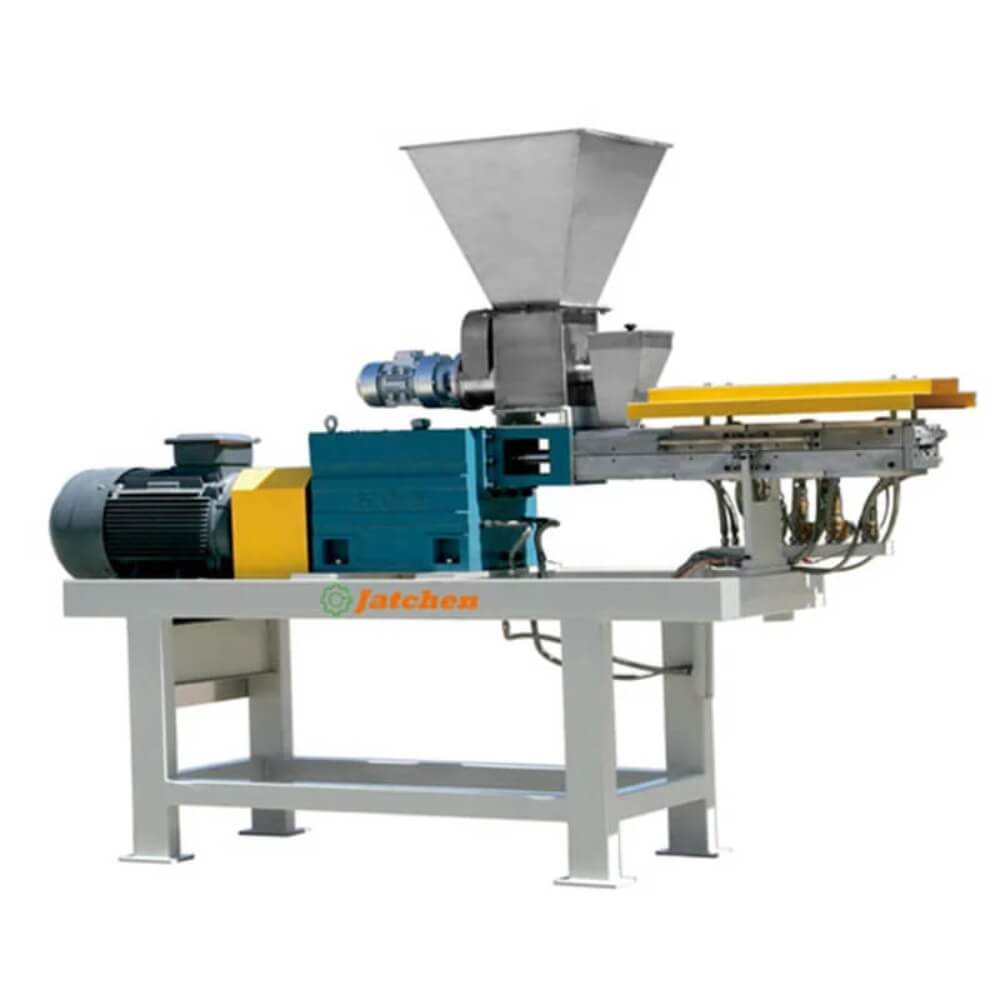
This is why the recommended machine uses a feeding structure designed for more uniform material entry. It gives you a steadier process base before the material reaches the die head.
Poor melt control makes later steps harder
In practice, a twin screw extruder gives you a better base when the barrel zones are held in a narrow working range. The TSK series uses multiple controlled zones, and the source material notes precision within ±2℃. That matters because the melt should be formed with repeatable conditions, not wide shifts that change the way the material behaves.
If melt quality moves too much, cooling and grinding cannot fully hide it. You may feel the effect in chip quality, particle size control, and batch repeatability.
Slow cleaning adds cost you can feel
Changeovers are part of real production. You may change colors, formulas, or daily schedules. If residue stays in hard-to-reach areas, downtime grows and the next batch becomes harder to trust.
The TSK barrel design uses a clam structure with liner inserts and strong self-cleaning support. In plain terms, that helps routine cleaning become less painful. It does not remove the need for good operating habits, but it eases the burden.
Why this extruder fits powder coating production
That leads to the product choice. You do not need a machine that only sounds advanced on paper. You need one that fits the powder coating process you actually run. The TWIN SCREW EXTRUDER is worth a close look for that reason.
Two intermeshing screws help build a more even melt
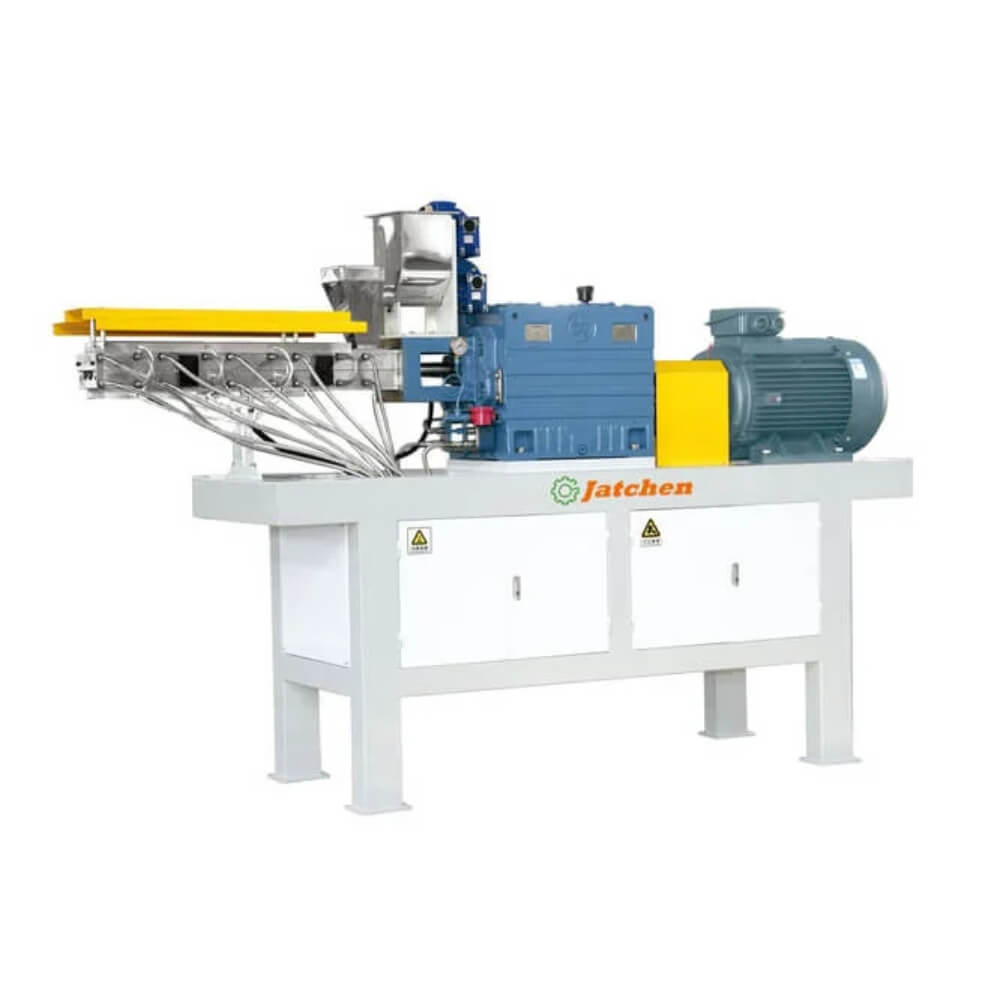
The machine uses two intermeshing screws inside the barrel. Premixed powder coating materials move forward, receive mechanical mixing, and leave through the die head as a more uniform melt. This structure helps the material move with less interruption while improving dispersion of resins, curing agents, pigments, fillers, and additives.
This is where the twin screw extruder earns its place. It does not just move material. It supports the quality of the semi-finished output that later becomes flakes and finished powder.
Output range helps you match real plant needs
Choosing the right model by output is more practical than chasing the largest model. The product family spans several working ranges, from TSK35 at 50–80 kg/h to TSK98 at 1200–1500 kg/h. Between them, models such as TSK40, TSK55, TSK65, TSK75, and TSK85 help cover different production plans.
That gives you room to match the extruder with your target line, instead of forcing the plant to work around a poor size choice.
It works better as part of a full process line
This machine holds the center of a process chain. Upstream, it benefits from a stable mixer. Downstream, it pairs with cooling belt equipment, grinding systems, and particle size improvement units that shape the final powder.
Conclusion: choose the product for the whole process, not one machine
By this point, the buying decision becomes more practical. You are choosing how stable you want daily production to feel.
What you gain in daily production
A twin screw extruder is valuable because it supports the middle of the process, where premixed materials become a controlled melt for later handling. Better continuity here can make cooling easier, grinding steadier, and final powder more repeatable.
For a powder coating producer, that is the real point. You want fewer avoidable swings in the line and less time spent compensating for unstable upstream work.
Why the company behind the equipment matters
The company introduced earlier is not only offering one machine. It works across powder coating production equipment and line planning, which is helpful when you need the extruder, mixer, cooling section, grinding section, and particle size work to make sense together.
For domestic projects, this matters. A supplier that can discuss line balance, output fit, and machine matching gives you a clearer route from inquiry to selection.
Service and contact should stay in the buying decision
A serious purchase should include more than the machine itself. You also need service, spare parts, layout discussion, and a clear contact path when you are comparing line options. If your goal is a powder coating line with fewer avoidable weak points, this product is a strong recommendation and deserves a direct contact step before you lock in your plan.
FAQ
Q1: Why does a twin screw extruder matter in powder coating production?
A1: It helps turn a premixed powder batch into a more uniform melt before cooling and grinding, which supports steadier downstream work.
Q2: What production range does the TSK series cover?
A2: The series covers several capacities, from 50–80 kg/h at the lower end to 1200–1500 kg/h at the higher end.
Q3: What comes before extrusion in the process?
A3: Premixing comes first. Raw materials need to be combined evenly so the extrusion stage receives a more stable feed.
Q4: What comes after extrusion?
A4: The melt usually moves into cooling, chip formation, grinding, and particle size work before it becomes finished powder coating material.
Q5: What should you ask before choosing a model?
A5: Ask about target output, matching upstream and downstream machines, cleaning needs, service, spare parts, and how the whole line should be arranged.


