

The Role of Grinding Machines in Solving Defects like Bubbles and Pores in Coatings
The Role of Grinding Machines in Solving Defects like Bubbles and Pores in Coatings
In manufacturing processes for coatings, surface flaws such as bubbles and pores frequently result in discarded lots, client dissatisfaction, and increasing expenses. Such problems originate from powder characteristics and handling accuracy. Grinding machines hold a vital position in this area, although numerous production setups continue to overlook their influence.
Advanced grinding options from Yantai Jatchen Powder Coating Processing Equipment Co., Ltd. offer a dependable method to lessen these flaws. This producer specializes in full powder coating handling setups, ranging from initial substance management to ultimate grinding and sorting. Practical knowledge gained from diverse industrial initiatives, available for review on the case page, illustrates how device construction influences coating effectiveness.
Introduction to Coating Quality Challenges and Industrial Grinding Solutions
Within a standard manufacturing setting, coating excellence relies on various interconnected phases. Grinding stands out as one of the most essential, yet frequently neglected. Lacking exact regulation during this phase, flaws emerge subsequently and prove challenging to correct.
Overview of Coating Defects in Industrial Powder Coating Production
Bubbles and pores generally become evident following the curing process. However, their source appears earlier in the sequence. Variations in particle dimensions, enclosed air, or inadequately spread elements can generate vulnerable spots within the coating film. These imperfections extend beyond appearance. Moreover, they diminish resistance to rust and physical durability.
Importance of Particle Size Control and Uniform Dispersion
Excessive differences in particle dimensions cause smaller bits to occupy spaces while bigger ones interfere with the film arrangement. Consequently, this unevenness produces air voids. Dependable grinding yields a limited particle size spread, which supports the creation of a compact and even coating surface.
Introduction to Professional Grinding System Providers
Suppliers of equipment possessing comprehensive system knowledge create significant advantages. Examination of the about page reveals emphasis on combined approaches over isolated devices. This method links grinding with supply, temperature regulation, and sorting, thereby decreasing flaw probabilities throughout the whole procedure.
How Particle Size Distribution Affects Coating Defects?
Careful oversight of initial substances may already exist, but unstable particle size spread still permits flaws to surface. Grinding shapes the manner in which particles function amid use and solidification.
Relationship Between Oversized Particles and Surface Imperfections
Particles exceeding standard sizes fail to liquefy or spread uniformly. They generate tiny openings within the coating film. As solidification occurs, the air contained in these openings enlarges and develops into noticeable bubbles.
Impact of Inconsistent Grinding on Bubble and Pore Formation
Fluctuations in grinding capability cause each lot to perform variably. One lot might display acceptable quality, whereas the subsequent one exhibits tiny holes. Such variability frequently connects to deficient sorting effectiveness.
Importance of Uniform Powder Fineness in Industrial Applications
Even refinement enables fluid movement and balanced layering. This aspect holds particular significance in extensive manufacturing where minor shifts can escalate into substantial quality concerns.
The solution center supplies practical arrangements that tackle these difficulties in a straightforward manner, offering further specifics on technical remedies.
Common Causes of Bubbles and Pores in Coating Production?
Numerous manufacturing groups concentrate on surface preparation or solidification settings, yet fundamental reasons typically begin sooner. Grinding contributes substantially to various such origins.
Air Entrapment During Processing
Air enters the substance amid blending and persists if particles undergo improper handling. Thorough and consistent grinding facilitates the expulsion of this confined air prior to utilization.
Inadequate Grinding and Agglomeration Issues
Insufficient grinding permits particles to adhere and create clumps. These groupings fracture during utilization, resulting in empty spaces that evolve into pores.
Improper Cooling and Material Handling Before Grinding
Substances inadequately readied before grinding exhibit erratic behavior. Reliable supply and managed environments enhance grinding capability and ultimate powder excellence.
Limitations of Conventional Grinding Methods in Defect Control
Earlier grinding setups commonly face challenges in fulfilling present quality requirements. Although they may operate, they impose concealed dangers.
Poor Classification Efficiency Leading to Uneven Particles
Standard setups frequently neglect to isolate refined and rough particles adequately. This deficiency produces a broad particle size spectrum, thereby elevating the likelihood of imperfections.
Difficulty in Achieving Stable Output Quality
Production excellence might alter according to warmth, burden, or runtime. This lack of steadiness complicates the preservation of uniform coating capability.
Advanced Grinding Technologies for Defect Reduction
Current grinding setups prioritize accuracy, reliability, and combination. They aim to address actual manufacturing obstacles beyond mere size reduction.
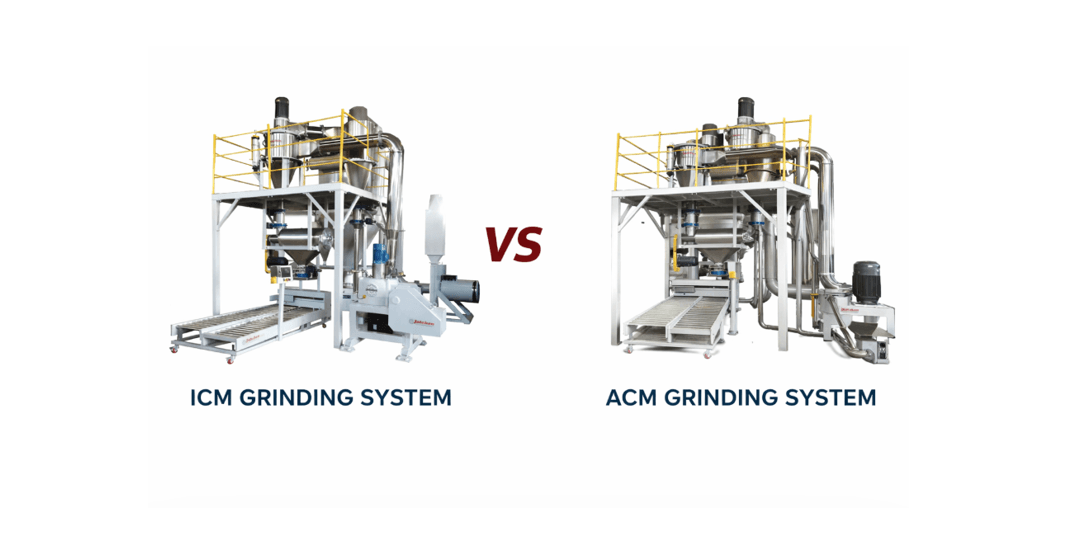
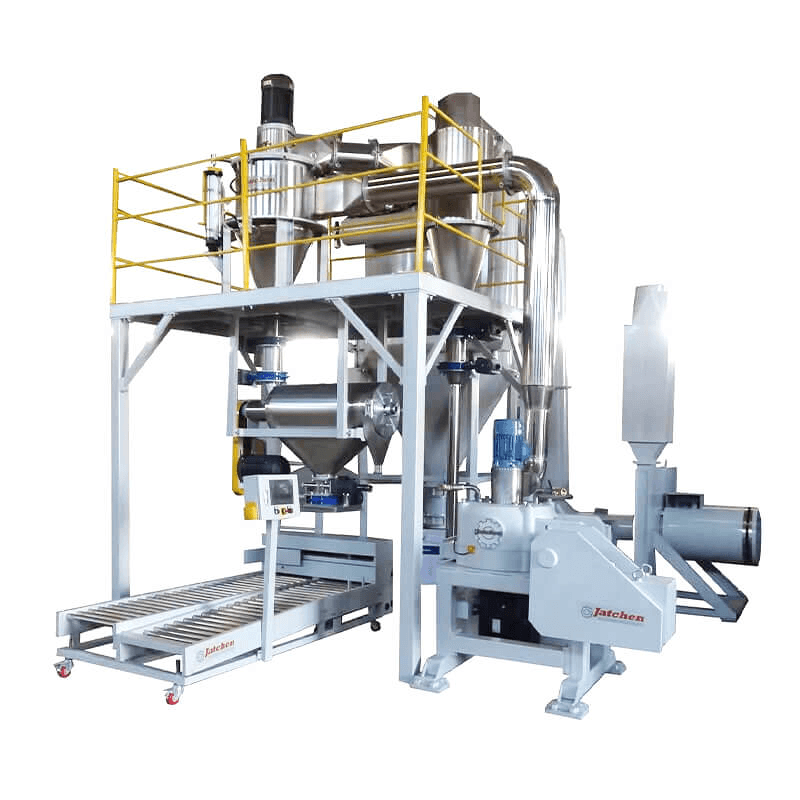
Features of ICM Grinding System in Enhancing Particle Uniformity
The ICM GRINDING SYSTEM delivers firm oversight of particle dimensions. Its core design facilitates effective grinding and sorting within a single unit. Consequently, it minimizes the presence of oversized particles and boosts evenness.
Furthermore, it aids in diminishing clumping. As an outcome, the processed powder moves more fluidly and produces a more level coating surface.
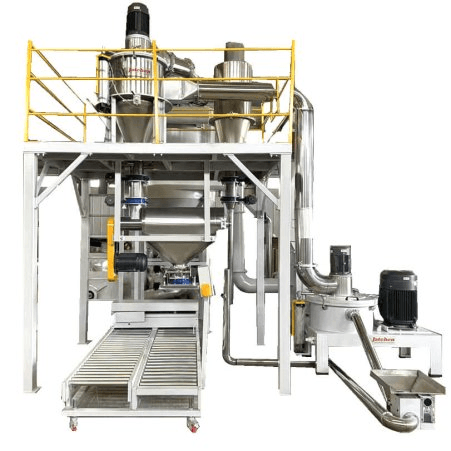
Advantages of ACM Grinding System for Fine Powder Processing
The ACM GRINDING SYSTEM concentrates on refined powder handling featuring modifiable refinement levels. Its air sorting mechanism divides particles with greater exactness.
This setup endorses dependable functioning across extended manufacturing periods. For expansive producers, this reliability converts directly into reduced imperfections and minimized discards.
Integrating Grinding Systems into a Complete Production Line
Grinding operates without separation. It requires seamless linkage with preceding and succeeding phases.
Coordination Between Extrusion, Cooling, and Grinding
Every phase influences the subsequent one. Instability in prior phases diminishes grinding effectiveness. A carefully constructed setup ensures alignment across all phases.
Importance of Consistent Feeding and Material Flow
Uneven supply generates irregular grinding. Steady substance movement sustains consistent particle size spread.
How Complete Turnkey Solutions Improve Efficiency
Rather than modifying distinct devices, a full setup method streamlines handling. This minimizes manual inaccuracies and elevates general quality uniformity.
Planning for enhancements or fresh setups permits direct communication via the contact page for customized approaches.
Best Practices for Minimizing Coating Defects Through Grinding Optimization
Advanced devices demand proper usage for optimal outcomes. Minor modifications can produce evident progress.
Adjusting Equipment Parameters for Different Materials
Substances vary in their response during grinding. Tweaking velocity, air movement, and sorting configurations yields superior outcomes.
Regular Maintenance and System Calibration
Erosion and deterioration impact grinding accuracy. Periodic evaluations maintain expected performance and avert abrupt quality problems.
Selecting the Right Grinding System Based on Production Scale
No single setup suits all manufacturing chains. Selecting devices aligned with scale and needs prevents avoidable issues.
Conclusion Improving Coating Quality with Reliable Grinding Technology
Bubbles and pores represent more than superficial concerns. They indicate underlying difficulties in powder handling. Grinding machines contribute crucially to resolving these by regulating particle dimensions, enhancing evenness, and stabilizing manufacturing.
Utilizing modern setups like the ICM and ACM grinding options enables flaw reduction and steadier achievements. A comprehensive setup perspective, backed by seasoned producers, renders this handling more trustworthy and simpler to oversee.
FAQ
Q1: Why do bubbles still appear even after adjusting curing conditions?
A: The root cause often lies in powder quality. Uneven particle size or trapped air from earlier stages can lead to bubbles during curing.
Q2: How does grinding directly affect pore formation?
A: Grinding controls particle size distribution. Poor grinding creates agglomerates and uneven particles, which form voids in the coating layer.
Q3: What is the difference between ICM and ACM grinding systems?
A: ICM focuses on integrated grinding and classification with strong uniformity control, while ACM offers flexible fineness adjustment and efficient air classification.
Q4: Can upgrading grinding equipment reduce production waste?
A: Yes. More stable grinding reduces batch variation, which lowers rejection rates and improves overall efficiency.


