

How to Scale a Powder Coating Formula from Lab Batch to Production Line
How to Scale a Powder Coating Formula from Lab Batch to Production Line
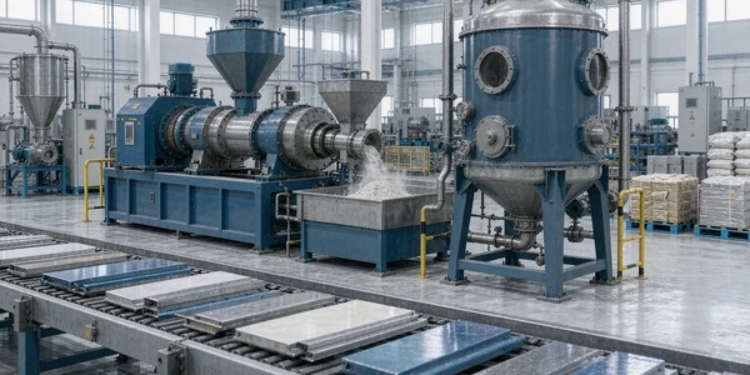
A formula that worked at two kilos has to be re-proved at production rate. Keep the ratios. Re-do the settings. The recipe travels to the line. The hardware does not, and that is where the trouble hides.
Process engineers call the jump from bench rate to line rate the scale-up factor. No datasheet carries it. Ask which machine breaks a scale-up and there are three answers: mixer, extruder, mill. Each changes character as it grows. None of them changes in the same direction. Align all three and the job is arithmetic. Miss one and your first commercial batch becomes the trial.
Why a Lab Result Rarely Survives Production
A Trial That Worked Twice at Two Kilos
One scale-up last year had a trial run three times, all clean, all at two kilos. The first production batch at three hundred kilos came out streaked. The formula was not the problem. The operator was not the problem. Somebody had filled the container to the hatch instead of the marked volume, and the head could not fold the top layer back into the batch.
Nobody in that room had done anything careless. The trial machine simply did not have a top layer big enough to hide in.
Three Machines, Three Personalities
Small bowl, blade close to the wall, every particle meeting the tool dozens of times a minute. Uniformity comes free at two kilos. Blow the bowl up and the same blade speed buys a fraction of those passes. Material near the wall waits its turn. Six steps later that wait looks like a streak on a panel nobody can sell.
The extruder changes more than the mixer does. A lab extruder with rollers pushing 2 to 5 kg/h can be watched, felt, adjusted by hand. Put a TSK65 at 600 to 800 kg/h in its place and the operator has seconds where he had minutes. Downstream it repeats. A lab grinder at 2 to 4 kg/h lets the classifier answer at once. A 400 kg/h ACM20 has to hold its cut with far more material and air going past the same wheel.
Shear Does Not Scale With Tonnage
16D on the datasheet means a screw sixteen diameters long, and the ratio holds whether the screw measures 22 mm or 65. They do not knead alike per kilo, and no quotation says so. More barrel. More surface. More heat per gram. A formula that wanted a firm hand on the bench gets overworked on the line. The giveaway is not the sheet on the belt. It is a film that flows too far, or one that will not flow at all.
Temperature you can watch. Energy you cannot. That is why a plant holds its zones steady for years and still wonders why the finish moved.
Matching the Lab Train to the Production Train
| Machine | On the bench | On the line |
| Misturando | Small bowl; every particle meets the blade dozens of times a minute | Container mixer, CM300 to CM2000, 150 to 1000 kg, 3 to 5 minutes a tank |
| Extrusion | Lab extruder with rollers, 2 to 5 kg/h, adjusted by hand | TSK65, 16D screw, 420 rpm, 600 to 800 kg/h, zones held to ±2 °C |
| Grinding | Lab grinder, 2 to 4 kg/h, classifier answers at once | ACM20, 400 kg/h, same 0 to 2800 rpm wheel, far more material and air |
Mixing: Bowl Volume Against Tank Volume
A Jatchen lab mixer and an misturador automático de recipientes are not one idea at two sizes. Learn the difference before writing a formula around either. The CM series lifts a trolley, tips it into the head, runs 3 to 5 minutes a tank, from CM300 at 150 kg up to CM2000 at 1000 kg. Spare trolleys keep that head working while the next batch is still being filled.
Volume and tilt do the work, not a blade sweeping the whole vessel. So a formula that leaned on violent shear in a small bowl usually needs a high speed mixer stage first, 3 to 5 minutes at 150 to 1000 kg/h, before the trolley ever rolls in. Two stages. The second one is cheaper than the batch it saves.
Extrusion: Diameter Changes the Rules
TSK22 moves 2 to 5 kg/h and TSK30 moves 10 to 15, both on a 16D screw at up to 600 rpm, both with a roller unit that presses sheet 0.5 to 3 mm thick. A TSK65 runs 16D at 420 rpm and 600 to 800 kg/h, with barrel zones held to ±2 °C. The screw turns slower. The barrel is longer. Material spends more time hot.
Most scale-up gloss problems trace back to that one fact. The lab sheet cooled in seconds on a small roller. The production sheet leaves a barrel that has been heating material for a minute or more, and the cooling belt then has to pull that heat out. Sizing a twin screw extruder is a dispersion question first. Tonnage comes second.
Grinding: The Cut Point Moves With Load
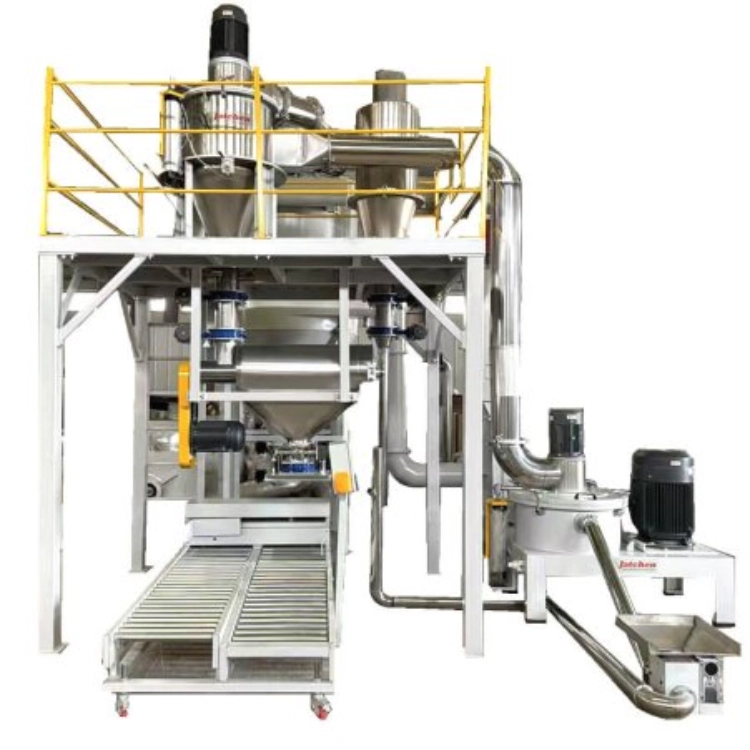
ACM02 grinds 2 to 4 kg/h. ACM20 grinds 400. ACM30 grinds 500. ACM50 grinds 1000. Every one of them uses a 0 to 2800 rpm classifier wheel, the wheel that decides which particles are fine enough to leave the mill, with a working range around 10 to 100 μm. The dial looks identical on all four. The behaviour is not.
At 400 kg/h there is far more material passing the same wheel in the same second, and more air carrying it. Copy the lab rpm across and the distribution shifts. Plan a fresh cut-point trial on the production Sistema de molho ACM before the first order, not after the first complaint.
A Ladder Instead of a Leap
Three Steps Beat One Jump
2 kg, 20 kg, 200 kg. Each step exposes a different variable. Twenty kilos is enough to show segregation in a container and enough to see whether a premix really blended. Two hundred is enough to find out whether the extruder’s cooling zone can keep up with its screw.
The ladder suits a plant with mixed order sizes, where no single machine will ever run one product alone. If the order book is one formula at one rate, the middle step teaches little and costs a week; run the trial straight against the production frame and keep the lab sample as the reference.
Ratios Stay, Settings Move
Pigment, matting agent, wax, accelerator: the ratios stay. Time, temperature, screw speed, belt speed, classifier rpm are yours to move, one at a time. Move three at once and the ladder teaches nothing. That is the usual reason scale-up gets a reputation for being unpredictable.
Sample Where the Buyer Samples
A lab sample has been sitting still in its bag. What the customer judges is powder that a box, a hopper and a gun have already shaken, so that is the powder the film comes from. Pull the production sample at the packing end, condition it the way the customer conditions it, and read that film. Sieve residue has one use. It tells you whether the mill was set sensibly, nothing more.
Where Scale-Up Actually Goes Wrong
Premix That Only Looks Mixed
Streaks in a finished coating often start with a container filled past its rated volume. From the hatch the batch looks even. From the wall it does not. Fill to the marked volume, give the trolley its full 3 to 5 minutes, and the formula that streaked in March behaves in April.
Residence Time Nobody Budgeted For
Residence time is the minutes a gram of powder actually spends inside the hot barrel, and batch size moves it as much as screw speed does. Bigger machines hold more material. Short runs on a large extruder cook the tail of the batch longer than the head. Two extra minutes at melt temperature is enough to move gloss, which is why a 50 kg order on a 1000 kg/h line never quite matches the trial.
Cut Point Drift Nobody Logged
Classifier speed gets set at commissioning and trusted for years. As throughput climbs, the same rpm returns a different distribution, slowly enough that no single batch looks wrong. Log D50 and D97 for the first month after any scale-up. D50 is the size half the batch falls below. D97 is the size 97 percent of it falls below. Boring. Cheap. The only reliable way to catch drift before a customer does.
Line capacity deserves the same treatment. There is a separate piece on matching capacity from mixing to grinding that works through the arithmetic, and one on extruder output calculation if the bottleneck turns out to be upstream.
Conclusão
Yantai Jatchen Powder Coating Processing Equipment Co., Ltd. covers both ends of this problem. Laboratory mixers, lab extruders with rollers and lab grinders for the trial. Container mixers, TSK twin screw extruders, cooling belts and ACM grinding systems for the line. Same process thinking at both sizes, which is the only thing that makes a ladder meaningful.
Scale-up is easier to plan than to rescue. Send the formula, the target batch size and the film you are chasing, and the team can size the train around it. Contact the Jatchen team through the site oficial.
FAQ
Q1: How much can a lab batch tell about production?
A1: Enough about chemistry, not enough about hardware. Ratios, cure response and general behaviour travel well. Temperature history, residence time and cut point do not.
Q2: What causes shade drift after scale-up?
A2: Premix uniformity, most of the time. Bigger vessels have dead zones, and a batch that looks even at the hatch can be uneven at the wall.
Q3: Is it worth buying production-sized equipment to run small batches?
A3: Only if the line will mostly run small. Oversized machines stretch residence time and shrink the usable batch range, which is a bad trade for a plant with mixed order sizes.
Q4: Can one extruder cover both trial and production volumes?
A4: TSK22 and TSK30 handle 2 to 15 kg/h, which is trial territory. Production frames start at TSK35 and run to TSK98 at 1200 to 1500 kg/h. One frame doing both jobs usually does neither well.
Q5: Which numbers should you log during the first month?
A5: D50, D97, extruder zone temperatures, belt speed, and weight in against weight out. Four weeks of those figures explains most of the surprises.


