

Why Particle Size Distribution Matters in Powder Coating Applications
Why Particle Size Distribution Matters in Powder Coating Applications
Particle size distribution (PSD) is one of the key process variables that strongly influences surface appearance and transfer efficiency. However, defects such as orange peel and bubbles are typically driven by a combination of PSD, formulation rheology and flow additives, cure profile and film build, spray parameters, and substrate cleanliness. To get that mirror-like smooth finish or perfectly even texture on industrial components, you need a rigorous process backed by top-tier equipment. As a veteran force in the industry, Yantai Jatchen Powder Coating Processing Equipment Co., Ltd. has been providing high-precision production solutions to global manufacturers, helping pros like you solve these tricky physical parameter headaches.
Why Is Particle Size Distribution Critical for Coating Quality?
Particle distribution is not just a technical buzzword; it directly impacts your costs and efficiency during spraying operations. If the particles are too coarse, the surface will feel like sandpaper. If they are too fine, the powder flies everywhere in the air, wasting material and clogging your recovery system. Keeping particles within a reasonable range is a challenge every powder manufacturer must face.
Uniform Particle Size for Consistent Surface Finish
When particle sizes are highly consistent, melt flow and leveling become more predictable, which helps reduce orange peel and improves surface smoothness. Film-thickness uniformity, on the other hand, is mainly governed by deposition conditions such as electrostatic field strength, spray setup, part geometry, and film build control.
Accurate Distribution for Superior Flow and Leveling
Good PSD allows the powder to spread rapidly during high-temperature curing. It is like pouring sand on the floor; if the grains are round and consistent in size, they naturally fill every gap to create a perfect leveling effect.
Precise Control for Optimized Transfer Efficiency
The right particle size increases the electrostatic charging capacity of the powder. Large particles are too heavy and fall off easily, while tiny particles are too light and get carried away by air currents. Only those “golden particles” in the middle can accurately adsorb onto the workpiece, saving you a fortune in raw material costs.
How Does Mixing Technology Influence Initial Particle Uniformity?
Before entering the extruder, the effect of pre-mixing determines whether pigments and additives are distributed evenly within the resin. If something goes wrong in the mixing stage, even the most advanced grinding equipment later cannot fix the defects caused by uneven composition. This is why many experienced engineers spend a lot of energy choosing a reliable mixer.
High Speed Mixer of Series HLJ for Homogeneous Blending
The HLJ series high-speed mixer is great at handling solid coarse and lumpish multi-component materials. It uses high-speed rotation to strongly crush these lumps, making sure every raw material hits and blends at a microscopic level.
Automatic Container Mixer of Series CM for Large Batch Consistency
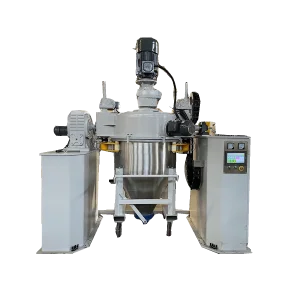
If you are dealing with large batch orders, the AUTOMATIC CONTAINER MIXER is an absolute lifesaver. It completes a batch of mixing in just 3 to 5 minutes with high automation, which greatly reduces the particle size fluctuations caused by human error.
Advanced Sealing Technology for Preventing Particle Solidification
Equipment from this range uses double-seals for the shaft. This is not just to prevent powder leakage; more importantly, it stops the powder from heating up and caking at the bearing.
Can Extrusion Processes Ensure Optimal Material Fusion?
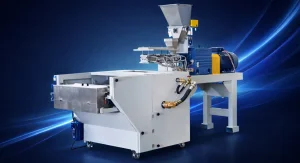
The extrusion process is the heart of powder coating production. Here, materials are heated, sheared, and stretched to finally become a uniform melt. If the extruder lacks sufficient shear or stable temperature control, melt fusion and dispersion can be incomplete, leaving pigment agglomerates or additive-rich zones. For thermoset systems, poor temperature management can also trigger premature curing or gel particles, which later widen the grind behavior and ultimately broaden the final PSD.
Precise Temperature Control for Consistent Material Morphology
Temperature control is the soul of extrusion. This equipment is designed for stable multi-zone temperature control with a narrow fluctuation band (e.g., ±2°C where verified by equipment specification and operating conditions). This stability ensures the material has a consistent physical morphology before cooling, setting a good foundation for the next grinding step.
High Torque Gearbox for Efficient Processing of Dense Materials
When facing hard resin formulas, ordinary motors might struggle. An efficient power system ensures the screws run at a constant speed, avoiding thickness variations in the extrudate caused by speed fluctuations, thereby stabilizing the feed size for the grinder.
Why Is Controlled Cooling Essential for Subsequent Grinding?
When the material comes out of the extruder, it is in a scorching molten state and must be cooled and hardened immediately. The cooling speed and flake thickness directly affect the brittleness of the material. If cooling is uneven—hard in some places and tough in others—the particle size distribution of the ground powder will become very wide and hard to manage.
Water Cooling Belt of Series GDJ for Rapid Sheet Solidification
The GDJ series cooling belt uses a circulating water system to take away heat quickly. This rapid cooling allows the material to “set” instantly, forming uniform flakes of about 1mm to 3mm, which is very beneficial for subsequent mechanical crushing.
Compact Roller of Series CR for Space Saving Efficiency
For friends with limited factory space, the COMPACT ROLLER provides a clever solution. It reduces the footprint while maintaining cooling effects, and it is much easier to clean than those long conveyor belts.
Adjustable Roller Speed for Managing Sheet Thickness and Texture
You can adjust the roller speed according to different formulas. By controlling the physical structure of the flakes, you are actually setting a “standard input” for the grinder, which indirectly controls the particle span of the finished powder.
How Does the Grinding System Achieve Targeted Particle Sizes?
This is the real “main battlefield” for determining particle size distribution. A grinding system does more than just crush big chunks; the key is to screen out unqualified particles through airflow. A well-designed ACM grinding system with an adjustable classifier can target specific PSD metrics (such as D50, D90, and distribution span) within the practical constraints of powder fluidization, charging behavior, and the coating thickness/application window.
Jatchen ACM Grinding System for Precise Micron Control
This system works with a classifier wheel. By adjusting the rotation speed and air volume, you can accurately capture specific micron-level particles. Whether you need extremely fine powder for thin coatings or regular powder for industrial protection, it handles it easily.
Patented Classifier Cyclone for Optimizing Size Distribution
The classifier is the core. It uses centrifugal force to send large particles back to the grinding chamber for re-crushing while letting qualified particles pass. This continuous cycle ensures that the final collected powder has a very steep distribution curve, meaning the size is very concentrated.
High Recovery Rate for Maximizing Production Yield
Industrial production values yield above all. High-efficiency cyclones and dust collection reduce powder loss to exhaust and improve material utilization. To maintain coating consistency, reclaimed powder still needs PSD and fines-buildup control.
What Role Does Bonding Technology Play in Metallic Powder Distribution?
When you produce metallic powders like silver or gold, the challenge scales up. Metallic flakes and base powder have completely different physical properties. If you just simply mix them, the flakes will distribute unevenly during spraying. This requires the “Bonding” process to stick them together.
Bonding Mixer of Series BD for Uniform Metallic Pigment Attachment
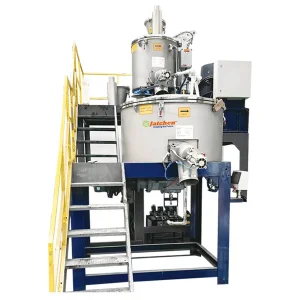
The BONDING MIXER controls the stirring temperature to slightly melt the surface of the base powder. At this point, metallic pigments are added, and they stick firmly to the base powder particles, forming composite particles with a consistent structure.
PLC Controlled Thermal Processing for Stable Particle Bonds
The entire bonding process is precisely monitored by a PLC. If the temperature is too high, the base powder can agglomerate and cake; if it is too low, metallic flakes may not achieve sufficient adhesion strength, leading to dry-blend separation. This precise automation solves common problems like color spots or spitting in metallic powder coating.
Multi Functional Structure for Enhanced Fluidity and Chargeability
Powder treated by bonding not only has better color consistency but also sees a huge improvement in overall charging and fluidity. This is not just a visual optimization; it is a reconstruction of the physical distribution of powder particles.
Why Choose Yantai Jatchen for Your Particle Size Optimization?
In the field of powder coating equipment, experience and technical accumulation cannot be bought. What you choose is not just a machine, but a whole set of production logic. With years of deep cultivation in the industry, this team has simplified complex physical processes into efficient and intelligent production lines.
Comprehensive Solutions for High Quality Powder Production
From mixing, extrusion, and cooling to grinding and bonding, what is offered here is a closed-loop solution. This full-line compatibility avoids parameter conflicts when connecting different brands of equipment, keeping your PSD under control from start to finish.
User Friendly Design for Easy Cleaning and Maintenance
Anyone who has worked in production knows that cleaning the machine is a nightmare. The designs take this into account, pursuing smoothness and zero dead corners in both the mixing pot and the grinding chamber. This saves time and prevents cross-contamination between batches.
Intelligent Systems for Enhanced Lean Production Efficiency
Through intelligent monitoring and precise mechanical design, you can achieve higher output with lower energy consumption. This is the charm of lean production. If you are looking for a reliable industrial partner, you might want to contact us directly to get a tailored plan based on your specific output needs.
FAQ
Q1: Why does my coating effect get worse after recycling the powder several times?
A: This is because the proportion of fine powder in the recycled material is too high, which changes the original particle size distribution. It is recommended to optimize the classification parameters during grinding or add appropriate particle stabilizers during production.
Q2: Does the speed of the extruder affect the final particle size?
A: Indirectly, yes. The speed affects the shear force and residence time of the material, which changes its brittleness. If the material is extruded too “tough,” it will be hard to break into the expected fineness during later grinding.
Q3: Does a longer mixing time mean a more uniform particle distribution?
A: Not necessarily. Over-mixing can cause the raw materials to overheat or even partially pre-cure, forming hard-to-process small lumps. Using an automatic mixer like the CM series and setting a scientific time of 3-5 minutes is usually most efficient.
Q4: What are the serious consequences if metallic powder is not bonded?
A: The most direct problem is “dry blend separation.” During spraying, metallic flakes will reach the workpiece earlier or later than the base powder, causing obvious color differences in the same batch, and the recycled powder becomes almost impossible to reuse.
Q5: What is a suitable thickness setting for the cooling belt?
A: For most industrial powders, a flake thickness of 1mm to 3mm is ideal. If it is too thick, the inside won’t cool through, causing the grinder to clog; if it is too thin, the output will suffer. You need to match the cooling belt speed to your specific extruder output.


