

What Is an Extruder’s Role in Powder Coating Extrusion Process
What Is an Extruder's Role in Powder Coating Extrusion Process
The powder coating manufacturing industry depends on extrusion as its essential production step which controls both product quality and production consistency. The extruder functions as the core equipment which unites blending and melting operations to create a uniform melt that will become the final product after cooling and grinding. The article examines how extruders operate in powder coating manufacturing through an analysis of performance elements which affect both product quality and production efficiency.
Yantai Jatchen Powder Coating Processing Equipment Co., Ltd. provides customized extrusion technology solutions for powder coating operations through their precise machinery and complete service package. Jatchen has established itself as a leading national provider of powder coating solutions through its extensive industry experience.
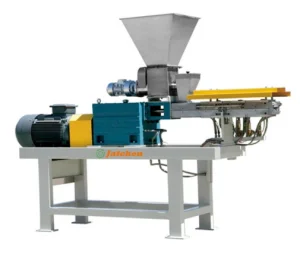
What Is the Function of an Extruder in the Powder Coating Extrusion Process?
The extruder functions as the mixing and melt-processing unit in powder coating extrusion. The extruder converts dry thermosetting resin and pigment and curing agent and additive powders into a single homogeneous molten substance.
Material Homogenization and Dispersion
The extruder performs a critical function by distributing all raw materials evenly throughout the melt mixing process. The feeder introduces materials into the barrel while rotating screws generate mechanical power to distribute all components uniformly. The feeder accepts premixed powder coating raw materials which then enter the barrel during operation. The rotating screws propel materials through the screw grooves which lead to the die head. The materials receive complete distribution during processing which stops any streaks or color variations from appearing in the finished powder.
Thermal and Mechanical Energy Input
The extrusion process utilizes both thermal and mechanical forces to initiate the melting process and ensure material uniformity. The external heaters melt the materials while screw rotation generates shear forces that knead and mix the components, including resins, curing agents, pigments, fillers, and additives. This heating process optimizes the flow characteristics of resins, and the shear forces from the screws break down agglomerates into small particles. This process requires precise temperature control, which is achieved by Jatchen’s twin-screw extruder with an efficient heating/cooling system maintaining temperatures within a ±2℃ range to support stable processing conditions.
Continuous Processing for Stable Output
The twin-screw extruder supports continuous production by maintaining stable material flow. The uniformly molten mixture exits the die head to produce high-quality semi-finished products, which are then used for tableting and crushing. The production line remains in continuous operation, with the products efficiently fed into the cooling belt and grinding equipment. This consistent material flow ensures a uniform particle structure and stable coating results, minimizing variability in the final product.
Why Is Twin Screw Extrusion Preferred for Powder Coating Production?
The twin-screw extruder is the preferred equipment for high-performance powder coating production due to its exceptional mixing performance and adaptable processing capabilities. This extruder offers superior material dispersion control and temperature management, making it ideal for various powder formulations, including clear coats, metallic finishes, and heavy-fill formulations. The co-rotating intermeshing screw design ensures faster and more efficient mixing compared to single screw systems.
Enhanced Mixing Efficiency
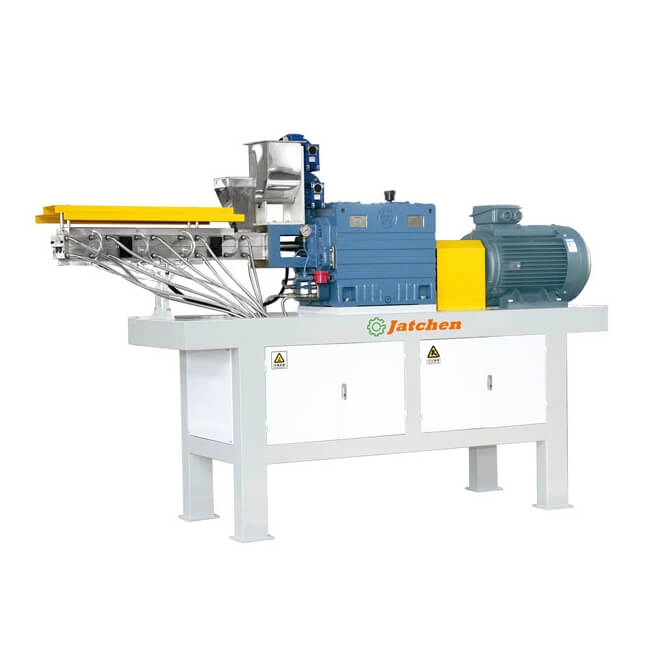
The twin screw extruder uses co-rotating intermeshing screws which generate better mixing results than single screw systems. The specific design of intermeshing screws along with their slot interactions produces powerful shear forces and stirring actions that generate effective pumping which results in fast kneading and dispersion. The system achieves complete integration of all formulation elements at the microscopic level.
Flexibility in Process Parameters
The system offers configurability as one of its benefits. The screw elements which include conveying and kneading and shear elements can be rearranged through mathematical formulas to support different processing requirements. The twin screw extrusion system allows users to design screw arrangements which fulfill various powder formulation needs from clear coats to metallic finishes with heavy fillings.
Stable Throughput and Temperature Control
Jatchen’s twin-screw extruder is equipped with an efficient heating/cooling system that ensures precise temperature control. The system maintains zone temperatures within a ±2℃ range, which is crucial for maintaining stable processing conditions and achieving uniform material flow during production. This precise temperature control supports consistent product quality and optimal processing of various powder formulations.
How Does Screw Design Affect Powder Coating Quality?
The design of the screws plays a critical role in the performance of the extruder. The mixing efficiency and product uniformity depend on three key factors: screw geometry, length-to-diameter ratio (L/D), and element configuration. The high-shear sections of the twin-screw extruder break down pigment clusters and filler agglomerates, improving pigment wetting and flow characteristics. This results in better component fusion and stable powder coating quality. The twin-screw system outperforms single-screw systems by providing more effective shear and mixing.
Influence on Residence Time Distribution
The design of conveying and kneading zones determines how long materials stay in different parts of the barrel. A consistent residence time enables all particles to receive the same thermal and mechanical processing which results in better batch quality.
Shear Intensity and Particle Size Control
The high-shear sections of the equipment work to break down pigment clusters and filler agglomerates into smaller pieces. The process improves pigment wetting during application while creating better flow characteristics. The dual screw design of this extruder outperforms single screw machines by effectively breaking down pigment clumps which results in better component fusion and stable powder coating quality.
Degassing and Volatile Removal Capability
Screw designs that include venting zones allow trapped air and volatiles to escape during processing operations. The venting function helps decrease coating porosity while creating a smoother film finish after application.
What Role Does Barrel Configuration Play in Extrusion Performance?
The barrel functions as a melting container which also determines the structural design that affects both processing efficiency and control methods.
Modular Design for Process Customization
The different sections of barrels serve specific purposes because they contain separate areas for feeding and melting and dispersing and venting operations. The clamshell design of the barrel features liner inserts which provide strong self-cleaning capabilities that enable fast formulation changes without product mix-ups.
Thermal Zoning for Precise Temperature Profiles
The system maintains precise temperature control for multiple zones through its efficient heating/cooling system which operates within a±2℃ temperature range. The system maintains separate thermal zones through modular control which enables processing of materials at their specific melting points and reaction limits.
Pressure Management Across Processing Zones
The design of barrels should control pressure distribution between zones to preserve melt uniformity while enabling steady production rates. The equilibrium between these elements enables the creation of uniform film layers during application.
How Does Yantai Jatchen’s Twin Screw Extruder Support Advanced Powder Coating Needs?
The TWIN SCREW EXTRUDER systems from Jatchen provide a reliable solution for equipment needs because they perform while adapting to changing production requirements.
Precision Engineering for Consistent Quality Output
The TSK series co-rotating twin screw extruder features deep groove design with low shear operation. The production system achieves stability through its combination of high-torque motors and zone control systems which maintain temperature precision at ±2℃ across all production levels.
Modular Construction Enhancing Process Flexibility
The sequence and quantity and type of materials in the process enable flexible process adjustments which produce different effects during conveying and kneading and shearing operations. Jatchen extruders operate according to your needs because they can be customized for any formulation requirement from high gloss whites to low cure hybrids.
Integrated Automation Systems for Operational Efficiency
The PLC&HMI system provides real-time monitoring through its automated error prevention system. The automated system decreases human mistakes while creating a safer working environment for operators.
What Are the Key Technical Considerations When Selecting an Extruder?
The selection of an extruder requires more than output capacity because it needs to match your production requirements and quality standards and production levels.
Throughput Capacity Relative to Production Scale
The output capacity of your equipment should match the size of your production batches. Jatchen provides laboratory-scale TSK22 models which produce 2–5 kg/h while their production units reach capacities above 500 kg/h.
Compatibility with Formulation Rheology Characteristics
The extruder needs to manage different viscosities found in thermoset blends while preventing overheating and under-shearing.
Maintenance Accessibility and Component Durability
The design should include quick-release screws and barrels which enable fast disassembly and cleaning operations during formula or color changes. The use of wear-resistant materials in screw and liner components helps to extend the equipment’s operational lifespan.
How Can Yantai Jatchen’s Solutions Optimize Your Powder Coating Line?
Jatchen provides complete powder coating production solutions through its full range of feeders and grinders which operate together for smooth process execution.
Turnkey System Integration Capabilities
Jatchen delivers complete feeding systems and cooling belts and grinding mills which operate in perfect harmony for both laboratory applications and 500kg/h production lines that span worldwide.
Technical Support from Formulation to Commissioning
The system provides access to process experts who help with formula adaptation and machine commissioning and troubleshooting and post-installation training. The system helps you achieve the highest possible return on your investment.
Proven Performance Backed by Industry Applications
Jatchen operates as a trusted partner for businesses across China which includes national research facilities and leading manufacturing companies. The company maintains a strong reputation through its ability to deliver efficient results that can be repeated at scale for various applications from building design to car paint finishing.
FAQ
Q1: What advantages does a twin screw extruder offer over single screw types?
A: The intermeshing design of twin screw extruders enables high shear dispersion and better processing parameter control which results in superior mixing performance.
Q2: Can I switch between different formulations quickly?
A: Yes. The quick-release barrel and self-cleaning screw design of these machines enables quick formulation changes while protecting against product contamination.
Q3: What effect does residence time have on the consistency of final products?
A: The process of controlling residence time allows thermal energy to affect all particles equally which results in uniform curing agent distribution and consistent film properties.


