

What Is a Powder Mixer and Why Is It Critical in Formulation
What Is a Powder Mixer and Why Is It Critical in Formulation
The process of powder mixing serves essential functions in multiple industrial sectors including and coatings because it ensures proper powder formulation stability which affects all subsequent manufacturing steps. The selection of appropriate powder mixing equipment determines how well your products will meet quality standards and operational efficiency in both pigment-based coating production and nutraceutical formulation.
Yantai Jatchen Powder Coating Processing Equipment Co., Ltd. stands as a reliable equipment manufacturer which produces optimized powder coating production equipment through their high-performance automated mixing systems. Their equipment solutions help you achieve process efficiency while maintaining exactness throughout your operations.
What Is a Powder Mixer and How Does It Work?
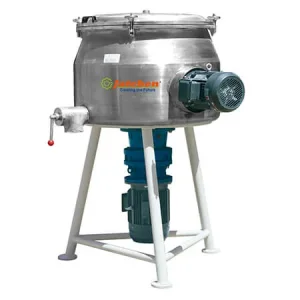
Industrial facilities use powder mixers as machines which distribute solid materials evenly through mechanical agitation to create uniform blends. The machine uses mechanical agitation methods to separate agglomerates while creating equal contact between all particles.
Definition and Core Function of Powder Mixers
Industrial powder mixers function as machines which use mechanical agitation to blend dry bulk materials until they become homogeneous. The machines operate to create uniform blends which need to follow exact formulation requirements for functional performance and color consistency and accurate dosage delivery.
Key Components and Mixing Mechanisms
The standard configuration of powder mixers includes a storage container for materials and a mixing tool that rotates to blend substances and a control system which operates speed and time settings. The system uses three main components to generate powder bed mixing forces through convection and diffusion and shear actions. The mechanical stirring process inside the container makes raw materials including resins and pigments and fillers and additives move against each other. The system distributes all components evenly through convection and diffusion and additional effects to reach proper mixing levels.
Common Types of Powder Mixing Technologies
The combination of different technologies falls into three distinct categories.
- Convective mixing: Moves bulk material by mechanical force for fast blending.
- Diffusive mixing: Relies on random particle movement; slower but gentle.
- Shear mixing: Applies localized force to disperse cohesive materials or break up clumps.
The selection of method depends on both the physical characteristics of the material and the desired outcomes of the process.
Why Is Powder Mixing Critical in Industrial Formulation?
The process of powder mixing serves as a fundamental quality control measure which enables manufacturers to achieve their production goals. The combination of ingredients through powder mixing requires more than basic mixing because it directly affects manufacturing efficiency and product safety.
Role in Ensuring Product Uniformity and Quality
The process of uniform mixing produces batches that maintain equal chemical properties and visual appearance and operational performance. The powder coating industry requires uniform pigment distribution because any inconsistencies will produce color differences in their final products. The process produces materials with uniform composition which becomes essential for extrusion operations and serves as fundamental equipment in powder coating manufacturing to achieve complete component integration.
Impact on Downstream Processing Efficiency
A powder blend that achieves uniform mixing will move more smoothly through feeders and extruders while staying evenly distributed during storage and transportation. The process becomes more efficient because it produces less waste.
How Do Different Powder Mixer Designs Affect Performance?
The design parameters of vessel shape and flow patterns and operation mode determine the efficiency of material mixing processes.
Comparison Between Batch and Continuous Mixers
Batch mixers provide flexibility and simple recipe modifications which make them suitable for research and development operations and limited production runs. The production requirements of high-throughput facilities with stable input materials make continuous mixers more suitable than batch mixers.
Integration With Automation Systems for Process Control
The Jatchen brand of modern mixers operates through PLC-based systems which enable users to control rotation speed and mixing time and activate safety functions in real-time. The automated system produces consistent results through automatic operations that need minimal human involvement.
What Are the Advantages of Jatchen’s Powder Mixer Solutions?
High Precision With Automatic Container Mixer
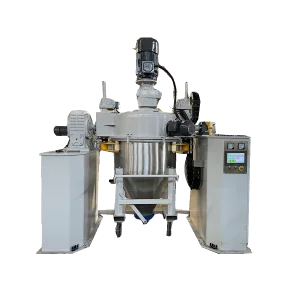
The Automatic Container Mixer serves to combine different solid powder materials (resins and curing agents and pigments and fillers and additives) into uniform blends according to exact measurement requirements. The system contains all components in one unit which prevents contamination between batches while enabling quick transitions between production runs. The system uses mechanical stirring and crushing to create relative motion between resins and pigments and fillers and additives inside the container.
Gentle but Effective Blending With Twin Cone Blender
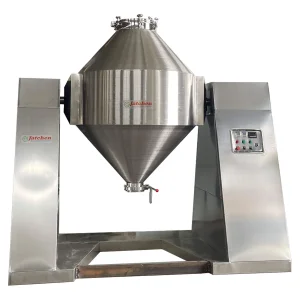
The twin cone blender functions as a material mixing device for powder coating production. The twin-cone container of the machine operates through motor power which drives the transmission system. The design structure of the blender reduces shear forces while achieving complete material mixing through its rotating motion pattern. The materials create intricate paths during rotation because they experience both axial tumbling and radial diffusion.
Fast Homogenization With High Speed Mixer
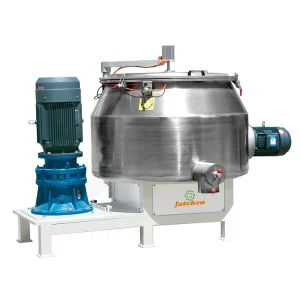
The high speed mixer functions as a specific tool for powder coating production to combine various unprocessed materials. The device operates through high-torque blades which generate powerful shear forces to achieve fast pigment and additive dispersion. The device produces materials with uniform composition which enables successful extrusion processing in high-volume manufacturing environments.
What Factors Should Be Considered When Selecting a Powder Mixer?
The selection of a mixer depends on multiple factors which directly relate to your specific formulation needs.
Characteristics of the Powders Being Mixed
The selection of a suitable mixer depends on four essential factors which include particle size distribution and flow behavior and density differences and moisture sensitivity. The Twin Cone Blender operates at low shear levels for fragile materials but the High Speed Mixer works best for blends containing many pigments.
Required Batch Size and Production Throughput
Scalability is key. A large-scale facility would choose continuous mixer setups but smaller operations would select batch systems including the Automatic Container Mixer for their flexibility needs.
Level of Automation and Integration Needs
Smart manufacturing environments require automated controls for their operation. The PLC systems in Jatchen’s products enable digital interface capabilities which support easy integration with contemporary production systems.
How Does Jatchen Support Clients Beyond Equipment Supply?
Jatchen provides complete support to its customers through equipment delivery and operational goal-based technology implementation.
Technical Consultation Through Solution Center Services
Their team provides customized process design solutions which match your specific formulation requirements. Their experts will help you find the best solution by optimizing particle flow and improving cycle times.
After-Sales Support Including Installation and Maintenance
The full-service packages provide customers with on-site installation services and operator training programs and scheduled maintenance and spare parts delivery and technical support for system operation.
Continuous Innovation Backed by Industry Expertise
The Jatchen particle size optimization system which the company developed independently serves as the top choice for high-quality powder coating manufacturers who need advanced powder-making equipment. Jatchen continues to fund research and development to maintain its position as a leader in precise mixing technology.
FAQ
Q1: What is the primary function of a powder mixer?
A: A powder mixer blends solid powders uniformly through mechanical movement to create batches with consistent chemical composition.
Q2: Why is uniform powder mixing important?
A: The system provides dependable product quality results while improving operational efficiency and minimizing waste and maintaining all necessary regulatory standards.
Q3: How does automation enhance mixer performance?
The PLC system enables real-time parameter control for mixing operations which produces consistent results and makes production processes more efficient.
Q4: Where can I find reliable industrial powder mixers?
A: The official website of Jatchen provides high-performance solutions for your specific application through their Automatic Container Mixer and High Speed Mixer automated options.


