

How to Increase Extruder Output: Calculation and Optimization Guide
How to Increase Extruder Output: Calculation and Optimization Guide
In the field of powder coating manufacturing, the extruder serves as the main driving force. When your production rate falls behind, the whole assembly line decelerates, which impacts your financial results. Boosting productivity involves a combination of accurate calculations and reliable machinery. Yantai Jatchen Powder Coating Processing Equipment Co., Ltd. offers the expert knowledge required to transform these engineering issues into effective operations. By examining the way raw ingredients travel through your screws and handling temperature wisely, you can greatly enhance your hourly yield.
Foundations of Extruder Output Calculation
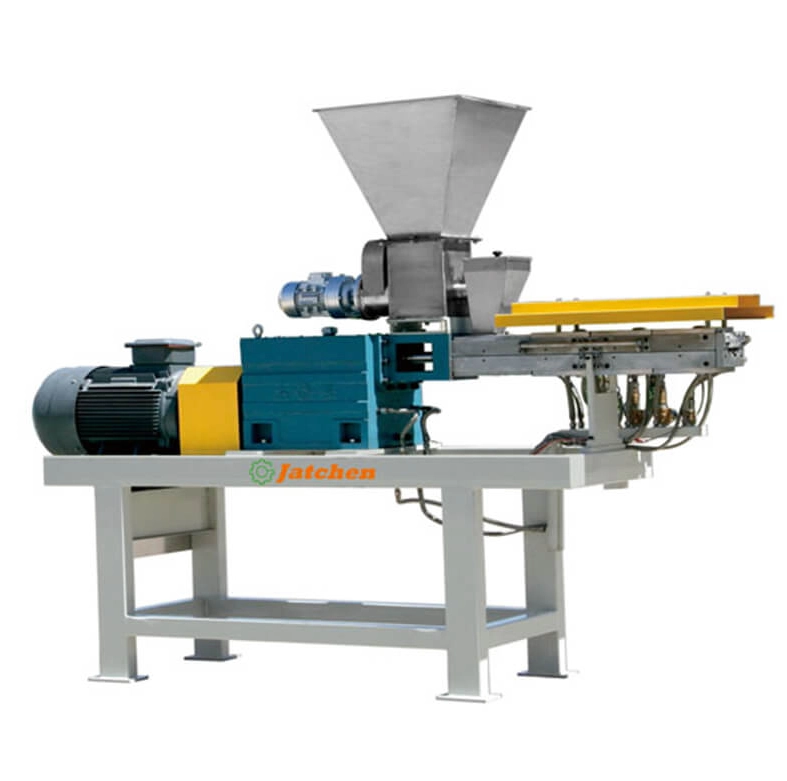
To grasp your present performance level, you need to examine the workings of your screw closely. The expected capacity relies on various physical elements, such as the screw’s width, the height of the threads, and the turning rate expressed in RPM. For example, a substantial unit like the TSK98 has a 98 mm screw diameter, and it achieves yields from 1200 to 1500 kg/h while operating at 420 rpm.
In practice, the ideal volume is seldom achieved because of differences in material compactness and inconsistencies in supply. You can assess your real performance by measuring the amount of extruded substance over a set period and comparing it to the top speed your motor can handle. If a significant difference appears, it typically indicates that your supply mechanism fails to fill the screw threads completely.
Addressing Inconsistent Material Feeding and Throughput Fluctuations
Do you observe sudden increases in your ingredient flow or uneven pressure near the equipment’s front end? Such issues frequently arise when the initial material clumps in the storage container or does not flow into the screw steadily. Irregular supply not only reduces your overall yield but also disrupts the uniformity of the softened blend.
The TWIN SCREW EXTRUDER resolves this challenge through an effective screw supply system that prevents delays. This setup guarantees that resins, pigments, and additives move into the cylinder in a consistent and even manner. As the supplier delivers a steady amount, the screws can sustain peak pressure without lacking input, and this approach simply helps maintain your production figures at a high level without requiring a more powerful engine.
Solving the Bottleneck of Poor Heat Management and Melt Quality
If you must reduce the screw’s turning rate to avoid scorching the material or because it fails to soften adequately, then you face a temperature control difficulty. When substances do not blend properly under heat, the resulting combination lacks evenness, and you will produce a lot that does not pass inspection standards.
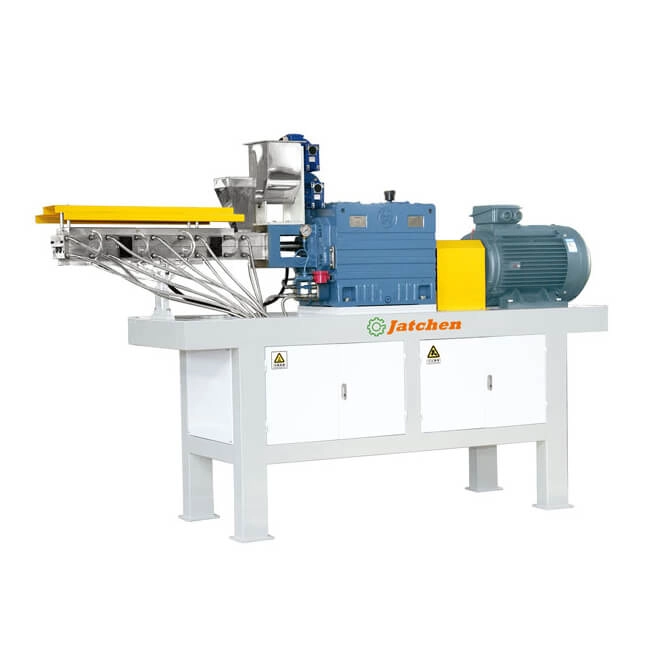
Advanced devices incorporate a cylinder built with inner linings and a split-open framework to improve heat consistency. Accurate regulation plays a crucial role in this area, for maintaining heat levels within a ±2°C range over several sections enables you to operate at faster rates while preserving an ideal softened state. When paired with a WATER COOLING BELT, this ensures that after the substance exits the front as a steady softened flow, it hardens rapidly into flat pieces ready for further processing.
High Maintenance Downtime Reducing Net Production Hours
Among the most significant hidden factors that harm productivity, one stands out as the duration when the equipment remains inactive. Conventional cylinders prove extremely difficult to clean during shifts in color. If you dedicate three hours to scrubbing between runs, you forfeit substantial amounts of possible goods each week.
The split-open cylinder structure represents a major improvement for upkeep tasks. Operators can simply access the cylinder to reveal the screws, which allows for straightforward removal of remnants without hidden spots. Since the screw parts feature a self-cleaning mechanism, the quantity of remaining substance stays low. Consequently, this cuts down the time you invest in manual scrubbing with tools, and it enables quicker return to active manufacturing.
Optimizing Output through Advanced Mechanical Configuration
At times, the equipment components themselves create the restriction. A fragile transmission or a motor with limited power will falter as you raise the thickness of your powder blend. When your motor operates continuously near its maximum, you invite a halt due to overload safeguards.
For demanding factory applications, selecting a strong transmission with high power delivery and quiet operation, along with integrated oiling, becomes essential. The TSK75, for instance, employs a 55 or 75 kW primary motor to achieve up to 1000 kg/h. Adopting a screw with deeper grooves also proves beneficial, as it transports greater volumes per turn while minimizing friction effects, which suits the goal of handling large quantities without harming the essential traits of your resins.
Integrating Intelligent Controls to Eliminate Human Error
Adjustments done by hand tend to proceed slowly and lack precision. Should an operator overlook a sudden rise in heat or a blockage in the supplier, the production rate declines immediately. This situation resembles attempting to operate a vehicle without a functioning gauge for speed, where you remain uncertain about whether you approach the boundary or fall short of it.
Contemporary setups employ automated controls through PLC and HMI interfaces to remove uncertainty from the procedure. These panels permit saving formulas and tracking manufacturing information as it occurs. In cases where parameters deviate from standards, the setup can notify personnel or perform self-corrections to uphold the desired yield.
Scaling Your Production with High-output Solutions?
Selecting the appropriate equipment size to fit your regular batch quantities marks the concluding phase in refinement. Employing a large TSK98 for a mere 50 kg trial wastes resources, yet attempting to fulfill a 10-ton requirement with a small-scale TSK30 generates a severe restriction.
Jatchen supplies a complete range of manufacturing systems tailored to your particular demands:
Small Scale: The TSK35/40 series suits yields up to 200 kg/h effectively.
Medium Scale: The TSK55/65 units provide a reliable intermediate option, capable of reaching up to 800 kg/h.
Industrial Mass Production: Robust TSK85/98 devices manage capacities up to 1500 kg/h, ideal for substantial orders.
By aligning your equipment with your typical order sizes, you position the motor to function within its most efficient range consistently. To gain insights into how these systems perform in real settings, consider reviewing customer cases from various locations worldwide.
FAQ
Q1: How do I know if my feeder is the cause of low output?
A: If your screw speed remains high yet the substance emerging from the front shows irregular bursts or reduced thickness, then your supplier probably fails to deliver a uniform stream or suffers from clumping within the storage hopper.
Q2: Can I increase output by just increasing the RPM?
A: You can do so only up to a specific threshold, because raising the RPM without adequate cooling or an appropriate screw layout will cause excessive heating of the substance, resulting in substandard softened quality or activating the high-temperature warning.
Q3: What is the benefit of a clam-shell barrel for output?
A: Although it does not elevate the screw’s turning rate directly, the clam-shell barrel greatly shortens the inactive periods during color transitions and cleaning routines, thereby increasing the total hours dedicated to actual manufacturing each day.
Q4: Why does the L/D ratio matter for throughput?
A: The Length/Diameter ratio influences the duration materials spend inside the equipment, and a 16D screw, common in many TSK models, offers sufficient length to allow ingredients to warm up, soften fully, and blend adequately before extrusion occurs.
Q5: How does a water cooling belt affect the extruder’s performance?
A: Even though it functions as a distinct component, an efficient water cooling belt such as the GDJ series stops the extruder from facing backups caused by warm, unhardened substance, and this promotes a smooth and rapid progression through the entire process.


