

Five Critical Factors Affecting Powder Blending Uniformity
Five Critical Factors Affecting Powder Blending Uniformity
Achieving a perfect mix in powder coating production is not just about turning on a machine and hoping for the best. It is the core process that determines whether your final product looks professional or like a botched DIY project. When you deal with resins, pigments, and additives, even a tiny lapse in blending uniformity can lead to color streaks or inconsistent gloss that ruins an entire batch. This is why industry leaders like Yantai Jatchen Powder Coating Processing Equipment Co., Ltd., a professional supplier with plentiful experience in high-end machinery, focus so heavily on the science of particle distribution. If you want to elevate your lean production line to a higher level, you need to master the specific variables that keep your powder homogeneous from start to finish.
1. Physical Properties of Raw Materials and Proportions
The first hurdle in blending is the sheer diversity of what you are putting into the tank. You are likely mixing solid powder raw materials like resins, curing agents, pigments, and fillers. These materials do not always play nice together because they have different weights and shapes. If one component is much heavier than another, it might sink to the bottom while lighter additives float, leading to a “layered” mix that fails subsequent extrusion.
Jatchen Precision Solution: Mechanical Crushing and Stirring To fix this, you need equipment that uses mechanical force to make different raw materials move relatively within the container. Through convection and diffusion effects, each component gets evenly distributed. For crushing and mixing solid coarse or lumpish multi-component materials, the High Speed Mixer of the HLJ series is a workhorse. It uses an automatic timer to manage the mixing and crushing cycles, making sure those stubborn lumps do not survive the process.
2. Inconsistent Color and Gloss Between Batches
Are you tired of seeing color shifts when you switch from a white architectural powder to a dark industrial coating? This is a classic pain point in the industry. Traditional mixers often have “dead ends” where old powder gets stuck, leading to cross-contamination. Cleaning these machines manually is a nightmare that eats up hours of your production time.
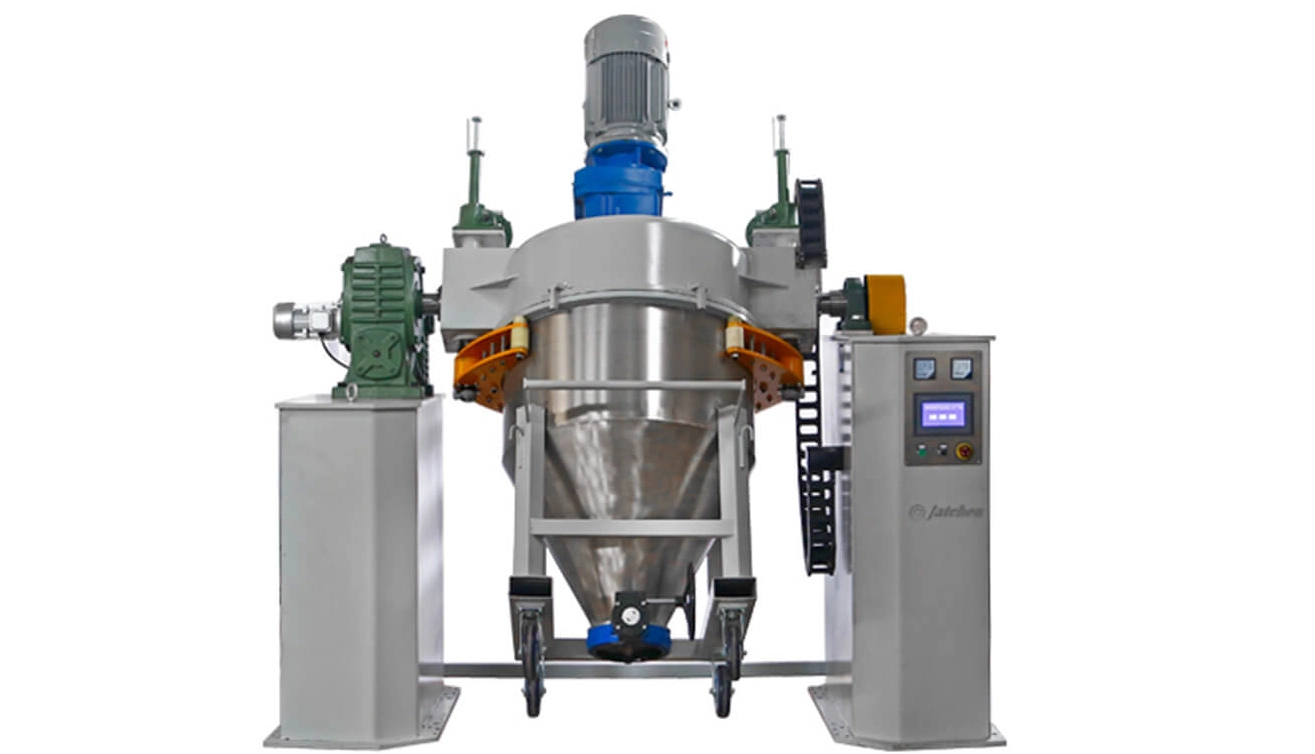
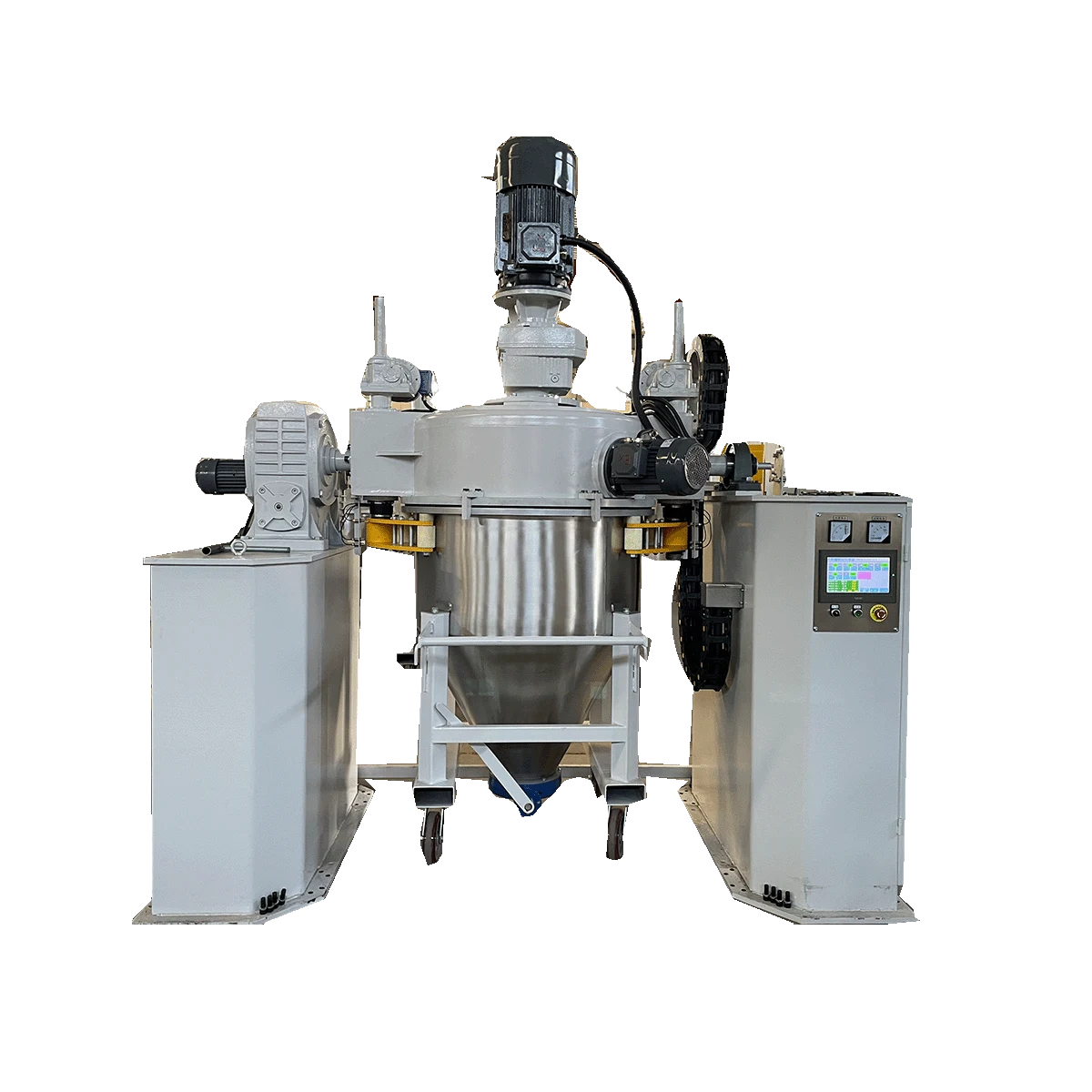
Solution: The Moveable Container Concept The best way to stop this is to use a system where the container itself is movable. An AUTOMATIC CONTAINER MIXER solves the cleaning headache because you can use multi-trolleys for operation. While one trolley is being mixed, you can be cleaning another. The trolley filled with your raw material is lifted and connected tightly with the mixing parts, then mixed automatically. Since it is controlled by a PLC and HMI system, you get high efficiency and a homogeneous mix every single time without the risk of human error.
3. Mechanical Force and Advanced Impeller Design
If your mixer does not provide enough “kick,” your additives—which often make up a tiny percentage of the total weight—won’t spread out. You need enough shear force to break down agglomerates.
Jatchen Solution: Specialized Blade Engineering You should look for mixers with optimized blade structures. For example, some high-end setups use propeller blades that are easy to clean and change color. In more specialized cases like metal powder bonding, you need the Bonding Mixer BD series, which uses mechanical or thermal force to make particles of different sizes collide and rub against each other. This creates a binding force on the surface so that small particles adhere to larger ones, significantly improving the fluidity and chargeability of your powder.
4. Powder Leakage and Workshop Contamination?
Nobody likes a dusty workshop. Beyond being a health hazard for your staff, powder leakage means your carefully calculated proportions are now wrong. If 2% of your pigment leaks out of a faulty shaft seal, your color consistency is gone.
Solution: Double-Seal Technology and Dust Vacuums You need a machine that treats sealing as a priority. High-quality mixers feature double-seals for the shaft to prevent any powder from escaping and to stop the formation of solidified particles. For an even cleaner environment, advanced systems like the CM series come equipped with an automatic dust vacuum. This keeps the environment safe and helps you comply with environmental protection standards.
5. Scaling From Laboratory to Industrial Production
A formula that works in a 5kg test batch often fails when you try to produce 500kg. This “scale-up” gap is where many companies lose their competitive edge.
Solution: Synchronized Lab and Production Parameters To avoid this, use laboratory equipment where the main technical parameters match the full-scale production line. For instance, a small Lab Mixer should use a similar principle to an industrial mixer but on a smaller scale for batch testing. This provides the technical support and parameter basis you need for large-scale production. When your R&D results are reliable, you can reduce the raw materials wasted during sampling and get your product to market 30% faster.
FAQ
Q1: How long does a typical powder mixing cycle take?
A: For most high-speed or container mixers, the mixing time is quite fast, usually between 3 to 5 minutes per batch.
Q2: What is the benefit of a PLC and HMI control system?
A: It automates the process and stores recipes, allowing you to call up specific parameters so that every batch is identical, which reduces human error.
Q3: Can I achieve a 97% recovery rate with these systems?
A: Yes, advanced grinding and mixing systems, especially those with the Jatchen particle size optimization system, can reach a recovery rate of 97% or higher.
Q4: How do I prevent powder from sticking to the inside of the mixer?
A: You should choose equipment with mirror-polished stainless steel interiors or non-stick ceramic coatings, which make it much harder for powder to adhere.
Q5: Is it possible to mix and crush materials at the same time?
A: Absolutely. Equipment like the HLJ series features both a mixing motor and a crushing motor to handle multi-component materials simultaneously.


