

A Complete Guide to the Various Types and Applications of Grinding Mills
A Complete Guide to the Various Types and Applications of Grinding Mills
Modern industrial production depends on grinding mills to achieve exact particle size reductions for various materials and industrial uses. The selection of appropriate mill technology between brittle compounds for coatings and robust ores for mineral processing leads to better operational efficiency and product quality. The selection of grinding mills for powder coating and fine chemicals and metallurgy operations determines how well operations run and affects both production rates and power usage and product quality.
Yantai Jatchen Powder Coating Processing Equipment Co., Ltd. serves as a leading provider of powder coating production equipment solutions which meet specific industry requirements. Their equipment range from laboratory testing devices to complete production lines which operate in modern manufacturing facilities.
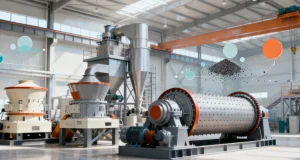
What Are the Main Types of Grinding Mills Used in Industrial Applications?
The selection of grinding mills depends on the specific material properties and processing requirements because they exist in multiple configurations.
Impact Mill Systems for Fine Powder Processing
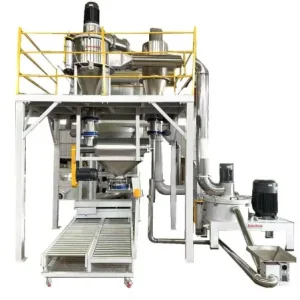
The operation of impact mills depends on fast-moving rotors which generate particle collisions against stationary surfaces and other particles until they break apart. The systems excel at processing brittle materials which need both fine particle sizes and precise particle size control.
The ICM series grinding system features a compact design which serves as a specialized tool for processing brittle materials into fine powders. The system enables users to achieve precise product characteristics including color strength and gloss levels. The ICM GRINDING SYSTEM delivers exceptional performance for industries that need consistent results and high-quality products.
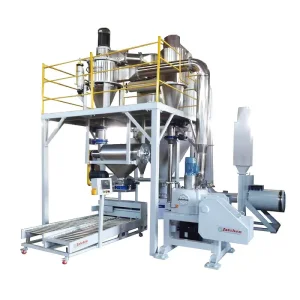
Air Classifying Mills with Integrated Classification
The single unit of Air classifying mills (ACMs) performs mechanical impact and aerodynamic classification operations.
The ACM system operates at high speed through grinding and air classification and cyclone separation and sifting and fine powder collection. The Jatchen classifier cyclone system enables users to achieve perfect powder coating particle size distribution. The ACM GRINDING SYSTEM serves powder coating operations because it delivers both high precision and maximum efficiency.
Ball Mills for Coarse-to-Fine Grinding Tasks
Ball mills operate through tumbling action which enables grinding media to crush and grind materials by performing impact and attrition operations. The processing of hard materials including minerals and ceramics occurs through the use of these mills during their initial stages.
Ball mills serve as pre-processing tools before materials reach advanced systems like ACMs or ICMs although they do not produce ultra-fine particle sizes as well as air classifying or impact mills do.
How Do Different Grinding Mills Operate Mechanically?
The different grinding mill types operate through unique mechanical systems which determine their effectiveness for particular applications. Knowledge of these mechanisms enables you to achieve better process results while preserving product quality standards.
Rotor-Stator Interaction in Impact Mills
The impact mill configuration uses fast-moving rotors to transfer energy which breaks down particles. The materials experience impact and grinding and shearing actions through high-speed rotating grinding discs and impact columns and toothed rings which lead to successful particle size reduction. The ICM Grinding System achieves exact upper particle size control while generating steep distribution patterns.
Airflow Control and Classification in ACM Systems
The internal classifiers of ACMs operate through centrifugal force and aerodynamic drag to sort particles. The milling machine accepts tableted materials for processing. The classification device operates simultaneously with the powder classification process to extract finished powder coatings that fulfill particle size standards. The system enables real-time adjustment of cut-points through automated processes which eliminates the need for manual sieving operations for continuous production needs that require precise output control.
Tumbling Action and Media Selection in Ball Mills
The grinding process in ball mills depends on rotational motion which creates a cascading effect of grinding media. The mechanical process of grinding media compression leads to material fragmentation. The selection of grinding media types and sizes determines both the milling performance and the risk of contamination in the process. The process of grinding materials through size reduction makes ball mills suitable for initial mineral processing stages before further classification steps.
In Which Industries Are Grinding Mills Most Commonly Applied?
The grinding technology sector operates throughout various industrial sectors. The selection of equipment depends on both the characteristics of processed materials and the desired product specifications.
Powder Coating Production for Surface Finishing Materials
The uniformity of powder coating fineness determines both the uniformity of application and the final film characteristics. The machine transforms tableted materials into small powder particles which produce finished powder coatings that fulfill particle size specifications. The equipment serves as a crucial tool to reach the desired particle size for powder coatings. ACM systems and ICM systems have become standard in powder coating production because they provide dependable results while minimizing material loss.
Chemical Processing for Pigments, Additives, and Catalysts
The production of chemicals needs facilities which maintain minimal contamination levels while scientists must precisely manage temperature conditions and particle structure. The ICM GRINDING SYSTEM operates as a high-throughput system which enables reactive compound processing through inert gas functionality.
What Are the Key Parameters That Influence Grinding Efficiency?
Multiple variables which can be controlled by operators determine the efficiency of grinding operations. The optimal performance of mills together with energy efficiency occurs when these parameters match the properties of processed materials.
Particle Size Distribution Requirements by End Use Application
The required particle size distribution determines the complexity level of your classification system. The electronics and coatings industries need precise particle size distributions which ACM GRINDING SYSTEM with its advanced classifier speed controls can efficiently produce.
Material Hardness, Moisture Content, and Flowability Characteristics
The processing of difficult materials requires strong systems which include ball or reinforced impact mills. The processing of powders that react to moisture needs dry milling systems which the ICM GRINDING SYSTEM with enclosed chambers provides as an optimal solution.
Mill Design Features Including Rotor Speed, Classifier Settings, and Cooling Options
The system enables you to optimize output through speed adjustments of the rotor and classifier settings without needing to modify the initial feed materials.
How Can Grinding Mill Systems Be Optimized for Energy Efficiency?
Industrial production requires energy reduction because it directly affects business financial performance. The implementation of mill configuration optimization together with process integration methods produces substantial energy reduction benefits.
Closed-Circuit Milling with Integrated Classification Units
The system operates in closed-loop mode to process only large particles which need additional processing while preventing excessive grinding of other materials. The classification device separates finished powder coatings from the powder stream based on their particle size requirements. The ACM system maintains consistent operation through this feature which operates at reduced energy levels.
Real-Time Monitoring of Particle Size via Inline Sensors
The implementation of sensors allows for adaptive control systems which manage classifier speed and airflow patterns to achieve optimal quality while minimizing power consumption during manufacturing operations.
Process Integration with Upstream/Downstream Equipment
Your production process becomes more efficient when you connect mills to feeders and filters and packaging lines. Yantai Jatchen Powder Coating Processing Equipment Co., Ltd. provides complete solutions through its product range which allows you to integrate their equipment directly into your manufacturing facility.
What Are the Advantages of Using Advanced Grinding Technologies Like Those Offered by Jatchen?
The selection of advanced milling technology solutions brings you machinery investments which lead to sustained operational stability and consistent product quality.
Enhanced Product Quality Through Precision Engineering
The product achieves perfect flowability and uniformity because of its defined upper particle size boundary and its narrow particle size distribution. The two systems ACM and ICM possess these characteristics as their fundamental properties.
Reduced Downtime Due to Modular Design and Easy Maintenance
The systems include replaceable parts which maintain operational continuity because they can be swapped out without requiring complete assembly disassembly for maintenance.
Scalability Across Laboratory to Full Production Volumes
The modular systems enable performance maintenance during scale-up operations from small R&D batches to 1000 kg/h industrial production lines. Their Contact Us page enables you to contact their specialists for custom system designs that match your facility layout and formulation requirements.
FAQ
Q1: What factors should I consider when choosing the right grinding mill for my application?
A: You should evaluate material hardness, moisture content, flowability, required particle size distribution and desired production capacity.
Q2: How choose between an impact mill and a ball mill?
A: Ball mills should be used first to grind hard materials into coarse particles before switching to impact or air classifying mills for achieving smaller particle sizes.
Q3: Can these mills operate continuously without overheating?
A: Yes. The ACM and ICM systems use cooling systems to handle heat buildup when they run for extended periods.


