Achieving Homogeneous Powder Blending with Twin Cone Blenders
In powder coating production, mixing is not a small step. It decides whether resin, pigments, fillers, and additives can move into the next process with a stable and even composition. If this step is weak, the later extrusion and grinding stages will keep showing problems. You may see uneven color, unstable flow, more cleaning work, and more wasted material.
For factories that want a practical mixing solution, 烟台雅琴粉末涂料加工设备有限公司。 is a reliable equipment supplier worth serious attention. The company focuses on powder coating processing equipment and lean production lines for domestic manufacturers. It has long experience in developing mixers, extruders, cooling belts, grinding systems, laboratory equipment, and full production line layouts. What makes the company useful for buyers is not only the machine itself, but also the way it looks at the whole process. A mixer has to match extrusion. A cooling belt has to match grinding. Cleaning, color change, sealing, safety, and operator convenience all have to be considered together. This is why many buyers choose this company when they need production equipment that is easy to use, stable in daily operation, and suitable for real factory conditions.

Why Uniform Powder Mixing Matters in Coating Production
Before choosing a blender, you need to look at what poor mixing actually does to your production. Powder coating formulas often contain several raw materials with different densities and flow behavior. If they do not mix well, the next process will not fix the problem completely.
Impact of Inconsistent Particle Distribution on Product Quality
When each component is not evenly distributed, the finished powder may not behave the same from batch to batch. One batch may show better flow, while another batch may need more adjustment later. This is not only a quality issue. It also makes production planning harder.
A stable mix helps the following extrusion process receive material with a more even composition. The extruder can then work in a more predictable way, and the later grinding process has a better material base to work with.
Challenges in Multi-Component Powder Formulations
Resins, pigments, fillers, and additives do not always move in the same way inside a container. Some materials are lighter. Some are heavier. Some flow easily, while others tend to stay in one area if the mixing action is weak.
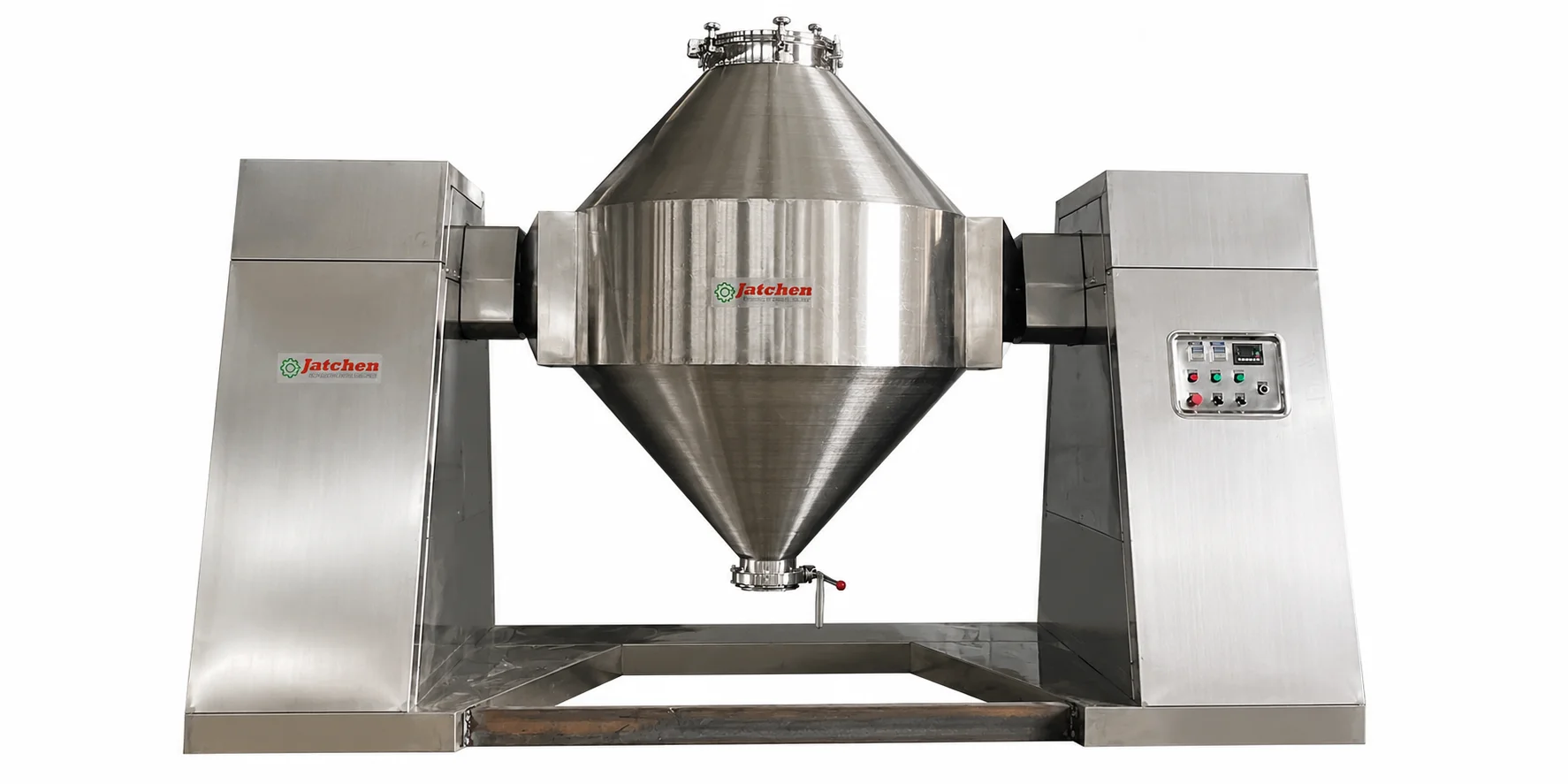
This is where a Mixer – TWIN CONE BLENDER becomes useful. The twin cone structure helps the material roll, turn, and spread repeatedly inside the stainless steel container, so different components can reach a more even state without complicated operation.
Consequences for Efficiency and Waste Reduction
If the blending result is poor, you may need to mix again, clean more often, or adjust later process parameters. Each extra step costs time. It also increases material loss, especially when you change colors or produce several formulas in one workshop.
A stable blender reduces these small problems before they grow into bigger production delays. For daily factory work, that matters more than fancy descriptions.
How Twin Cone Blenders Ensure Consistent Powder Mixing
A twin cone blender uses a simple but effective working method. The container rotates, and the powder moves with gravity and rotation. The material keeps changing position inside the vessel, which helps different components contact each other again and again.
Design Features That Promote Uniform Mixing
The twin cone structure is suitable for mixing powder products and other multi-component materials. The container is made of stainless steel, and the inner surface is mirror polished. This helps powder move more smoothly and makes cleaning easier after production.
The discharge port uses a stainless steel sealed butterfly valve. This design helps reduce dust leakage during discharge and keeps the work area cleaner. For powder coating production, that is a very practical detail.
Gravity and Rotation Mechanism for Better Homogeneity
The blending action does not need an overly complex structure. The rotating container lets powder fall, spread, and turn inside the two cone sections. With enough mixing time, the components become more evenly distributed.
The machine supports time setting and stable operation. Its rotation speed is controlled by VFD, usually within 6 to 9 r/min. This gives operators a simple way to match the mixing condition with the material and batch requirement.
Preventing Powder Segregation and Clumping
A good blender should not create new problems while solving old ones. The sealed discharge design helps reduce dust leakage, while the polished container helps lower material residue after discharge.
In a complete powder coating line, this type of blender can also work with other equipment features such as PLC/HMI control, low shear processing design, sealing anti-leakage structure, automatic lifting in matching systems, and low-dust material handling. The key is to make the whole production process easier to control, not just to mix one batch.
Key Advantages of the Mixer – TWIN CONE BLENDER
The real value of this machine is in daily use. You need a blender that gives stable blending, does not take too long to clean, and can match your production scale.
Precision Mixing for Multi-Component Powders
The blender is made for powder products and multi-component materials. In powder coating production, it can help mix resins, pigments, fillers, and additives before the material moves to the next stage.
A more even pre-mix gives the downstream process a better start. You do not want the extrusion stage to receive raw material with one area rich in pigment and another area short of additives. That kind of problem is hard to control later.
Easy Cleaning and Low Maintenance
Color change is always a real concern in powder coating factories. If a machine is hard to clean, the downtime between batches becomes too long. It may also bring color carryover.
The stainless steel container with a mirror-polished inner surface is easier to clean. The structure is not unnecessarily complicated, so operators can handle routine cleaning and maintenance with less effort. Low noise and stable running also make the machine more comfortable for regular workshop use.
Scalable Models for Different Production Volumes
The blender has several model choices. SHJ-300 offers 50 to 150 kg/h output. SHJ-500 reaches 100 to 250 kg/h. SHJ-1000 can handle 300 to 1000 kg/h, while SHJ-2000 supports 800 to 1000 kg/h.
This range gives you room to choose based on your real batch plan. You do not need to overbuy a large machine if your production volume is moderate. You also do not need to limit output with a machine that is too small.
Solving Common Powder Blending Pain Points
Most buyers do not only ask whether a blender can mix powder. They care about batch consistency, cleaning time, powder loss, and whether the machine can fit into their existing line.
Reducing Material Waste Through Efficient Mixing
A steady mixing process helps each batch reach the required composition faster. This means fewer repeated operations and less material left behind after discharge.
The stainless steel sealed butterfly valve also helps during unloading. Powder can be discharged with less leakage, so the workshop stays cleaner and material loss is easier to control.
Minimizing Downtime With Quick Discharge and Cleaning
A smooth inner container and practical discharge structure help reduce cleaning pressure. This is useful when you produce different colors or formulas in one line.
For buyers comparing different production equipment, the wider 产品系列 is also worth checking. A blender should not be selected alone. It should match the whole line, including extrusion, cooling, grinding, and weighing.
Improving Production Consistency Across Batches
Repeatable operation matters. Time setting, stable rotation, and VFD speed control help operators keep a similar mixing condition from batch to batch.
This is not about making the operation complicated. It is about giving the operator enough control to keep quality steady without relying only on experience.
Integrating the Twin Cone Blender into Your Powder Coating Line
A blender works best when it fits the production flow. In a powder coating plant, mixing usually comes before extrusion, cooling, grinding, and final collection. If the first step is steady, the whole line runs with fewer surprises.
Optimizing Workflow With Pre- and Post-Mixing Equipment
Raw materials first need to be prepared and mixed in proper proportion. After blending, the material can move into extrusion equipment, then cooling and crushing, then grinding and classification.
This process is already common in powder coating production. The point is to make each step connect smoothly. If you are planning a new layout or improving an old one, the 解决方案中心 can help you see how different machines may fit together.

Enhancing Productivity With Modular Layouts
Some factories need flexible production because order sizes change. Others focus on stable batch production. The blender can be selected according to the planned output, then matched with the right downstream equipment.
A clean layout reduces material transfer problems. It also helps operators move around the machine safely and clean it faster after each batch.
Complementary Systems for Particle Size and Quality Control
After mixing and extrusion, the grinding stage decides the final powder size. If you want better particle size control, the production line can include grinding and classification systems to keep the final powder closer to the target range.
Good blending does not replace grinding. It supports grinding. A more even feed material helps later equipment run in a steadier way.
Maintenance, Safety, and Operational Tips
Even a simple machine needs correct use. If you take care of the blender, it can keep stable performance for a longer time.
Best Practices for Cleaning and Component Longevity
Clean the inner container after each batch, especially when changing color. Use suitable cleaning tools that will not damage the polished surface.
Check the discharge valve and sealing area regularly. If powder builds up around these parts, clean it before the next batch. Small habits like this reduce later trouble.
Safety Measures During Operation
Operators should keep away from rotating parts when the machine is running. Maintenance should only be done after the machine is stopped and secured.
Low-dust design also matters in daily work. A cleaner workshop is easier to manage, and operators can focus on production instead of constant cleanup.
Maximizing Lifespan Through Regular Maintenance Checks
Check the transmission system, sealing parts, and discharge structure on a routine schedule. Listen for abnormal noise during operation. If the machine starts to vibrate more than usual, stop and inspect it before continuing production.
For long-term use, you can also refer to the company’s 服务 support when you need help with equipment care, line adjustment, or process matching.
Customer Applications and Selection Ideas
A twin cone blender is not the right choice for every single mixing task, but it is a strong option when you need stable powder blending, simple cleaning, and a practical machine structure.
Case Example for Consistent Coating Powder Production
In domestic powder coating production, factories often need equipment that can support different batch sizes without making operation too complex. The twin cone blender fits this kind of requirement well.
You can also review application information and project references through the company’s 案例部分. For a buyer, real factory use is often more helpful than only reading machine parameters.
Achieving Larger Batch Efficiency Without Losing Control
If your workshop needs higher output, model selection becomes important. SHJ-1000 and SHJ-2000 are more suitable when you need higher hourly output. Smaller models are better when formula changes are frequent or production volume is not fixed.
The main point is balance. Choose the blender based on actual production rhythm, not only the largest number on the specification sheet.
Feedback on Ease of Integration and Reliable Operation
For many operators, the most welcome machine is not the most complicated one. It is the one that mixes well, cleans quickly, and does not create constant trouble.
That is exactly where the Mixer – TWIN CONE BLENDER makes sense. It gives powder coating factories a stable mixing option with stainless steel construction, sealed discharge, VFD speed control, low noise, and simple maintenance.
结论
If your powder coating production needs more stable blending, the twin cone blender is a practical place to start. It helps you handle multi-component powder materials more evenly, reduce unnecessary rework, and make the following production steps easier to manage.
The company behind this equipment is not only selling one mixer. It provides powder coating production equipment and line planning based on real factory needs. The Mixer – TWIN CONE BLENDER is a good fit when you want a clean, stable, easy-to-maintain blending machine for domestic powder coating production. With stainless steel construction, mirror-polished inner surfaces, sealed discharge, VFD control, and model options from SHJ-300 to SHJ-2000, it gives you enough flexibility to match different output plans.
To see more equipment, visit the official website, browse the product center, read more company updates in the 新闻中心, or reach the team through the 联系页 when you need a more specific selection plan.
常见问题解答
Q1: What Is the Main Use of a Twin Cone Blender in Powder Coating Production?
A1: It is mainly used to mix powder products and multi-component materials before the next production step, helping resins, pigments, fillers, and additives reach a more even composition.
Q2: Why Is the Stainless Steel Container Important?
A2: The stainless steel container has a mirror-polished inner surface, which helps powder move smoothly and makes cleaning easier after each batch.
Q3: Can the Mixer – TWIN CONE BLENDER Help Reduce Dust Leakage?
A3: Yes. The discharge port uses a stainless steel sealed butterfly valve, which helps reduce dust leakage during discharge and keeps the workshop cleaner.
Q4: Which Model Should I Choose for Different Output Needs?
A4: SHJ-300 and SHJ-500 are suitable for smaller output needs, while SHJ-1000 and SHJ-2000 are better for higher production volume. The final choice should match your batch size and daily production rhythm.
Q5: Can This Blender Work With a Full Powder Coating Production Line?
A5: Yes. It can be used as part of a full powder coating production process, working before extrusion, cooling, grinding, and classification equipment.