

Benefits of Hot vs Cold Extrusion: Choosing the Right Process
Benefits of Hot vs Cold Extrusion: Choosing the Right Process
Within the manufacturing sector focused on powder coating, the extrusion phase stands out as the core element of the complete assembly line. This procedure handles the conversion of a dry combination of resins, pigments, and additives into a cohesive and effective softened form. Manufacturers frequently weigh the options of hot and cold methods, since each approach influences the strength and visual appeal of the end coating in distinct ways. The primary objective remains to secure a thorough molecular combination, ensuring that the coating functions dependably in tough environments. For those seeking a collaborator with deep insight into these operational demands, يانتاي جاتشن مسحوق طلاء معالجة المعدات المحدودة brings extensive background in producing advanced devices and tailoring streamlined production setups, which assist in advancing with more intelligent and productive tools.According to Grand View Research, the global powder coatings market was valued at USD 11.5 billion in 2025 and is projected to reach USD 18.5 billion by 2033, growing at a CAGR of 6.2% from 2026 to 2033. This robust expansion, fueled by demand in automotive, architecture, and industrial sectors for durable, low-VOC coatings, underscores the critical role of advanced extrusion technologies in meeting quality and productivity requirements.
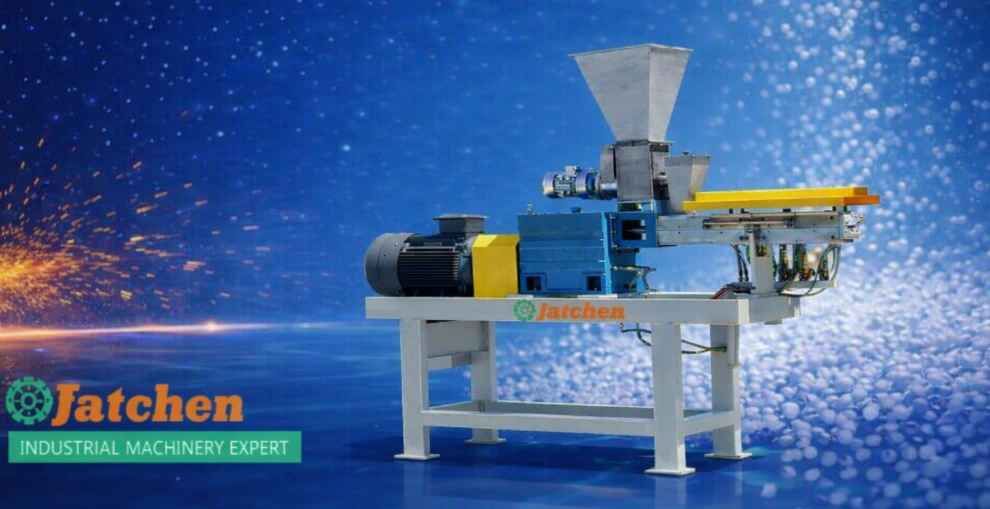
How Does the Mechanics of Hot Extrusion Work?
Hot extrusion depends on the joint application of heat energy and physical pressure to alter raw substances. In such arrangements, the key part consists typically of a Twin المسمار Extruder, and this device employs two screws that turn in the same direction to handle the substance.
When your substances arrive via the hopper, the engine powers the screws to spin, advancing the blend onward through vigorous transport and friction processes. The action extends beyond mere motion, because external heating units around the cylinder elevate the warmth until the substance softens and becomes pliable. As the grooved and blending sections apply pressure, the liquefied substances mix evenly and emerge from the equipment’s front as an ongoing softened stream. Consequently, this prepares the item with the suitable structure needed for later phases, including forming into tablets.
Why Compare Efficiency in Hot vs Cold Process Dynamics?
| Parameter | Hot Extrusion | Cold Extrusion |
| Processing Temperature | 80–130°C (powder coating typical range) | Room temperature |
| Mixing Uniformity | Excellent (molecular-level fusion) | Moderate (mechanical blending only) |
| Energy Consumption | Higher (due to heating) | Lower |
| Output Stability | High | Medium |
| Material Compatibility | Ideal for thermosetting resins | Limited |
| Surface Finish Quality | Smooth, high gloss | Possible inconsistency |
| Equipment Type | Twin Screw Extruder (TSK series) | Compression / mechanical mixing |
Deciding between these operational patterns demands a careful review of their approaches to substance blending and overall productivity. Although both techniques advance the substance, the degree of evenness they deliver varies considerably, and this variation directly influences your manufacturing capacity.
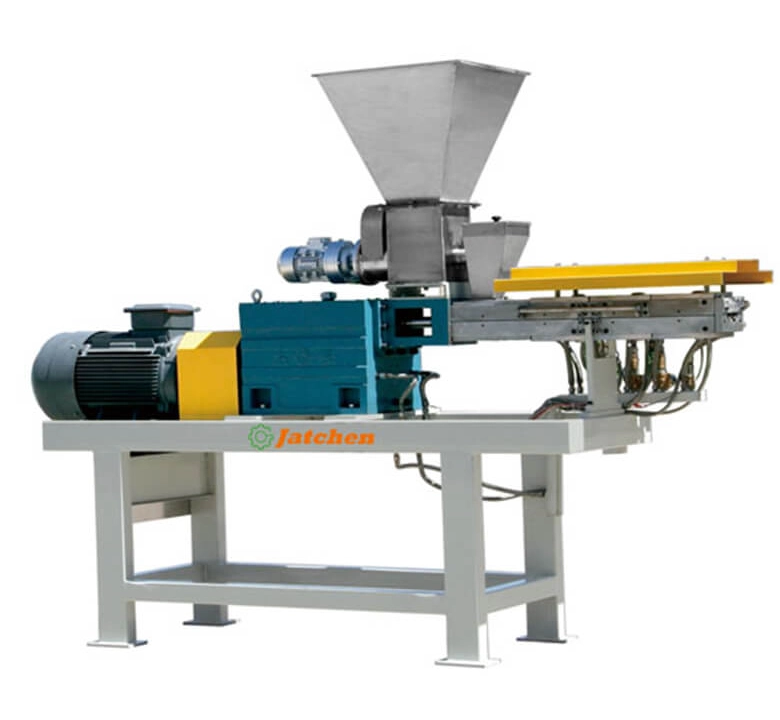
Hot extrusion typically excels in producing a uniform makeup, since the elevated warmth in the softened state enables pigments and resins to connect at a fundamental molecular scale. In comparison, cold methods depend largely on physical compression or rubbing forces, which may suffice for some joining stages but frequently miss the profound and consistent merging offered by a warmed arrangement. Jatchen’s TSK series receives design for reliable and substantial output in factory settings, featuring units that support yields ranging from 50 kg/h for modest quantities to 1,500 kg/h for extensive tasks.
| نموذج | الناتج (كجم / ساعة) | قطر المسمار (مم) | سرعة المسمار (دورة في الدقيقة) | المحرك الرئيسي (كيلوواط) |
| TSK35 | 50–80 | 35 | 600 | 7.5 |
| TSK55 | 300–500 | 55 | 500 | 30 |
| TSK65 | 600–800 | 65 | 420 | 45 |
| TSK75 | 800–1000 | 75 | 420 | 55/75 |
| TSK85 | 1000–1200 | 85 | 420 | 90/110 |
| TSK98 | 1200–1500 | 98 | 420 | 110/135 |
Facing Inconsistent Coating Quality and Finish
Variable lots represent a significant challenge for producers, commonly causing uneven spreading or a lackluster surface on the completed item. Such difficulties generally originate from fluctuating operational settings or inadequate friction applied during the softening period.
Precision Control over Temperature and Shearing
To address variations in quality, equipment emphasizing reliability becomes necessary. The TSK series incorporates an effective warming and chilling mechanism, where warmth levels across various sections receive exact management within a narrow ±2°C margin. Through the adoption of deeper channels and reduced-friction configuration, the device safeguards the core qualities of your resins, while guaranteeing that every element blends completely. This degree of exactness, overseen via a configurable PLC and HMI framework, leads to improved spreading characteristics and better shine for the completed coatings.
Dealing with High Energy Consumption and Costs
Operating a large-scale extrusion system throughout the day demands considerable electricity, which diminishes your earnings potential. Identifying methods to cut these running expenses while preserving productivity ranks as a leading concern for contemporary facilities.This focus on energy efficiency aligns with strong market demand for optimized equipment: the global powder coating equipment market was valued at USD 3.336 billion in 2025 and is expected to reach USD 5.223 billion by 2033, growing at a CAGR of 5.9% from 2026 to 2033, driven largely by needs for lower energy use, precise temperature control, and reduced maintenance in high-output lines.
Smart Equipment with Low-Energy Integration
One viable approach entails employing efficient transmissions that deliver strong power and operate quietly, equipped with integrated oiling and chilling features to avoid unnecessary power loss. Incorporating engines with adjustable frequency controls permits fine-tuning of screw rotation rates, such as from 420 to 600 rpm, to align precisely with your particular manufacturing requirements. Moreover, applying durable, abrasion-proof substances like tempered metal alloys for essential parts prolongs the upkeep intervals and lessens the need for frequent fixes. Individuals can review قضايا ناجحة involving firms in areas like Saudi Arabia or Anhui, where these configurations have helped reduce ongoing costs and the expenses related to obtaining replacement components over time.
Why Is Post-Extrusion Cooling Vital for Success?
After the warmed softened form exits the extruder, it exists in a liquid condition unsuitable for direct handling or pulverizing. This phase connects the chemical merging within the extruder to the material shaping in the milling device.
A conveyor belt made of stainless steel, like the GDJ series, plays a crucial role in receiving that heat-softened substance and shaping it into slim layers, usually measuring 1 to 2 mm in depth. Spraying systems with water cooling positioned below the belt quickly lower the substance to room temperature, converting it into firm pieces that undergo further breaking into fragments. Without proper oversight of this shift, the result includes oversized, difficult-to-process lumps that complicate the milling stage. By modifying the spacing and turning rate of the compression rollers, operators can regulate the depth and standard of the formed pieces, thereby supporting an effective and superior grinding procedure that follows.
| نموذج | Belt Width (mm) | الناتج (كجم / ساعة) | Cooling Method | Motor Power (kW) |
| GDJ-406 | 600 | 200–400 | تبريد المياه | 1.5 |
| GDJ-410 | 1000 | 400–500 | تبريد المياه | 3 |
| GDJ-510 | 1000 | 500–700 | تبريد المياه | 3 |
| GDJ-612 | 1200 | 700–900 | تبريد المياه | 4 |
| GDJ-712 | 1200 | 900–1200 | تبريد المياه | 5.5 |
Why Jatchen Is Your Global Partner for Extrusion Excellence
| Production Scale | Recommended Model | Output Range | Application |
| Lab Testing | TSK22 | 2–5 kg/h | R&D |
| Small Batch | TSK35 | 50–80 kg/h | Custom orders |
| Medium Production | TSK65 | 600–800 kg/h | Stable production |
| Large Scale | TSK98 | 1200–1500 kg/h | Mass manufacturing |
In Saudi Arabia, for example, the paints and coatings market (including powder applications) reached USD 1.612 billion in 2025 and is projected to grow to USD 2.146 billion by 2034 at a CAGR of 3.23%, supported by Vision 2030 infrastructure projects, automotive localization, and stricter VOC regulations that favor efficient, high-performance powder coating lines.Picking the suitable method covers just part of the requirements, and one also requires a collaborator capable of supplying a full مركز الحل suited to your exact factory demands. Whether establishing a testing lab for research and development or a substantial line yielding 1,000 kg/h, personalization holds the essence of achievement.
إن TSK22 lab extruder fits ideally for limited-quantity trials and recipe refinement, whereas the robust TSK98 manages factory-level yields effortlessly. Practical dependability emerges from collaborations with top-tier research centers and large facilities across the globe, in which these units run for over 20 hours each day with minimal variations. Supported by a committed “Golden Service” support group offering distant and in-person technical aid, acquiring a Twin المسمار Extruder means committing to a sustained manufacturing plan reinforced by genuine replacement parts and skilled guidance.
أسئلة متكررة
Q1: What are the benefits of the clam-shell barrel design?
A: The barrel receives construction as a clam with liner inserts, which offers robust self-cleaning functions and simplifies the cleaning and upkeep tasks between various production cycles.
Q2: Can the thickness of the cooled material sheets be adjusted?
A: Yes, adjustments to elements like the spacing and rotation rate of the press rolls allow control over the depth and standard of the tablets created on the cooling belt.
Q3: How accurate is the temperature control on the TSK series extruders?
A: These extruders include an effective heating and cooling system, in which the temperatures of multiple zones undergo precise regulation within ±2°C.
Q4: What kind of output can a single production line achieve?
A: The yield varies by model, for instance, the TSK35 generates 50-80 kg/h, and the sizable TSK98 attains up to 1200-1500 kg/h.
Q5: Is there a way to prevent feeding errors during production?
A: Yes, these systems feature an anti-lag screw feeding system for consistent supply and a PLC&HMI program-controlled error prevention system to maintain stable functioning.


